
Thanh An Hair
Hair Growth Myths: The Truth About What Makes Your Hair Grow

Jul
Most hair growth myths share one flaw: they promise faster growth, but growth speed is set by biology. Healthy scalp hair grows about half an inch (1.25 cm) a month, roughly six inches a year, and no trim, food, or serum reliably changes that rate. What you can control is retention, meaning the length you already grow, by protecting the scalp and preventing breakage.
How hair actually grows (the part myths ignore)
Before busting hair growth myths, it helps to know how growth works. Each strand you see is dead protein. The living activity happens below the skin, inside the follicle, where cells divide and push the shaft upward. According to the American Academy of Dermatology (AAD), scalp hair grows on average about half an inch (1.25 cm) per month, and it is normal to shed 50 to 100 hairs a day as older strands make room for new ones.
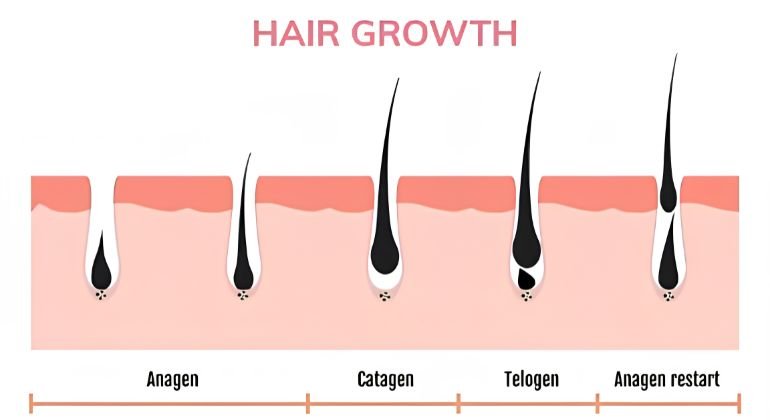
You are also born with every follicle you will ever have, commonly cited as roughly 100,000 on the scalp. You cannot add new ones with a product. This single fact dismantles a whole category of hair growth myths built around brushing, oils, or serums that claim to create hair from nothing.
Every follicle runs on its own clock through the hair growth cycle, which is why your hair does not all shed at once.
| Phase | What happens | Typical duration | Share of scalp hair |
| Anagen (growth) | The follicle actively builds the shaft. This phase decides your maximum length. | 2 to 7 years | About 85 to 90% |
| Catagen (transition) | Growth stops and the follicle detaches from its blood supply. | About 2 to 3 weeks | Roughly 1 to 2% |
| Telogen (rest) | The strand rests in place, neither growing nor changing. | About 3 months | About 10 to 15% |
| Exogen (shedding) | The old club hair releases and falls out as a new anagen hair emerges. | Overlaps telogen | The 50 to 100 daily |
The practical takeaway is the one the beauty aisle rarely says out loud: your genes set how long anagen lasts, and that determines how long your hair can get. People who grow hair past the waist usually have unusually long anagen phases, not a secret product. Healthy hair growth is less about speeding the clock and more about not sabotaging it.
Hair growth myths, debunked
The global hair growth supplement and treatment market was worth about USD 7.73 billion in 2023 and is projected to reach USD 11.58 billion by 2030, according to Grand View Research. A lot of that spending rides on beliefs that do not hold up. Here are the most common hair growth myths, and what is actually true.
| The myth | Verdict | What is actually true |
| Trimming makes hair grow faster | False | Growth starts at the follicle, not the ends. Trims remove split ends and prevent breakage, so hair looks healthier and keeps its length, but the growth rate does not change. |
| Shaving or cutting makes hair grow back thicker | False | Cutting only blunts the tip, which can feel coarser as it regrows. It does not change the diameter, color, or speed of the new hair. |
| Plucking one gray hair grows several back | False | One follicle grows one hair. Plucking cannot multiply follicles, though repeated plucking can damage a follicle over time. |
| Brushing 100 strokes a day boosts growth | False | Aggressive brushing causes mechanical breakage. Gentle detangling from the ends upward is all hair needs. |
| Wearing hats causes hair loss | False | A normal hat does not choke follicles. Only constant, tight tension (very tight styles) is a real risk, which is traction alopecia. |
| Cutting out shampoo helps hair grow | Mostly false | A clean scalp supports healthy follicles. Skipping washing lets sebum and product build up, which can worsen the growing environment. Use a gentle, suitable shampoo instead. |
| A single serum or oil will fix everything | Overhyped | Topicals can support the scalp, but none override genetics, hormones, or nutrition. Results come from a consistent routine, not one bottle. |
| Biotin makes anyone’s hair grow | Only if deficient | Biotin helps hair only in the rare case of true deficiency. In healthy people, evidence for a benefit is lacking. |
| Hair grows faster in summer | Weak evidence | Some small studies hint at seasonal variation, but the effect is minor and not a reliable lever. Hair follows its cycle, not the calendar. |
| Colored or bleached hair cannot grow | False | New hair grows from the scalp unaffected by dye further down. Chemical processing weakens the fiber, so breakage can make hair look stuck at one length. |
| Stress makes hair fall out overnight | Partly true, delayed | Major stress can trigger telogen effluvium, pushing hairs into shedding. It shows up 2 to 3 months later, not the same day, and usually recovers. |
| You can grow brand new follicles yourself | False | Follicle count is fixed. Products at best strengthen existing hairs, reduce shedding, or extend the growth phase. |
The myths that waste the most time and money
Biotin for everyone. Biotin is the most oversold hair supplement. A widely cited review in the Journal of Clinical and Aesthetic Dermatology found no studies showing biotin improves hair growth in healthy people; benefit appears only in genuine deficiency, which is uncommon on a balanced diet. Worse, high-dose biotin can distort some lab tests. If your hair is thinning, ask a clinician to check for a real deficiency rather than guessing.
Miracle oils and serums. The nuance matters here. A 2015 randomized trial published in SKINmed compared rosemary oil against 2% minoxidil in 100 people with pattern hair loss and found similar increases in hair count after six months, with less scalp itching in the rosemary group. That is promising, but it is one small study on a medical condition, not proof that any oil will make an average head of hair grow faster. Treat topicals as support, not magic.
Stress equals instant shedding. Telogen effluvium is real, but delayed. If you notice a sudden increase in shedding, look back 2 to 3 months for an illness, crash diet, childbirth, or major stressor. Addressing the trigger, and time, usually resolves it far better than a panic purchase.
What actually works for hair growth
Stripping away the hair growth myths leaves a short, honest list. Two drugs, minoxidil and finasteride, are the only options approved by the US FDA for pattern hair loss, and the rest of the list is about giving healthy follicles a fair chance and keeping the length you grow.
| Approach | What the evidence shows | Evidence strength |
| Topical minoxidil | FDA approved for pattern hair loss; can extend the growth phase and thicken hair for many users over 3 to 6 months. | Strong |
| Correcting a real deficiency (iron, protein, vitamin D, zinc) | Fixing a diagnosed shortfall can restore normal growth. Extra intake beyond your needs does not add benefit. | Strong (if deficient) |
| Reducing breakage and tension | Gentle handling, heat limits, and avoiding tight styles preserve length, which is what most people call growth. | Strong |
| Scalp care and regular gentle washing | A clean, healthy scalp is a better environment for follicles than a clogged one. | Moderate |
| Rosemary oil | One randomized trial found it comparable to 2% minoxidil for pattern loss; larger studies are still needed. | Emerging |
| Scalp massage | Small studies suggest improved blood flow and modest thickness gains with consistency. | Limited |
| Biotin (no deficiency) | No demonstrated benefit for hair growth in healthy people. | Insufficient |
How to grow and keep more hair: a simple routine
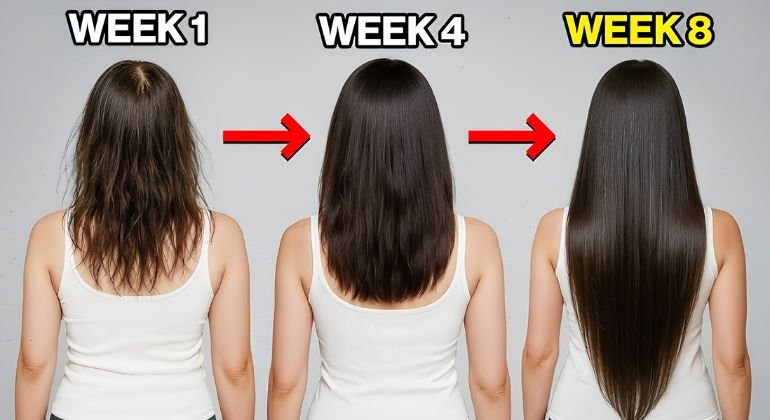
You cannot rush the follicle, but you can stop losing what it produces. This routine focuses on healthy hair growth and retention rather than false speed.
- Feed the follicle. Eat enough protein (roughly 0.8 to 1 g per kg of body weight) plus iron, zinc, vitamin D, and omega-3s. Ask a clinician for blood work if you suspect a deficiency.
- Keep the scalp clean and calm. Wash on a schedule that suits your scalp with a gentle formula, and massage briefly to support circulation. Avoid heavy buildup.
- Cut breakage, not corners. Limit high heat, use a heat protectant, detangle from the ends upward, and sleep on silk or satin to reduce friction.
- Lower the tension. Avoid constantly tight ponytails, buns, and heavy styles. Rotate your part and styles to spare any one area.
- Be patient and consistent. At about half an inch a month, visible change takes several months. Track progress from a fixed point every 30 days instead of chasing quick fixes.
Do hair extensions stop your hair from growing?
No. Human hair extensions do not stop the hair growing underneath them, and this is where a manufacturer’s perspective matters. Your natural hair keeps cycling as long as the scalp stays healthy and the roots are not under constant strain. The real risk is not the extensions themselves but tension and weight.
The American Academy of Dermatology warns that heavy or tightly attached extensions, weaves, and very tight styles can cause traction alopecia, hair loss from repeated pulling on the follicle. Caught early it is reversible, but left unchecked the follicle can scar. The fix is simple: choose the right weight, keep tension low, and give your scalp room to breathe.

That is why the format you pick matters. Lower-tension, temporary options such as halo extensions and well-fitted clip-in hair extensions sit gently and come out at night, so the scalp is never under continuous strain. For salon installs, matching the weight of weft hair to a client’s own density protects the hairline. And because extensions give instant length while your own hair grows at its natural pace, quality raw hair such as single donor bulk hair that lasts through repeated wear reduces how often you re-install, which further limits tension. If you want the science of why some textures blend more seamlessly, see our guide to straight versus wavy hair, and for daily upkeep that prevents breakage, our guide on detangling matted hair.
Hair growth myths FAQ
Does trimming your hair really make it grow faster? No. Hair grows from the follicle in the scalp, so cutting the ends cannot change the growth rate. Regular trims do help by removing split ends and preventing breakage that travels up the shaft, so hair stays healthier and holds its length better over time.
How fast does hair actually grow? On average, scalp hair grows about half an inch (1.25 cm) per month, or roughly six inches (15 cm) a year, according to the American Academy of Dermatology. The rate varies with genetics, age, and health, but no product reliably makes hair grow faster than your biology allows.
Does biotin help hair grow? Only if you are genuinely biotin deficient, which is uncommon on a balanced diet. Dermatology reviews have found no evidence that biotin improves hair growth in healthy people, and high doses can interfere with some lab tests. Get tested before supplementing for hair.
Can stress cause hair loss? Yes, but not instantly. Significant physical or emotional stress can trigger telogen effluvium, which pushes hairs into the shedding phase. The extra shedding usually appears 2 to 3 months after the trigger and typically recovers once the cause is addressed and time passes.
Do hair extensions stop natural hair from growing? No. Extensions do not stop the hair growing beneath them if the scalp stays healthy. The risk is tension: heavy or tightly fitted extensions worn constantly can cause traction alopecia. Choose lightweight, low-tension options, keep scalp access, and take breaks between installs.
How often should I wash my hair for healthy growth? There is no single rule. Wash often enough to keep the scalp clean without stripping it, which for many people is every 2 to 3 days, adjusted for oil, texture, and lifestyle. A clean scalp supports follicles better than either buildup or constant over-washing.
Grow your business while your clients grow their hair
Thanh An Hair is a family-run Vietnamese manufacturer with 20 years of raw hair production. If you run a salon or hair brand, our factory-direct, single donor hair gives your clients length today, gently, while their natural hair grows on its own schedule. Contact us for wholesale pricing and a sample.
Contact Thanh An Hair today for expert consultation and the most competitive price list.
- WhatsApp/Hotline: (+84) 973 522 855
- Official Website: https://thanhanhair.com/
- Instagram: @thanhanhair
- Email: thanhanexport@gmail.com