
Raw Vietnamese Hair
Best Protein Treatment for Hair
Aug
The best protein treatment for hair is the one matched to your damage level and built on hydrolyzed protein small enough to enter the fiber. Peptides near 200 to 3,000 daltons reach the cortex; larger proteins coat the surface. Bleached and heat-damaged hair needs both sizes, applied every two to four weeks.
Most guides on this topic stop at a list of masks and a kitchen recipe. That advice fails because it skips the one variable that decides whether a protein treatment does anything at all: the size of the protein molecule. We manufacture raw Vietnamese hair and test it on the bench before it ships, so we evaluate protein systems the way a factory does, by what changes in the fiber rather than by what the label promises.
What a Protein Treatment Does to the Hair Fiber
A protein treatment deposits peptides into and onto a hair shaft to replace protein that oxidation, heat, and friction have removed. It works on the fiber, not on the follicle. That distinction matters, because a lot of published advice claims these products strengthen follicles. The follicle sits below the skin surface and receives nothing from a rinse-out mask.
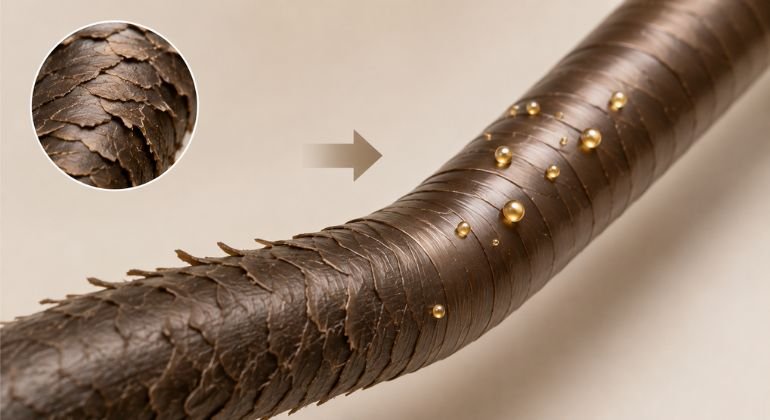
Hair is a keratin composite in three layers. The cuticle is a 0.3 to 0.5 micrometer scale sheath. The cortex holds keratin intermediate filaments bundled into macrofibrils and carries most of the tensile strength. StatPearls describes the cortical layer as the structure that determines strength, texture, and color. Cross-links between cystine residues hold that architecture together.
Once a shaft leaves the scalp it is metabolically dead. Dermatologist Zoe Draelos, speaking at an American Academy of Dermatology annual meeting, has pointed out that the most common misconception about hair is that it is alive, when in fact it does not heal itself once injured. A protein treatment is prosthetic, not regenerative. You are filling a gap, not growing new keratin.
Molecular Weight Decides Whether a Hair Protein Treatment Works
This is the section every competing article leaves out, and it is the reason two products with identical marketing claims perform differently on the same head of hair.
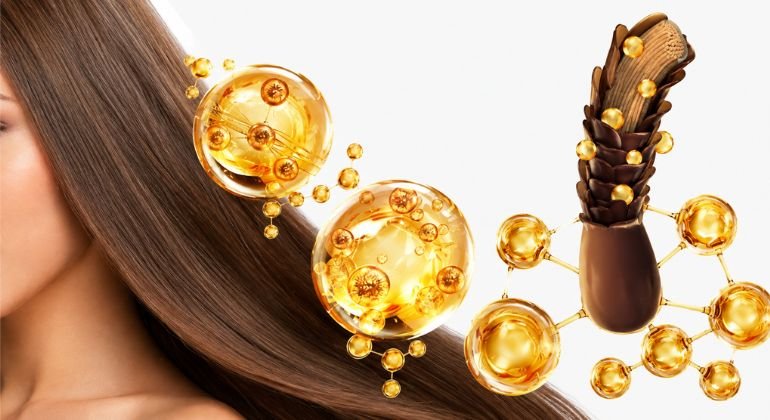
Researchers publishing in the International Journal of Cosmetic Science tested wool-derived hydrolyzed keratins at three sizes on relaxed textured hair: 221 daltons, roughly 2,577 daltons, and roughly 75,440 daltons. Low and mid molecular weight peptides penetrated deep into the cortex, while the high molecular weight peptide adsorbed onto the surface and reached only the outer fiber layers. At 20 percent relative humidity, break stress rose by about 18.6 percent for the mid-weight peptide and about 16.3 percent for the high-weight peptide against the relaxed control.
Both sizes earned their place. The small peptide travels; the large one films. A serious formula carries both.
Protein sources by molecular weight and where they act
| Protein input | Approximate size | Where it acts | Best use |
|---|---|---|---|
| Free amino acids (cysteine, leucine) | 120 to 200 Da | Cortex | Deep fill for porous, over-processed lengths |
| Low molecular weight hydrolyzed keratin | Around 220 Da | Cortex | Bleached hair, elasticity recovery |
| Mid molecular weight hydrolyzed keratin or silk | 2,000 to 3,000 Da | Cortex and inner cuticle | The workhorse; strongest measured tensile gain |
| High molecular weight hydrolyzed wheat or soy | Above 20,000 Da | Cuticle surface | Film-forming, shine, reduced combing friction |
| Whole egg or dairy protein (DIY masks) | Above 40,000 Da | Surface only, rinses away | No measurable structural benefit |
Egg white and yogurt masks appear in almost every article on this subject. Ovalbumin is a large globular protein. It cannot enter an intact cuticle, and nothing in the peer-reviewed record shows it changes fiber mechanics. It conditions the surface for one wash cycle. Call it what it is.
How to Choose the Best Protein Treatment for Hair by Damage Level
Start by grading the damage, then buy to the grade. Guessing produces the two failure modes we see most often on returned wefts: undertreated hair that keeps breaking, and overtreated hair that feels like straw.
The wet stretch test
Pull a shed strand from your brush, wet it, and stretch it between two fingers.
- Extends slightly and springs back: healthy. Protein every eight to twelve weeks, or none at all.
- Snaps almost immediately with no stretch: protein-heavy and moisture-starved. Add conditioning first, protein later.
- Stretches a long way, feels gummy, stays stretched: protein-deficient. This is the strand that needs hydrolyzed keratin.
Match the treatment to the damage source
Bleaching is the harshest input. Alkaline peroxide and persulfate systems oxidize cystine disulfide bonds into cysteic acid and leach protein from the whole fiber, not the cuticle alone. Work using transmission electron microscopy and redox proteomics found protein loss through leaching rose with bleaching severity, and that the leached proteins included cortical intermediate filaments. Published work on hair lipids also reports that more than 80 percent of the surface lipid 18-methyl eicosanoic acid comes off in a single bleaching treatment, which is why bleached hair feels rough and wets through so fast.
Heat and mechanical damage behave differently. Combing and rough drying chip cuticle cells away without oxidizing the cortex. In that case a film-forming protein plus a pre-wash oil does more than a heavy reconstructor. In Journal of Cosmetic Science, Rele and Mohile found coconut oil reduced combing-related protein loss where mineral oil and sunflower oil did not, which they attributed to lauric acid’s linear structure and low molecular weight.
How Often Should You Do a Protein Treatment?
Protein treatment frequency by hair condition
| Hair condition | Protein frequency | Conditioning between |
|---|---|---|
| Virgin, air-dried, no chemical service | Every 8 to 12 weeks or as needed | Standard conditioner after every wash |
| Color-treated, no lift | Every 4 to 6 weeks | Weekly moisture mask |
| Highlighted or partially lightened | Every 3 to 4 weeks | Twice-weekly moisture mask |
| Bleached, relaxed, or heat-damaged | Every 2 to 3 weeks until elasticity returns | Moisture mask after every wash |
| Hair extensions and wigs | Every 3 to 4 weeks, low strength | Leave-in conditioner after every wash |
The AAD advises using conditioner after every shampoo and stretching color touch-ups to every 8 to 10 weeks. Both recommendations reduce how much protein you need in the first place.
Protein Overload: What the Evidence Supports
Salons describe protein overload as stiff, rough hair that snaps instead of stretching. Stylists see it. The mechanism people cite for it, a protein-to-moisture ratio that must be kept in balance, does not appear in the cosmetic-science literature. Multiple studies report the opposite of the folk model: peptides make hair less brittle, not more.
Two documented effects explain what stylists observe. First, quaternized proteins carry a positive charge so they bind to the negatively charged surface of damaged hair. That binding is what makes them work, and it also means they accumulate across repeated applications. Second, mid and high molecular weight peptides raise Young’s modulus, which is a measured increase in stiffness. Stiff plus built up feels exactly like the salon description.
The fix is buildup removal and conditioning, not permanent protein avoidance. Clarify once, condition for two to three washes, retest elasticity, then resume protein at a longer interval.
Protein Treatments for Hair Extensions and Wigs
Extensions change the arithmetic in three ways, and every one of them argues for gentler, more frequent protein.
- No sebum supply. Growing hair receives lipid from the scalp. An installed weft or wig receives none, so its surface barrier depletes and never rebuilds.
- No replacement growth. Damage on your own head grows out. Damage on a bundle stays until you cut it off or replace the set.
- Processing already spent part of the budget. Colored, bleached, or steam-textured hair arrives with some of its cystine cross-links already consumed.
Why cuticle alignment changes the result
Cuticle direction is the variable most buyers miss. Cuticle-aligned hair, where every strand runs root to tip in the same direction, holds a protein treatment evenly because the scale edges all point the same way. Acid-bath hair, stripped of its cuticle and coated in silicone, shows a dramatic first result and then degrades, because the coating rinses off and there is no cuticle left to receive peptides. Our single-donor bulk hair and machine and hand-tied wefts keep cuticle alignment intact for that reason.
Three rules for treating installed hair. Use half the label strength on the first pass. Never soak wefts overnight, because prolonged wetting drives swelling cycles that loosen the weft seam. Always follow with conditioner and a low-friction sleep surface, since friction undoes in a week what a treatment bought you. For maintenance between protein applications, our guide to keeping a weave silky and tangle-free covers the wash cadence.
The AAD also recommends wearing a professional weave or extension set for two or three months at most and keeping up scalp hygiene underneath. No protein treatment compensates for tension on the follicle.
Talk to the Factory Before You Buy Your Next Bundle
Protein treatments work on what you give them. Hair that arrives cuticle-aligned, single-donor, and minimally processed responds to a mask; hair that arrives stripped and silicone-coated does not, no matter what you spend on products. Thanh An Hair has manufactured raw Vietnamese hair for roughly two decades and ships factory-direct to salons, stylists, and resellers.
Request a sample bundle and run the wet stretch test yourself. Tell us the textures and colors you sell most and we will quote factory-direct pricing on your first order.
Ready to find your perfect match? Contact us today for expert advice and exclusive discounts on premium human hair extensions.
📲Phone/WhatsApp: +1 (206) 698‑5133
🛜Instagram: RAW HAIR LUXURY COMPANY
🌐Tik Tok: RAW HAIR LUXURY
📧 Email: Rawhairluxury.us
🌐Website: rawhairluxury.com