
Raw Vietnamese Hair
Types of Braids 2026: Hair Needed, Wear Time & Tension
Aug
The types of braids worth planning around in 2026 split into three families, and the family sets both your hair budget and your scalp load. Three-strand braids such as French, Dutch and waterfall use only the hair on your head. Two-strand braids like rope and fishtail do the same. Extension-fed braids carry purchased hair, and that weight decides how long you can wear the style.
Most braid roundups stop at a photo and four bullet points. This guide adds the numbers a braider and a client both need before booking: how many grams each style carries, the minimum natural length it takes to install, and the wear ceiling the American Academy of Dermatology sets for braided hair. Thanh An Hair has manufactured bulk hair for braiders for two decades, so the weight figures below reflect how the hair gets bought, divided and fed into a section.
What are the main braid families?
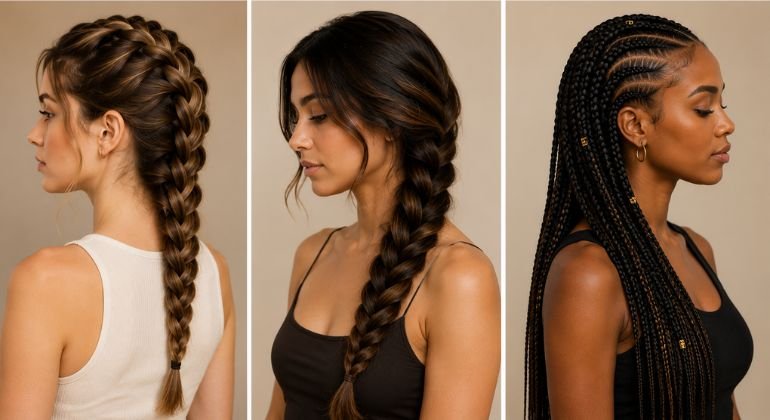
Every braid belongs to one of three structural families, and the structure predicts the maintenance more reliably than the name does.
- Three-strand braids. Three sections cross in sequence. A French braid crosses the outer sections over the middle one, so the plait lies flat. A Dutch braid crosses them under, which lifts the plait into a raised ridge.
- Two-strand braids. These twist instead of weaving. A rope braid twists each half in one direction, then winds the two halves the opposite way. A fishtail passes thin pieces from the outer edge of one half across to the other.
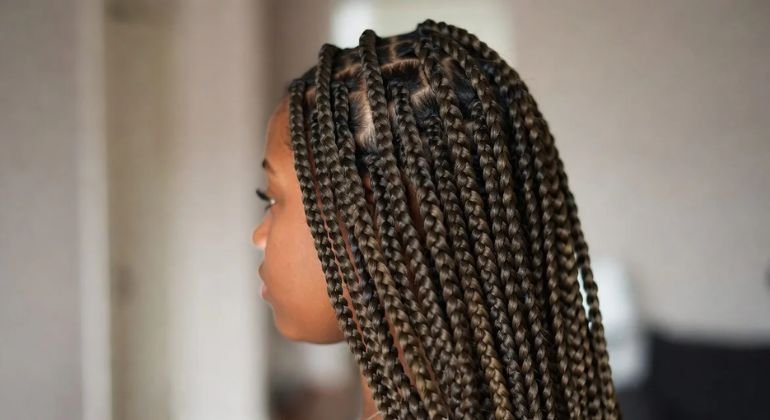
- Extension-fed braids. Purchased hair enters at or near the root. Box braids, knotless braids, cornrows, Fulani braids and boho braids all sit here, and this is the group people mean by protective styles.
The first two families cost you nothing but time at the mirror. The third turns into a purchasing decision, because you buy the hair by weight and that weight ends up hanging from your follicles for the next six weeks.
Which types of braids need added hair and how much?
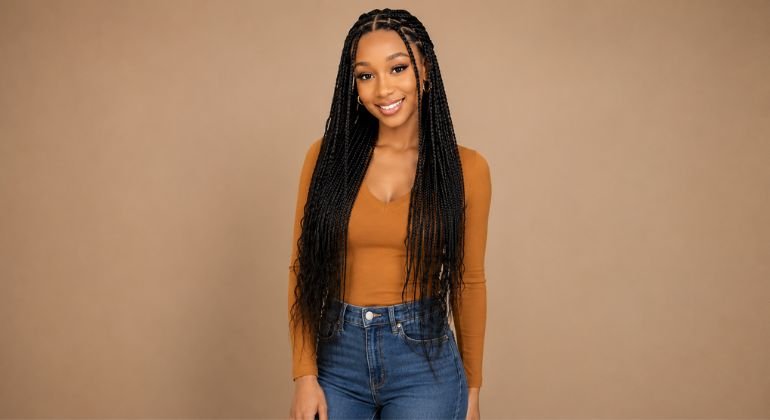
Five families need purchased hair: box braids, knotless braids, cornrows and feed-ins, Fulani braids, and boho braids. A full head runs 500 g to 800 g of bulk hair for box and knotless styles. Cornrows need 200 g to 400 g, because a cornrow tracks along the scalp instead of hanging free.
Braid types compared by added hair, load, minimum length and wear ceiling
| Braid type | Added hair | Typical bulk load | Min. natural length | Wear ceiling | Tension lands on |
| Knotless box braids | Yes, fed in | 500-800 g across the head | 3 in / 7.5 cm | 6-8 weeks (AAD) | Mid-shaft, not the root |
| Traditional box braids | Yes, knotted at root | 500-800 g across the head | 3 in / 7.5 cm | 6-8 weeks (AAD) | The follicle, from strand one |
| Cornrows / feed-in | Yes, fed in | 200-400 g across the head | 2 in / 5 cm | 6-8 weeks (AAD) | Parting lines and hairline |
| Boho / bohemian braids | Yes, plus loose curly ends | 400-700 g plus 100-200 g of curl | 3 in / 7.5 cm | 6-8 weeks (AAD) | Mid-shaft, plus drag on the ends |
| Fulani braids | Yes, fed in | 200-400 g across the head | 3 in / 7.5 cm | 6-8 weeks (AAD) | Hairline and centre part |
| Viking braids | Optional | 0-300 g | 6 in / 15 cm | Take down nightly | Parting lines |
| Dragon braid | No | None | 8 in / 20 cm | Same day | Crown and centre part |
| French braid | No | None | 6 in / 15 cm | Same day | Crown, spread wide |
| Dutch braid | No | None | 6 in / 15 cm | Same day | Crown, spread wide |
| Fishtail braid | No | None | 8 in / 20 cm | Same day | Nape, low load |
| Rope braid | No | None | 6 in / 15 cm | Same day | Nape, low load |
| Waterfall braid | No | None | 8 in / 20 cm | Same day | Crown, very low load |
| Halo / crown braid | Optional | 0-100 g | 10 in / 25 cm | Same day | Pin points |
| Milkmaid braid | No | None | 12 in / 30 cm | Same day | Pin points |
| Bubble braid | No | None | 8 in / 20 cm | Same day | Each elastic point |
Wear ceilings for extension-fed styles follow AAD guidance for braided styles. Bulk loads describe what braiders commonly budget at 100 g per bundle, not a measured average. Minimum lengths are practical install guidance from braiders, not a clinical standard.
How long can you safely wear each braid type?
Six to eight weeks. The American Academy of Dermatology sets that ceiling for braided styles and pairs it with two other levers: braid thicker, and braid shorter.
Length matters because a braid behaves as a lever. A 24 inch braid and a 14 inch braid can start with identical weight at the root, but the longer one swings further and multiplies the pull every time you turn your head. The AAD states the rule without hedging, advising patients to keep braids and locs short because longer hair is heavier and pulls more. If you install long lengths, drop the section count to compensate.
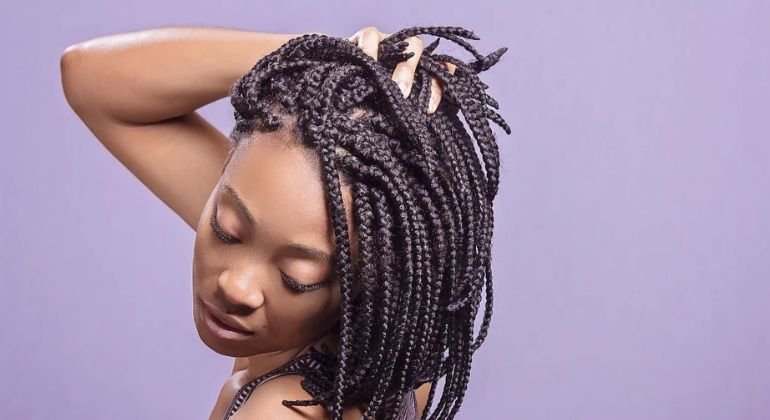
Time matters for a separate reason. Your own hair grows out from under the braid and the base slackens. A braid that gripped 40 anchor hairs on install day hangs from fewer of them by week eight, as the outer strands slip free of the plait.
Dermatologists have measured the cost of ignoring that ceiling. Billero and Miteva’s review in Clinical, Cosmetic and Investigational Dermatology reports that traction alopecia affects one-third of women of African descent who wear traumatic hairstyling over prolonged periods, and that the risk climbs with both the extent of pulling and its duration. Left in place, the condition scars, and a scarred follicle does not regrow. Earlier work by Khumalo and colleagues in the Journal of the American Academy of Dermatology traced the same pattern to specific styling determinants rather than to hair type.
Which braiding hair should you buy?
Bulk hair, sold loose by weight rather than sewn onto a weft. Braiders buy it in 100 g bundles because a braid needs free strands to feed into a section, and a weft seam will not disappear inside a plait.
Three specifications change how the install behaves, and only one of them shows in a product photo.
- Cuticle alignment. Every strand runs root to tip in the same direction. Misaligned hair catches against itself and matts inside the braid, and matted hair at takedown is exactly when a hairline gets yanked.
- Single donor sourcing. One head means one texture and one curl pattern, so braid 180 matches braid 1. Mixed-donor bulk shifts texture partway through a head and the change shows under salon lighting.
- Fibre type. Boho and French curl styles need ends that hold a wet set. Synthetic fibre will not take heat or a roller, so those styles run on human hair.
Demand backs up the specification. Grand View Research values the global wigs and extensions market at USD 15.2 billion in 2025, with human hair holding 65.6% of it and extensions growing faster than any other product segment at a 10.0% CAGR through 2033. Buyers keep moving toward hair that behaves like hair.
Thanh An Hair produces raw Vietnamese bulk hair in 100 g bundles, including single donor bulk for braiders who install full heads in one sitting.
Get braiding hair that survives takedown
Thanh An Hair manufactures raw Vietnamese bulk hair at our own factory and ships factory direct to salons and resellers. Tell us the braid style you install most, your usual section count and length, and we will send a colour ring plus a sample bundle so you can test the comb-out before committing to a wholesale order. Request a sample bundle.
Ready to find your perfect match? Contact us today for expert advice and exclusive discounts on premium human hair extensions.
📲Phone/WhatsApp: +1 (206) 698‑5133
🛜Instagram: RAW HAIR LUXURY COMPANY
🌐Tik Tok: RAW HAIR LUXURY
📧 Email: Rawhairluxury.us
🌐Website: rawhairluxury.com