
Raw Vietnamese Hair
Swimming With Hair Extensions: How to Protect Them and Keep Them Damage-Free (2026 Guide
Jul
Yes, swimming with hair extensions is safe when you protect them correctly. Take clip-ins and halos out before you get in. For bonded methods such as tape-ins, nano rings, keratin tips, and wefts, the rule is two-part: build a barrier before the water, then rinse and chelate after. Chlorine and salt both pull moisture from the fiber and roughen the cuticle, so preparation decides how your hair looks when you towel off.
Most guides on this topic tell you to braid your hair and rinse it afterward, then stop. That advice is fine as far as it goes, but it skips the part that actually protects your investment: what chlorine and salt do to a hair fiber, why light hair goes green, and how the way your extensions were made decides how well they survive a season of swimming. As a raw-hair manufacturer, that is the part we can speak to with authority, so this guide goes further than the poolside checklist.
Can you swim with hair extensions?
Yes, and the honest answer depends on the attachment method. Removable pieces should come out. Clip-in sets and a halo are built to lift out in seconds, so there is no reason to soak them. Their wefts and hardware trap water, loosen, and tangle, and they are simply easier to protect on a towel than on your head.
Bonded and sewn methods stay in and get protected instead. Tape-ins, nano rings, keratin I-tips, U-tips and K-tips, and hand-tied or machine wefts are made to live in the hair for weeks, swimming included. The water will not pop them out. What it does do is dehydrate the hair and, without aftercare, wear on the bond and the cuticle over time. So the method sorts neatly into two jobs: remove what is removable, and prep and rinse what is not.
Which extensions handle the water best
Use the table to match your method to the water. It sets out the real risk for each type, the one move that matters most before you swim, and the priority the moment you are out.
| Extension type | In the water? | Main risk | After-swim priority |
| Clip-ins | Take out before you swim | Wefts and clips trap water, loosen, tangle | Store dry, clip back in when hair is dry |
| Halo | Take out before you swim | Wire and weft not made to be submerged | Store dry, refit after drying |
| Tape-ins | Stays in, protect it | Oils plus pool chemicals can soften the adhesive | Rinse fast, keep product off the root |
| Nano rings | Stays in, protect it | Buildup at the bead, tangling at the root | Fresh-water rinse, gentle detangle |
| Keratin I / U / K-tips | Stays in, protect it | Repeated wetting stresses the bond | Rinse, deep condition the lengths |
| Wefts (hand-tied / machine) | Stays in, protect it | Water stress on the seam, matting at the track | Rinse, dry the track, condition |
What chlorine and salt water actually do to hair extensions
Hair is dead keratin protein wrapped in a shingled outer layer called the cuticle, and a thin lipid coat on top makes that surface water-repellent. Damage in the pool or the sea is really damage to that barrier. Once the cuticle lifts and the lipid layer strips away, the fiber turns porous, drinks in more water, tangles, and loses shine. Extensions cannot repair themselves the way growing hair slowly can, so protecting the cuticle is the whole game.
Chlorine sanitizes pools as hypochlorous acid, and peer-reviewed dermatology research describes how it penetrates the hair cortex, drives oxidation that degrades the pigment, and breaks down keratin while it compromises the cuticle, which is what leaves swimmers’ hair dry and prone to breakage (exposome review, An Bras Dermatol). That is a chemical change to the protein, not surface dirt, which is why a quick rinse alone never fully fixes it.
Salt water works by a different route. The sea is saltier than the inside of a hair fiber, so through osmosis it draws moisture out of the strand, dehydrating the keratin and disrupting the hydrogen bonds that hold your style. As the water evaporates it leaves microscopic salt crystals behind, and those grind against the cuticle every time strands move, roughening the surface and driving the tangling you feel after a beach day. Different mechanism, same practical result, and the same fix works for both.
The green-hair myth: it is copper, not chlorine
Blonde, grey, and light or lifted hair can pick up a green cast after repeated swims, and chlorine takes the blame it does not deserve. The stain is copper. Pools carry trace copper from copper-sulfate algaecides and from corroded plumbing, and clinical case reports name the condition chlorotrichosis, describing green hair as insoluble copper deposits that fix to the hair with prior cuticle damage as a prerequisite (NIH case report). Chlorine is the accomplice: as an oxidizer it makes dissolved copper far more reactive, and that reactive copper binds to the protein.
Cosmetic-science testing points the same way. Work summarized by the fiber-science institute TRI Princeton confirms that the interaction between hair and copper salts, not chlorine, produces the color, and that a chelating agent lifts the copper back out (TRI Princeton). Independent chemistry coverage traces the finding to controlled studies from the 1970s, where free copper ions turned hair green while chlorine on its own did not, and notes that damaged, porous hair grabs the copper most (ScienceAlert). Two lessons follow. Dark hair collects the same copper but hides it, so dullness rather than green is the tell. And because porous hair grabs copper fastest, the quality and condition of your extensions decides how visible the problem gets.
Swimming with hair extensions: the pre-swim routine that protects them

The barrier you build in the two minutes before you swim does more than anything you do afterward. The logic is simple physics. A healthy fiber absorbs close to a third of its own weight in water, so if you fill it with clean water first, there is little room left for chlorinated or salty water to move in. Add a light coating on top and you slow the uptake further. Follow the steps in order.
- Take out anything removable
Unclip clip-in sets and lift out a halo before you go near the water. These pieces are not built to be submerged, the clips and thread hold water and loosen, and a wet set tangles fast. Store them dry and clip back in once your own hair is dry. - Detangle from ends to roots
Work a loop brush or wide-tooth comb through dry hair before it gets wet. Wet hair swells and weakens, so knots that go into the pool come out worse. Clearing them first protects every bond and weft seam. - Saturate strands with clean water
Soak your hair with tap or shower water until it stops absorbing. A healthy fiber takes on close to a third of its own weight in water, so a strand already full of clean water has little room left for chlorinated or salty water. - Seal in a leave-in or light oil barrier
Smooth a leave-in conditioner or a few drops of a light oil down the mid-lengths and ends. This coats the cuticle and slows the uptake of pool chemicals and copper. Keep product off keratin and tape bonds at the root. - Braid it back or coil it into a low bun
Plait a French braid, or twist hair into a low bun and pin it. Contained hair meets less moving water, picks up fewer salt crystals, and rubs against itself far less, which is where most tangling and matting starts. - Add a swim cap for long or repeated sessions
For laps, daily swims, or blonde and light hair, a silicone cap over prepped, braided hair is the strongest single barrier. Wet the hair with clean water first so the cap seals against a full fiber, not a thirsty one.
One caution for bonded wear: keep leave-in and oil off the attachment points. Sunscreen and hair oils can soften a weak keratin or tape adhesive, so smooth product through the mid-lengths and ends and leave the root clean.
After the swim: rinse, chelate, and recondition
Aftercare is where good hair stays good. The moment you are out, rinse with fresh water to flush chlorine, salt, and loosened copper before any of it dries in. Do not wait until you are home, because salt crystals and oxidized copper do their worst damage sitting in the hair for hours.
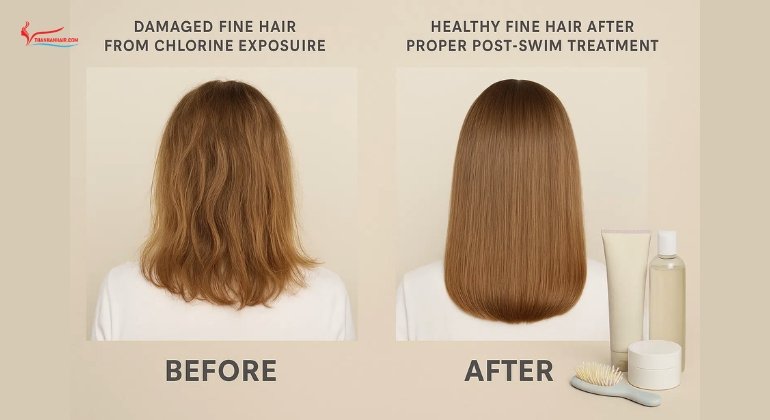
Match the wash to how often you swim. After an occasional dip, a sulfate-free moisturizing shampoo and a conditioner are enough. If you swim several times a week, copper and mineral buildup compounds on already-porous hair, so reach for a chelating or clarifying shampoo about once a week to strip it out, and always follow with a deep conditioner or mask because that wash cleanses hard. Blot with a microfiber towel rather than rubbing with terry cloth, detangle from the ends with a loop brush, and let hair dry away from direct heat where you can. For a full recovery routine after a holiday of sun and salt, see our guide on restoring hair extensions after a holiday, and for heat-free drying that protects the cuticle, our guide on drying hair extensions like a pro.
Why extension quality decides how well they survive the pool
Every mechanism above turns on one property: porosity. Porous hair drinks in more chlorinated water, dehydrates faster in salt, and grabs more copper. And porosity is set at the source, by how the hair was collected and processed long before it reaches your head. This is the part a reseller who buys finished bundles cannot verify, and where a factory has the answer.
Raw single-donor hair keeps its cuticle intact and aligned in one direction from root to tip, so the fiber’s own lipid layer stays in place as a built-in water-repellent barrier. A lot of hair sold as remy is stripped in an acid bath to remove the cuticle, then coated in silicone to fake shine. It looks glossy in the pack, but chlorine strips that coating quickly, and once it is gone the porosity spikes and the green and the frizz arrive early. At Thanh An Hair, we manufacture raw Vietnamese single-donor hair with the cuticle kept intact and aligned, which is the property that helps our extensions resist chemical uptake in the first place.
Construction matters too. Repeated wetting stresses weft seams and bond points, so weft stitching and the formulation of keratin and tape bonds decide how a set holds up across a swimming season. A manufacturer controls both.
Frequently asked questions
Can you swim with clip-in hair extensions?
You can, but you should not. Clip-ins are designed to come out in seconds, and the wefts and metal clips hold water, work loose, and tangle when submerged. Remove them before you swim, keep them dry, and clip them back in once your own hair has dried. That habit is exactly why clip-ins and halos suit a beach or pool trip.
Will chlorine ruin my tape-in or keratin extensions?
Not in one swim, and not if you prep and rinse. Chlorine dehydrates the fiber and, over repeated exposure, oxidizes keratin and lifts the cuticle. Pool chemicals plus sunscreen oils can also weaken cheap adhesives at the root. Keep product off the bonds, rinse with fresh water straight after, and deep condition the lengths.
How do I stop my extensions turning green in the pool?
Green tint comes from copper in the water, not chlorine itself. Block it by wetting hair with clean water and sealing it with a barrier before you swim, then washing with a chelating or clarifying shampoo after. A swim cap is the surest physical block. Once copper has bonded, only a chelating wash lifts it, not a plain rinse.
Is salt water or chlorine worse for hair extensions?
They damage hair in different ways. Salt water pulls moisture out of the fiber through osmosis and leaves gritty crystals that abrade the cuticle, so hair feels rough and tangles. Chlorine oxidizes the protein and can drive discoloration over time. Both respond to the same fix: barrier before, fresh-water rinse and deep conditioning after.
Do I need a chelating shampoo after every swim?
Not after an occasional dip, where a fresh-water rinse and a moisturizing wash are enough. If you swim several times a week, copper and mineral buildup compounds on porous hair, so a chelating or clarifying shampoo once a week clears it. Follow every chelating wash with a deep conditioner, because it cleanses hard.
Is swimming with hair extensions safe in the ocean?
Yes, with the same routine as a pool. Pre-wet and seal the hair, braid or bun it, and rinse the salt out with fresh water as soon as you are out. Do not let salt crystals dry into the hair for hours, since that is when the abrasion and dehydration do the most damage to the cuticle and to any bonds.
Source extensions built to survive the water
Cuticle-intact raw Vietnamese hair holds up to chlorine, salt, and sun far better than acid-stripped bundles, because the barrier is built in at the fiber. If you run a salon or resell, that difference is what keeps clients out of the toner chair after summer. Message Thanh An Hair for wholesale pricing and a sample order, and test a bundle in real water before you commit.
Contact Thanh An Hair today for expert consultation and the most competitive price list.
- WhatsApp/Hotline: (+84) 973 522 855
- Official Website: https://thanhanhair.com/
- Instagram: @thanhanhair
- Email: thanhanexport@gmail.com