
Raw Vietnamese Hair
How to Keep Your Hair or Wig Color From Fading?
Aug
To keep your hair or wig color from fading, wash two or three times a week with sulfate-free color-safe shampoo, chelate copper and iron out of your tap water monthly, block UV outdoors, keep heat tools below 350F, and refresh tone with a gloss every four to six weeks. Fading has four drivers and you can slow all of them.
Most color-care advice tells you to avoid the sun and skip the sulfates, then stops. It never explains why a $300 blonde unit goes brassy in five weeks while a burgundy one from the same factory still looks fresh at four months. The difference sits in dye chemistry, fiber porosity and water quality, and once you can see those three variables you can plan around them.
We have manufactured raw Vietnamese hair at Thanh An Hair for two decades, which means we lighten, dye and tone thousands of kilograms of fiber a year and watch how each shade behaves after it leaves us. What follows is what we track internally, written for the person wearing the hair.
How long should your color actually last?
Before you diagnose a fading problem, check whether the color is doing anything unusual. Different dye chemistries have different exit routes, and a vivid pink was never going to behave like a permanent brown.
| Color type | Where the pigment sits | Typical fade window |
| Direct dye (vivids, pastels, most colored wigs) | On and just under the cuticle | 8 to 12 washes |
| Semi-permanent | Small molecules, partial penetration | Around 24 washes |
| Demi-permanent gloss or acid toner | Low peroxide, small to medium molecules | 4 to 6 weeks |
| Permanent oxidative | Large molecules polymerized inside the cortex | Holds past 24 washes at over 85 percent intensity when well formulated |
Permanent color resists washing because the developer builds the pigment molecule inside the cortex, where it is too large to diffuse back out. It fades through cuticle abrasion and UV instead. Direct dyes never polymerize, so they leave the same way they arrived.
Why does hair color fade so fast? Four mechanisms
1. Washing swells the fiber and lets dye walk out

Water penetrates the cortex and swells it. Cuticle scales lift to accommodate the swelling, and dye molecules diffuse into the wash water through the gaps. Surfactants make it worse by stripping the lipid layer that coloring already depleted, which raises porosity and speeds up the next round of leaching. This is why wash frequency matters more than any single product choice.
2. UV light breaks the pigment and the protein together
Sunlight does two jobs at once. It oxidizes pigment through free radical reactions, and it degrades keratin. Tryptophan is the strongest UVB-absorbing amino acid in the fiber, and its main photo-oxidation product, N-formylkynurenine, is a yellow compound. Sun exposure does not simply lighten your color. It deposits yellow into the fiber while removing what you paid for, which is why sun-faded blonde reads brassy rather than pale.
3. Metals in your tap water oxidize the color
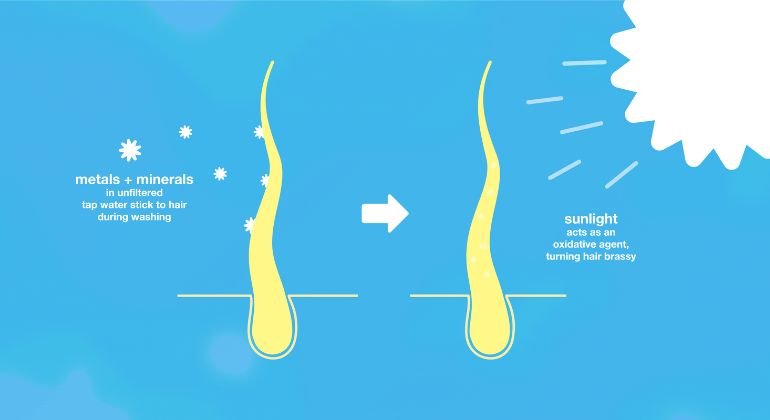
This is the mechanism almost every care guide skips. Copper and iron from household plumbing deposit on the hair shaft and catalyze oxidation reactions on the pigment. TRI Princeton soaked virgin blonde hair in a 0.5 ppm copper sulfate solution for one hour and produced a visible color change. That is a trace concentration and a single hour. Research also shows copper ions drive protein oxidation with or without UV exposure, and that chelating agents such as EDDS, EDTA and histidine measurably reduce copper uptake.
4. Heat drives water and pigment out at the same time
Flat irons and curling wands push bound water out of the cortex. Pigment migrates with it. Colored fiber has already lost lipid content during processing, so it heats faster and holds less water than virgin hair does. A single 400F pass on a lightened wig costs more tone than a week of washing.
The brassiness myth: your hair is not turning orange
Wearers describe brassiness as the color changing. It is the opposite. Lightening a dark fiber exposes warm yellow and orange pigment that was always sitting underneath, and the stylist neutralizes it with a violet, blue or ash toner. Those cool toner molecules are small direct dyes. They wash out faster than anything else on the strand.
So when a blonde unit goes brassy, the warm base has not appeared. The cool layer covering it has left. That reframes the fix: you do not need to re-lighten anything, you need to put the cool pigment back with a gloss. Re-lifting a wig that only lost its toner is how people destroy otherwise healthy fiber.
What a factory knows about color retention that a reseller does not
Two wigs can carry the same shade code and fade at completely different rates. Three manufacturing variables decide it.
Lift level sets porosity. Reaching a level 10 blonde on dark Vietnamese hair takes far more oxidative work than reaching a level 6 brown. Each lift step removes lipid and opens the cuticle further, and the resulting porosity never fully closes. The American Academy of Dermatology advises staying within three shades of the natural base for exactly this reason, since lightening beyond that requires higher peroxide volumes. A #613 blonde will always fade faster than a #4 brown. That is physics, not a defect.
Cuticle alignment decides whether fade is even. In single-donor bulk hair, every strand runs root to tip in the same direction and the scales overlap like roof tiles. Dye sits under a continuous surface. Mixed-donor hair has strands facing both ways, so scales collide and leave open gaps where pigment escapes first. That is what causes patchy fade, where one section turns brassy while another holds.
The finishing rinse locks the pigment. After dyeing we drop the fiber into an acidic bath in the pH 3.5 to 4.5 range before drying. Acid contracts the fiber and flattens the cuticle over the fresh pigment. You replicate this at home with an acidic conditioner, and skipping it is one of the most common reasons color walks out in the first two weeks.
The 8-step routine that holds color
- Wait 72 hours before the first wash. Oxidative dye keeps developing for roughly two days after rinsing. Washing on day one flushes pigment that has not finished polymerizing inside the cortex. On a freshly dyed wig, wait three days and handle it dry.
- Cut wash frequency to two or three times a week. Every wash cycle swells the fiber and lets dye diffuse out. Dry shampoo or a rinse with conditioner only on the days in between keeps the fiber clean without the surfactant load.
- Switch to a sulfate-free, color-safe shampoo. Sodium lauryl sulfate and sodium laureth sulfate strip lipids along with dirt, and lipid loss raises porosity. Higher porosity means faster leaching on the next wash.
- Chelate the metals out once or twice a month. A chelating shampoo containing EDTA, EDDS or citric acid binds copper and iron and rinses them away. A clarifying shampoo will not do this. Wait two weeks after a fresh color service before you chelate.
- Finish with an acidic conditioner or rinse. Products in the pH 3.5 to 4.5 range flatten cuticle scales and lock pigment. This is the step that actually seals the fiber, not a cold water blast.
- Cap heat tools at 350F and always use a protectant. Above roughly 175C the fiber loses bound water fast and pigment migrates out with it. One high-heat pass on a lightened base costs more tone than a week of washing.
- Block UV before you go outside. Use a leave-in with a hair-rated UV filter such as benzophenone-4, or wear a hat. Body sunscreen is formulated for skin and leaves a heavy residue on a wig cap.
- Refresh tone with a gloss every four to six weeks. A demi-permanent gloss or acid toner puts the cool pigment back without another lift. This single habit does more for perceived color life than any shampoo.
Wig color care is not the same as scalp hair care
Advice written for colored scalp hair transfers badly to a wig, and the difference is not cosmetic. A wig receives no sebum, grows no new fiber, and cannot repair itself. Every fade event on a wig is permanent and cumulative.
| Factor | Colored scalp hair | Colored human hair wig |
| Natural oil supply | Sebum coats the fiber daily | None, so lipid must be replaced by product |
| Renewal | New growth replaces damaged fiber | The same fiber for the life of the unit |
| Color history | Usually one or two processes | Often decolorized then dyed at the factory |
| Sun exposure | Only when worn | Also when stored near a window |
| Best storage | Not applicable | Closed box or bag on a stand, away from light |
The storage line matters more than people expect. A unit sitting on an open mannequin head near a bright window accumulates UV dose on days you never wear it. Colored human hair wigs and clip-in extensions should live in a closed container between wears.
Two pieces of common advice that do not survive testing
Cold water does not seal anything. TRI Princeton rinsed hair above 98F and below 65F and measured shine, and the cold rinse produced no benefit while warm water performed better. Hair is dead keratin with no muscles to constrict. Water swells the fiber and lifts the cuticle at any temperature. What flattens the cuticle is acidic pH, which is why your conditioner does the sealing work. Avoid water above 105F because it strips lipid, then stop worrying about the last ten degrees.
Clarifying shampoo is not the brassiness culprit. Guides routinely tell color-treated wearers to avoid clarifying products because they cause brass. Clarifying shampoos remove oil and styling residue and leave mineral deposits untouched. Copper and iron are what turn blonde green and brassy, and only a chelating agent binds them. Confusing the two categories means wearers avoid the wrong product and never remove the metals actually damaging their tone.
Buying for color longevity in the first place
If you resell colored units or run a salon, fade complaints usually trace back to sourcing rather than aftercare. Ask a supplier which donor structure the hair uses, what lift level the shade required, and whether the fiber was acid-finished after dyeing. A vendor buying from a middleman cannot answer those questions. Order from a physical color ring before committing to a wholesale run, and note that the global hair wigs and extensions market reached USD 15.22 billion in 2025 with human hair holding 65.6 percent of it, which means buyers now have enough choice to refuse vague answers.
If chlorine or salt water is part of your routine, the pre-swim preparation matters more than anything you do afterward. We covered that separately in our guide to swimming with hair extensions and to restoring extensions after a holiday.
Frequently asked questions
How long should colored hair or a colored wig hold its color?
A permanent oxidative color holds until it grows out or the fiber abrades. Semi-permanent color survives around 24 washes. Direct dyes, which cover most vivid and pastel wigs, fade over 8 to 12 washes. A colored human hair wig on a two-wash week routine usually needs a gloss at six to eight weeks.
Does rinsing with cold water stop color from fading?
No. TRI Princeton rinsed hair above 98F and below 65F and measured no shine benefit from cold water, with warm water performing better. Water swells the fiber and lifts cuticle scales at any temperature. Acidic conditioner flattens the cuticle, not temperature.
Why does my blonde wig turn brassy instead of just getting lighter?
Brassiness is the toner leaving, not the hair changing. Lightening exposes warm yellow and orange pigment in the fiber, and a cool violet or blue toner sits on top to neutralize it. Those toner molecules are small and wash out first, so the warm base underneath reappears.
Will a clarifying shampoo make my color brassy?
A clarifying shampoo removes oil and product residue but leaves mineral deposits behind. Copper and iron from tap water are what push blonde toward green and brass, and only a chelating agent removes them. Skipping chelation is more likely to cause brass than using it.
Can I stop a colored wig from fading in the sun?
You can slow it. UV light degrades tryptophan in keratin into N-formylkynurenine, a yellow compound, and oxidizes pigment through free radicals. A hair-rated UV filter, a hat, and storing the wig in a closed box away from window light all reduce cumulative exposure.
Does the quality of the hair itself change how fast color fades?
Yes, more than any product does. Single-donor hair with root-to-tip cuticle alignment holds dye evenly because the scales overlap in one direction. Mixed-donor hair with scrambled cuticles leaches pigment through the gaps and fades in patches.
Source your color from the people who dyed it
Color longevity starts at the lift, not at the shampoo aisle. Thanh An Hair processes raw Vietnamese hair in our own factory, which lets us tell you the donor structure, the lift level and the finishing pH behind every shade we ship. If you sell colored units and want fewer fade complaints, contact our team for a wholesale color ring and factory pricing. Tell us which shades your clients ask for and we will tell you honestly which ones will hold.
Ready to find your perfect match? Contact us today for expert advice and exclusive discounts on premium human hair extensions.
📲Phone/WhatsApp: +1 (206) 698‑5133
🛜Instagram: RAW HAIR LUXURY COMPANY
🌐Tik Tok: RAW HAIR LUXURY
📧 Email: Rawhairluxury.us
🌐Website: rawhairluxury.com