Raw Vietnamese Hair
High Ponytail vs Low Ponytail: Which Should You Choose?
Aug
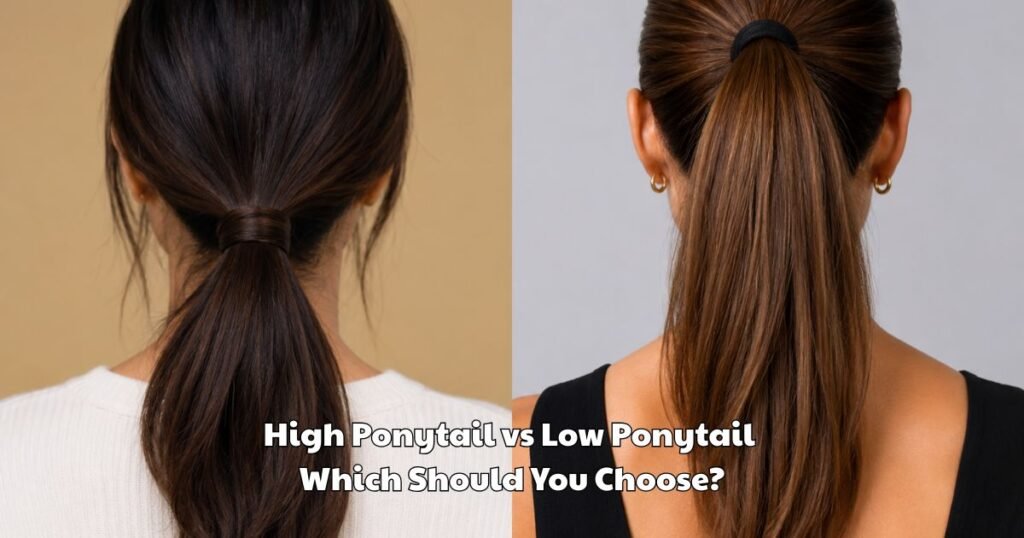
High ponytail vs low ponytail comes down to one trade-off. Choose a high ponytail for lift, volume and an energetic line. Choose a low ponytail for polish, comfort and the lowest scalp tension. The difference that matters sits below the surface: a high ponytail drags your frontal and temporal hair against the direction it grows.
High ponytail vs low ponytail at a glance
| Factor | High ponytail | Mid ponytail | Low ponytail |
| Placement landmark | Above the ear-top line | Level with the ear-top line | At or below the earlobe |
| Direction of pull | Against hair growth at the hairline | Slightly against | With the natural fall |
| What carries the weight | Hair inside the elastic only | Hair inside the elastic | Elastic plus contact with the neck |
| Scalp tension | Highest | Moderate | Lowest |
| Headache risk | Highest | Moderate | Low |
| Hairline risk over years | Frontal and temporal margin | Spread | Occipital margin, lower overall |
| Best face shapes | Round, square | Square, heart, oval | Long, heart, oval |
| Fine hair | Slips, needs support | Workable | Best fit |
| Extension that suits it | Light wrap piece | Wrap or drawstring | Any weight |
| Best occasions | Gym, photos, glam | Everyday | Work, interviews, formal |
What actually changes when you raise the ponytail?
Three things change, and none of them is the vibe.
Direction of pull. Hair at your frontal hairline and temples grows forward and down. A tie at the crown drags it backward and up, across that growth direction. A tie at the nape moves it the way it already falls. A 2025 review in Brain and Behavior names ponytails worn against the growth direction as a primary driver of traction headache.
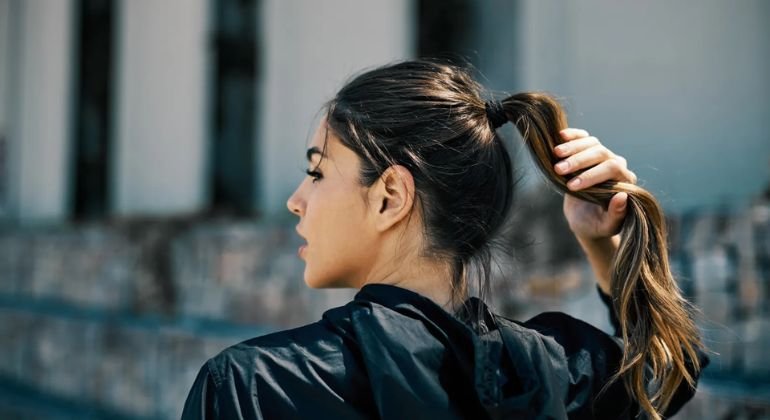
What carries the load. At the crown, every gram hangs from the hair inside the elastic. At the nape, the tail rests against your neck, so your body absorbs part of the weight instead of your roots.
Movement. A crown ponytail swings, and every step sends a pulse of tension to the roots. A nape ponytail barely moves, and steady tension is easier on a follicle than repeated tugging at one point.
Is a high ponytail bad for your hair?
A high ponytail is not damaging on its own. Worn tight and daily for years, the evidence points to real hairline loss.
Two studies looked at ponytails directly. A 2019 study in Dermatologic Therapy examined 43 women presenting with frontal alopecia, and 79 percent had worn a ponytail four or more days a week for an average of 10 years. A 2020 analysis in the International Journal of Medical Sciences tied regular ponytail wearing to more severe female pattern hair loss, at an odds ratio of 2.03 (95% CI 1.40 to 2.96).
The condition behind those numbers is traction alopecia, and its key feature is timing. StatPearls calls it biphasic: the early stage is non-scarring and reversible, the chronic stage scars the follicle and the loss turns permanent. It shows along the marginal hairline. Clinicians look for the fringe sign, a surviving band of short fine hairs at the front while the hair behind thins.
The American Academy of Dermatology gives one threshold worth memorizing: if your hairstyle feels painful, it is too tight. Watch for broken hairs along the forehead, a receding hairline, stinging, crusts, or a tented look where the scalp lifts with the hair. Risk is not spread evenly either: research from Johns Hopkins in the Journal of the American Academy of Dermatology puts traction alopecia at roughly one third of Black women, because a curved follicle leaves the shaft more vulnerable to tension. None of this rules out the high ponytail. It argues for rotating placement so one band of hairline never carries the load seven days a week.
Why does a high ponytail give you a headache?
Because sustained pull irritates the soft tissue over your skull, not anything inside it.
In a 2004 study in Headache, 50 of 93 women reported headache from wearing a ponytail, with pain starting at the hair tie and spreading to the vertex or forehead. The author classed it as a pure extracranial headache arising from traction on the fascia and tendons over the skull. The International Classification of Headache Disorders now lists it as code 4.6.2, external-traction headache, with ponytail headache as the common name.
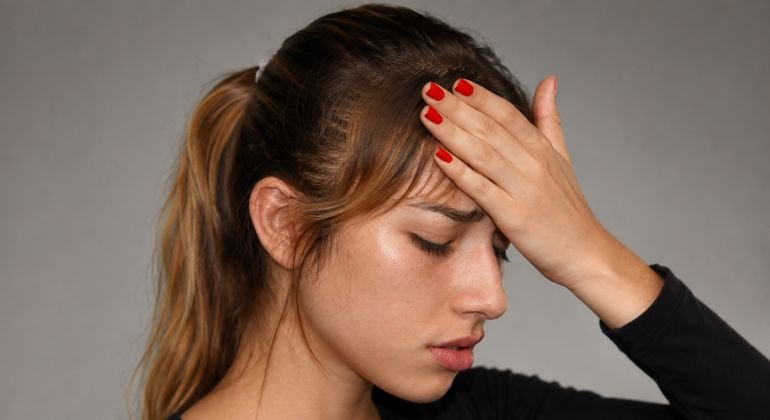
The 2025 Brain and Behavior review puts prevalence among women at 40 to 54 percent, with a mean duration of 76 minutes and 64 percent of episodes resolving inside half an hour once the hair comes down. It also names heavy hair and extensions among the triggers, which is why weight matters as much as tightness.
When a ponytail headache needs a doctor
Take the hair down and give it an hour. Pain that continues after the traction is released does not fit the pattern, and a clinician should look at it. The same goes for scalp pain that arrives with visible thinning, crusting or bumps along the hairline.
How do you choose between a high, mid and low ponytail?
Match placement to four things: face shape, hair density, hours worn, and added weight.
- Round or square face: high. The vertical line lengthens the proportions and balances a strong jaw.
- Long or oblong face: low. Height at the crown stretches a long face further.
- Heart or oval face: mid suits both, and oval takes any height.
- Fine or thinning hair: low or mid, and add a piece rather than tightening the base.
- Twelve-hour day or a flight: low, whatever your face shape.
- Migraine history: low. Migraine-prone people report external-traction headache more often.
The mid ponytail is the placement most guides mention and none define. Use the ear-top line: a tie level with the tops of your ears, seen from the side, is a true mid. It keeps most of the lift and spreads the pull across more hairs.
What a hair factory checks that a styling guide will not
Weight is the variable almost nobody measures, and it decides whether a ponytail holds or drags. A piece adds a fixed number of grams to a fixed anchor. At the crown, the hair inside your elastic carries all of it. At the nape, your neck takes a share. The rule we give salon buyers: the piece should not outweigh the hair holding it. When it does, the wearer feels the tail slide, tightens the base to compensate, and turns a weight problem into a tension problem at the hairline.
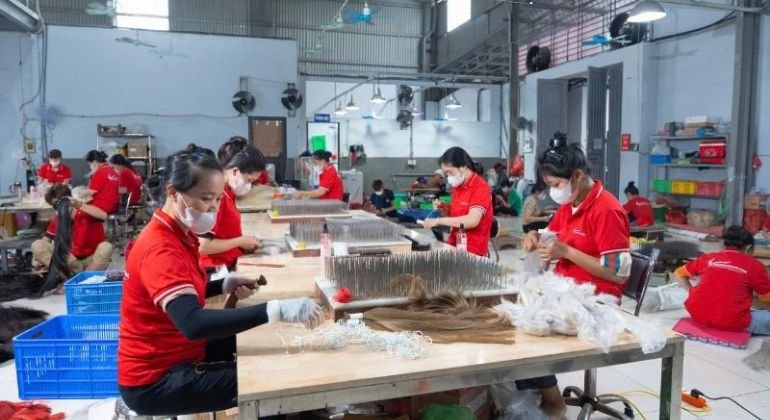
Construction changes the load path. A wrap ponytail spreads weight around the base. A drawstring piece concentrates it on the combs and string, which suits a mid or low mount and fights you at the crown.
Two details decide whether the base stays comfortable. Cuticle alignment stops the tail matting where it meets the elastic, and a matted base is what makes a wearer pull tighter. Single-donor hair carries one growth direction through the bundle, so the piece falls the way your own hair falls. We build our ponytail hair extensions and one-donor bulk hair to hold both. For volume without a daily anchor, halo hair rests on the head instead of clamping to it. Match color against a physical color ring in daylight, because screens get it wrong.
How to set a ponytail that holds without pulling
- Style on dry or nearly dry hair. Wet hair stretches under load and dries into the tension you set.
- Set placement against the ear-top line. From the side, a tie above the line across the tops of your ears is high, level with it is mid, at or below the earlobe is low.
- Detangle from the ends upward. Brushing root to tip drags every knot against the follicles you are about to load.
- Gather with your fingers on the final pass. A brush pulls the hairline tighter than your hand. Smooth the last pass with your palms so the temples keep some slack.
- Secure with a fabric or coil tie, one wrap looser than feels right. Metal clasps cut the shaft at the fold point. Add a second elastic for support instead of pulling the first one harder.
- Run the pain check before you leave. The AAD threshold: if it hurts, it is too tight. Stinging, a tented scalp or pulling at the temples means reset lower.
- Attach any ponytail piece after the base is set. Adding weight changes the load. Fit the piece, move around for a minute, then test the base again.
- Take it down before you sleep. Eight hours of pillow friction adds tension you cannot feel.
Frequently asked questions
Is a high ponytail or low ponytail better for thin hair?
A low ponytail is better for thin hair. It sits against the neck, so part of the weight rests on your body instead of the hair inside the elastic. A high ponytail on fine hair also slips and needs retightening, and each retightening adds tension at the hairline.
Can a ponytail cause permanent hair loss?
Yes, if it is tight and worn daily for years. Traction alopecia runs in two phases. The early phase is non-scarring and the hair grows back once you release the tension. The chronic phase scars the follicle and the loss becomes permanent.
How long can I wear a high ponytail safely?
No fixed hour limit exists, because tightness matters more than duration. A loose high ponytail worn all day is safer than a tight one worn for two hours. Rotate placement across the week so one band of hairline never carries the load daily.
Do ponytail extensions make traction alopecia worse?
They can, when the piece outweighs the hair holding it. Extensions add grams to a fixed anchor. Match the piece to your own density, mount it low or mid if your hair is fine, and take it off at the end of the day.
Which ponytail suits a round face?
A high ponytail suits a round face. The vertical line at the crown adds height and draws the eye upward, which lengthens the proportions. A long face gets the opposite effect, so a low ponytail at the nape reads better.
Why does my scalp hurt after I take my ponytail down?
That is external-traction headache, listed in the International Classification of Headache Disorders as code 4.6.2. Sustained pull irritates the soft tissue over the skull rather than anything inside it. Most cases fade within half an hour of releasing the hair.
The short verdict
High gives lift and costs tension. Low gives comfort and costs volume. Mid sits between them. If you wear a ponytail most days, rotation beats placement: move the tie, keep it loose enough to pass the pain check, and add weight only where your hair can carry it. For fullness at any height, a clip-in set or light wrap piece does the work the elastic should not, and four easy hairstyles for extension newbies covers the low ponytail setup.
Source ponytail hair direct from the factory
Thanh An Hair has manufactured raw Vietnamese hair for two decades and ships factory-direct to salons and resellers worldwide. Send us your lengths, textures and colors, and we will come back with weights, pricing and a physical color ring.
Request a ponytail sample and color ring
Ready to find your perfect match? Contact us today for expert advice and exclusive discounts on premium human hair extensions.
📲Phone/WhatsApp: +1 (206) 698‑5133
🛜Instagram: RAW HAIR LUXURY COMPANY
🌐Tik Tok: RAW HAIR LUXURY
📧 Email: Rawhairluxury.us
🌐Website: rawhairluxury.com