
Raw Vietnamese Hair
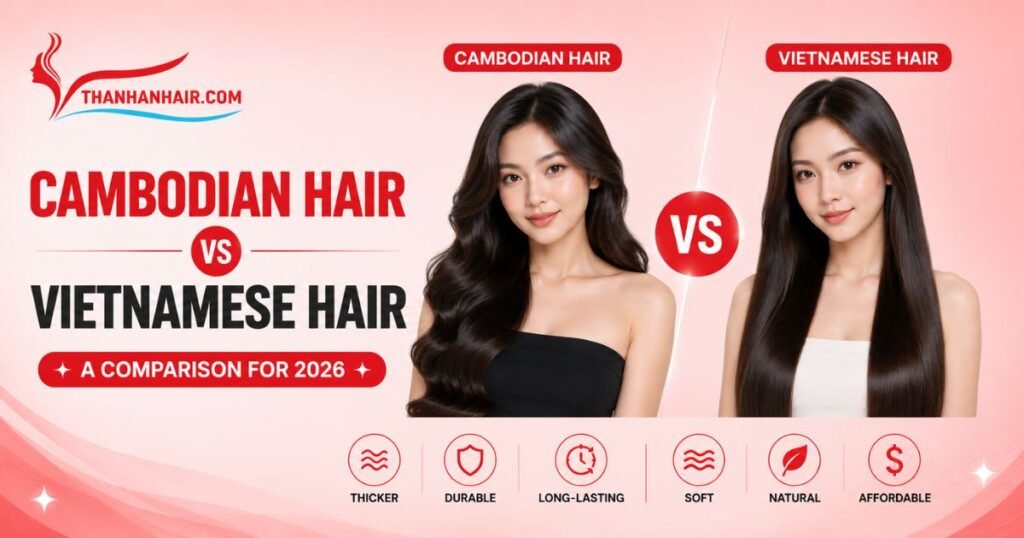
Cambodian Hair vs Vietnamese Hair: A Detailed Comparison for 2026
Jun
Cambodian hair vs Vietnamese hair comes down to texture and supply. Vietnamese hair is smooth, strong, available in long lengths, and backed by abundant supply that keeps prices lower and lead times shorter. Cambodian hair is coarser and naturally fuller, holding curls beautifully but in shorter lengths and scarcer quantities. Your best choice depends on the textures, lengths, and order volumes your clients need.
| Factor | Cambodian Hair | Vietnamese Hair |
| Natural texture | Coarse, full-bodied, slight natural wave | Smooth, silky, mostly straight |
| Natural color | Off-black to dark brown | Natural black to jet black |
| Typical max length | ~22–24 inches | ~28–40 inches |
| Strand thickness | Thicker, denser strands | Medium-thick, strong cuticle |
| Style retention | Excellent for wavy & curly looks | Versatile — straight, wavy & curly |
| Raw material supply | Limited (smaller population) | Abundant (~6× larger population) |
| Bulk-order lead time | Longer, less predictable | Shorter, more consistent |
| Price per bundle | Higher | More affordable |
| Best for | Textured styles, coarse-hair clients | Long lengths, versatile styling, scale |
What is the difference between Cambodian and Vietnamese hair?
The core difference is strand structure and availability. Cambodian hair has a thicker, coarser strand that gives natural volume and outstanding curl retention, while Vietnamese hair has a smoother, straighter strand that takes any style and comes in longer lengths. Vietnam’s far larger population also means a steadier raw-hair supply, which directly shapes price and lead times.
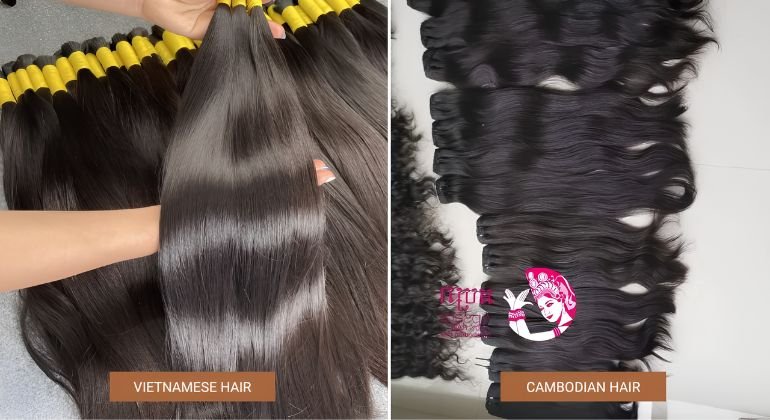
Both are genuine, high-grade Asian human hair and both sit in the premium tier of the global market — which favours natural hair strongly, with the human-hair segment holding around two-thirds of the wigs and extensions market. The differences below are about fit for your clients, not one origin being “real” and the other not.
One point many guides miss: in the global trade, “Cambodian hair” often describes a texture grade as much as a strict country of origin. A great deal of hair sold as Cambodian is prized for its coarse, full-bodied feel rather than a verified Cambodian donor. So treat texture and documented origin as two separate things, and confirm both with any supplier before you commit.
Where does Cambodian and Vietnamese hair come from?
Both originate from donors in Southeast Asia, but supply scale and traceability differ. Vietnamese raw hair is collected from a large domestic population through an established network, making documented-origin and single-donor hair easier to source. Cambodian hair comes from a smaller population, so verified, ethically collected supply is tighter.
This matters commercially, not just ethically. Roughly 55% of buyers now prioritise ethically sourced hair, and about a third of suppliers report difficulty securing ethically collected raw material. Clear origin has become a selling point you can put in front of your own customers.
Cambodian hair origin
Cambodian hair is collected mostly from rural communities in a country of roughly 17 million people. Because the donor pool is small and demand is high, origin documentation varies more from supplier to supplier, and large quantities of one consistent texture can be hard to assemble. Reputable vendors keep transparent sourcing records — so ask for them, rather than assuming, and be cautious of suppliers who cannot explain where their hair comes from.
Vietnamese hair origin
Vietnamese raw hair is gathered largely from highland communities in the north, where growing long, chemical-free hair is a long-standing tradition. With a population near 100 million — about six times Cambodia’s — the supply base is deep enough to offer abundant volume, a wide length range, and traceable single-donor bulk hair for buyers who need maximum consistency. That depth of supply is the foundation for everything that follows on price, length and lead time.
Show Image
How do texture, color, and quality compare?
Cambodian hair feels coarser and fuller with a natural body that holds curls with little heat, while Vietnamese hair feels smoother and silkier, carries a higher shine, takes color and heat styling well, and reaches longer lengths. Both are durable when minimally processed; the right one depends on the look your clients want.
Texture and feel. Cambodian strands are thicker with a denser cuticle, which is exactly why they give that full, slightly matte body and grip a curl pattern so well — ideal for clients with coarse or relaxed natural hair. Vietnamese strands have a smooth, aligned cuticle, so the hair blends seamlessly, reflects more light, and moves between straight, wavy and curly styling with ease.
Color and length. Both are naturally dark, but Vietnamese hair tends toward a deeper natural-to-jet black while Cambodian hair runs off-black to dark brown. Length is a clear divider: Vietnamese hair is readily available up to 28–40 inches, whereas Cambodian hair typically caps around 22–24 inches because of how it is collected.
Lifespan and durability
Premium raw hair of either origin commonly lasts one to three years with proper care, and Vietnamese raw hair is frequently cited at the longer end thanks to strong, intact strands and minimal processing.
Real-world lifespan depends far more on care than on origin — gentle washing, low heat and sulphate-free products extend any extension’s life. Note that human-hair prices have been rising alongside supply pressure, which makes longevity an even more important part of the value calculation.
Cambodian hair vs Vietnamese hair: price and supply
Vietnamese hair is generally more affordable per bundle, and Cambodian hair commands a premium — a direct result of supply. Vietnam’s larger donor base produces more raw hair, lowering unit costs and shortening lead times, while Cambodia’s smaller supply pushes prices up and makes large orders slower to fulfil.
Within each origin, the biggest price driver is the drawn grade, which describes how uniform the strand lengths are in a bundle:
| Grade | What it means | Relative price |
| Single drawn | Mixed lengths; fuller at the top, naturally tapered ends | Lowest |
| Double drawn | Most short strands removed; thick from root to tip | Mid |
| Super double drawn | Nearly every strand the same length; maximum thickness | Highest |
Supply also drives lead time. Vietnamese factories sitting close to raw material can typically turn around bulk orders in days, whereas smaller Cambodian workshops often need longer and may not hold large stock. For buyers ordering weft hair or raw bulk hair at volume, that predictability is often worth as much as the price difference itself.
Which should you choose Cambodian or Vietnamese hair?
Choose Vietnamese hair if you need long lengths, versatile styling, consistent bulk supply and competitive pricing — it fits the majority of salons, resellers and extension brands. Choose Cambodian hair if your clients specifically want a coarse, full-bodied texture for wavy or curly looks and shorter lengths are acceptable.
A quick way to decide by business type:
- Salons and stylists: Vietnamese hair, for its length range, versatility and reliable restocking across colours and textures.
- Resellers and growing brands: Vietnamese hair, where price, lead time and a broad length range let you scale SKUs without supply gaps.
- Curly and textured-hair specialists: Cambodian hair delivers that signature coarse body — though steam-processed Vietnamese curly and wavy textures are an increasingly popular alternative that keeps the length and supply advantages.
That last point is worth underlining: Vietnamese raw hair can be steam-textured into body wave, deep wave and tighter curls without harsh chemicals, so you no longer have to trade away length or supply to offer a full-bodied, textured look. It is also the base for hand-tied wefts, lace closures and frontals, and most other formats your clients ask for.
Frequently asked questions
Is Cambodian or Vietnamese hair better?
Neither is universally better; they suit different needs. Vietnamese hair wins on length, styling versatility, supply and price, making it the practical choice for most salons and resellers. Cambodian hair wins when clients want a naturally coarse, full-bodied texture for wavy or curly styles in shorter lengths.
Why is Cambodian hair more expensive than Vietnamese hair?
Price tracks supply. Cambodia has a far smaller population than Vietnam, so verified raw hair is scarcer and costs more per bundle. Vietnam’s larger donor base produces more raw hair, lowering unit costs and shortening lead times for bulk orders.
Does Vietnamese hair come in curly and wavy textures?
Yes. Vietnamese hair is naturally straight to lightly wavy, but it can be steam-processed into body wave, deep wave and various curl patterns without harsh chemicals. This lets buyers offer textured styles while keeping the length and supply advantages of Vietnamese raw hair.
How long does raw Vietnamese hair last?
Premium raw hair commonly lasts one to three years with proper care, and Vietnamese raw hair is frequently cited at the longer end thanks to strong, intact strands and minimal processing. Lifespan depends heavily on washing, heat use and the products applied.
How can you tell Cambodian and Vietnamese hair apart?
Texture and length are the clearest cues. Cambodian hair feels coarser and fuller with a natural body and tends to be shorter. Vietnamese hair feels smoother and silkier, holds a higher shine, and is available in noticeably longer lengths.
Which hair is best for wholesale and bulk orders?
Vietnamese hair is the stronger choice for wholesale. Abundant supply means larger orders can be produced faster and priced more competitively, with a wider range of lengths and consistent restocking — all of which matter for resellers and growing brands.
See the difference for yourself
Want to feel raw Vietnamese hair before you commit? Request a sample pack or a wholesale quote from Thanh An Hair — a factory-direct manufacturer with two decades of raw-hair experience. Contact us for a sample and quote →
Contact Thanh An Hair today for expert consultation and the most competitive price list.
- WhatsApp/Hotline: (+84) 973 522 855
- Official Website: https://thanhanhair.com/
- Instagram: @thanhanhair
- Email: thanhanexport@gmail.com