
Raw Vietnamese Hair
How to Get Shiny Hair: What Actually Controls Shine
Aug
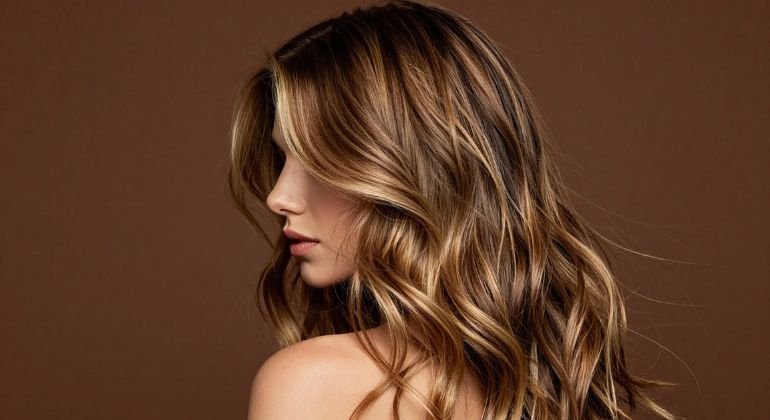
How to get shiny hair comes down to one physical property: how flat the cuticle scales lie. Flat, intact scales bounce light in a single direction and read as gloss. Lifted or eroded scales scatter it and read as dull. Every technique below does one of two jobs. It either flattens the cuticle or protects the lipid layer that holds it flat.
We manufacture raw human hair, which means we spend our working days looking at cuticle under magnification and rejecting bundles that will not hold shine past the third wash. What follows is the science, the numbers that matter, and the part almost no shine guide covers: what changes when the hair on your head is not growing out of your scalp.
Why Hair Looks Dull: What Is Actually Happening on the Strand
The visible hair shaft holds no living cells. It cannot heal, repair, or regenerate. StatPearls describes the hair shaft as an inner medulla wrapped in a cortex, wrapped in a single outer layer of flattened keratinized cells. Those outer cells overlap like roof shingles. They are transparent. Light passes through them, hits the pigmented cortex beneath, and reflects back out.
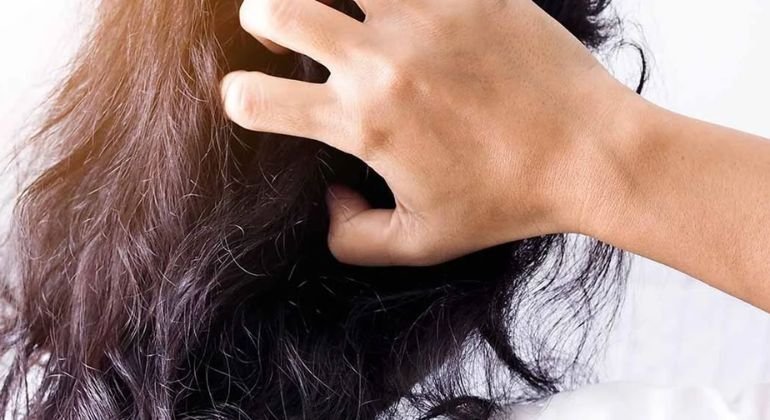
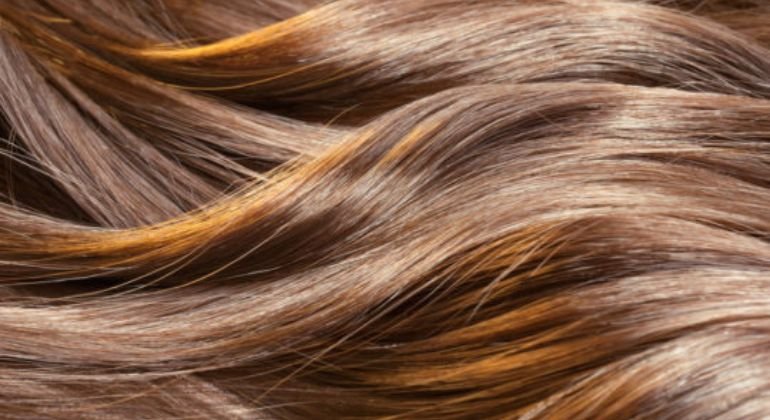
When the shingles lie flat, that reflection leaves the strand in one coherent direction. Your eye reads a bright band running down the hair. When the shingles lift, crack, or wear away, the same light exits at scattered angles. No bright band forms. The hair reads as dull, and it will read dull regardless of color, cut, or how much serum you apply.
So the useful question is never “what makes hair shiny.” It is “what is lifting my cuticle.” There are only four common answers: heat above the damage threshold, chemical processing, mechanical friction, and mineral or product film sitting on top of the surface.
The 1.1-Nanometer Lipid Layer That Makes Hair Shine
Sitting on the outermost cuticle cell is a layer of covalently bound fatty acid about 1.1 nanometers thick. It is called 18-MEA, and researchers publishing in Scientific Reports describe it as the component that makes hair hydrophobic, smooth, and shiny. In the top three nanometers of the fiber, roughly 36 percent of the material is 18-MEA.
Two facts about this layer drive most of what follows. First, it cannot be regenerated once it is gone. Your scalp does not push more of it up the shaft. Second, a single bleaching service removes more than 80 percent of it, because bleach oxidizes the sulfur bonds anchoring it to the fiber. Even without chemistry, the amount in your hair declines by more than 10 percent per year through ordinary washing, brushing, and sunlight.
The measurable consequence is water behavior. Undamaged hair holds a water droplet at a contact angle near 96 degrees, meaning the droplet beads and sits up. On hair stripped of 18-MEA, a droplet loses its shape on contact and cannot be measured at all. That shift from water-repelling to water-loving is the same shift that turns a reflective surface into a scattering one.
Dull Hair Causes: Diagnose Before You Buy Anything
Buying a shine product before identifying the cause is how people end up with a shelf of bottles and the same dull hair. Run this diagnostic first. Each cause has a distinct signature, and the fixes are not interchangeable.
Matching dull hair causes to the correct fix
| What you notice | Likely cause | What actually fixes it | Time to see change |
| Dull from roots to ends, hair feels coated or heavy, shampoo barely lathers | Product or silicone buildup | One clarifying wash, then cut conditioner back to the ends | Same wash |
| Ends look dull and rough, roots still shine | Cumulative weathering and lipid loss | Trim the worn length, then reduce heat and friction | One haircut |
| Dull with a white or gray cast, worse after moving house | Hard water mineral deposits | Chelating shampoo, shower filter | Two to three washes |
| Dull and rough only where you use hot tools | Heat above 284F | Drop tool temperature, use protectant | Prevents further loss only |
| Dull immediately after color or bleach | 18-MEA and cuticle loss from processing | Gloss treatment, bond builder, acidic rinse | One salon service |
| Shiny in the package, dull after three weeks of wear | Silicone-coated extension hair | Replace with cuticle-intact hair | Next purchase |
Notice that only two rows in that table call for a product. The rest call for removing something you are already doing. This is why the AAD publishes a list of damaging hair-care habits rather than a list of recommended products.
How to Get Shiny Hair in Six Steps: The Wash Routine That Works
This routine takes about twenty-five minutes including drying. It follows the wash guidance published by the American Academy of Dermatology, reviewed by five board-certified dermatologists, with the temperature threshold pulled from the cosmetic science literature rather than from marketing copy.
- Step 1: Clarify first if product has been building up
Wash once with a clarifying shampoo if you have used silicone conditioners, dry shampoo, or styling cream for more than two weeks without a reset. Film buildup scatters light the same way a dusty window does. Do this no more than once every two to four weeks, since clarifying shampoo also strips the natural surface lipids you are trying to keep. - Step 2: Shampoo the scalp only, not the lengths
Work shampoo into the scalp with your fingertips and let the rinse water carry the lather down the lengths. The American Academy of Dermatology recommends this because the scalp holds the oil and dead skin, while the mid-lengths and ends are the oldest, most weathered part of the fiber and dry out fastest. - Step 3: Condition the ends and leave it on for two minutes
Apply conditioner from the mid-lengths down if your hair is fine or straight, and along the full length if it is dry or curly. Give it two minutes. Conditioner does not repair the fiber, it lays the cuticle scales down and reduces friction, which is exactly what a light-reflecting surface needs. - Step 4: Do the final rinse cool, not cold
Drop the water to cool for the last fifteen seconds. Cool water helps the cuticle sit flat and rinses conditioner residue that would otherwise dull the surface. Ice cold water adds nothing beyond this and is not necessary. - Step 5: Squeeze dry with a cotton t-shirt, then detangle wet with a wide-tooth comb
Press the water out rather than rubbing, since a terry towel lifts cuticle scales through friction. Detangle from the ends upward with a wide-tooth comb while the hair still holds conditioner. Hair is at its most fragile when it is wet. - Step 6: Apply heat protectant and dry at 284F or below
Coat damp hair with a heat protectant, then blow-dry on medium with the nozzle pointing down the shaft. Keep flat irons and curling irons at or under 284F. Above that threshold the structural changes in the fiber stop being reversible.
Two details in that sequence do most of the work: shampooing the scalp instead of the lengths, and staying under the heat threshold. If you change nothing else, change those.
Heat Damage Hair: The Number Almost Everyone Gets Wrong
Heat protectant sprays imply that heat is survivable at any setting if you apply the product. The temperature data says otherwise, and it has said so since 1984.
Bories and colleagues, publishing in the International Journal of Cosmetic Science, heated hair from 20C to 200C and tracked the structure with electron microscopy and X-ray diffraction. They found a critical temperature of 140C, which is 284F. Below it, the changes were modest and reversible, tied to free water leaving the fiber. Above it, the changes were profound and irreversible, and they watched the cuticle fold and its scales gradually disappear. By roughly 200C, or 392F, the structure had degraded completely.
Now compare that to the tools. Most consumer flat irons top out between 400F and 450F. The high setting on a straightener sits above the temperature at which cuticle scales stop existing. Those scales are the entire optical mechanism for shine, and they do not grow back.
The same paper points to 60C, about 140F, as the optimal drying temperature, because hair dried at that temperature picks up ambient moisture more slowly afterward and stays less sensitive to humidity. That is a medium setting on most dryers, not the highest one.
If you already have heat damage along the mid-lengths, read our guide to hair breakage, which covers where the fiber fails and why cutting is sometimes the only honest answer.
Shiny Hair Extensions: Why the Rules Change Completely
Every piece of shine advice written for growing hair carries a silent assumption: that a sebaceous gland sits at the root, pushing out oil that coats the shaft each day. Extensions have no gland. No scalp, no sebum, no daily replenishment.
That single difference rewrites the maintenance math. On your own hair, the lipid layer erodes slowly and sebum partially compensates. On extensions, every wash strips surface lipid that nothing replaces. The hair starts at its maximum shine on day one and moves in one direction from there. How fast it moves depends almost entirely on how the hair was processed before it reached you.
What a Factory Checks Before Hair Ships
Hair sold cheaply is often acid-bath processed. The bath dissolves the cuticle to stop tangling in mixed-donor bundles, then silicone goes on top to restore the look of shine. In the package it gleams. After three to five washes the silicone is gone, and what remains is a fiber with no cuticle, which means no mechanism for reflecting light in the first place. It cannot be brought back, because there is nothing left to lay flat.
Cuticle-intact single-donor hair behaves the opposite way. All strands run root to tip in the same direction, so the scales lie in one plane and light reflects coherently along the bundle. On our bench, we check three things before a bundle ships: cuticle direction under magnification, whether the strand squeaks when drawn between wet fingers, and how the hair behaves after a controlled wash cycle. Hair that dulls in that test does not go in the box.
Our full method is written up in how to identify high-quality hair extensions, and the specific care sequence for installed hair is in keep a weave silky and tangle-free. If you are buying wholesale, our single-donor raw bulk hair is the category where cuticle alignment is preserved through the entire process.
For extensions, add a leave-in conditioner or light oil after every wash to replace the sebum that is never coming. Sleep on silk, since friction damage is permanent on hair that cannot be replaced by growth. We reviewed what the evidence does and does not support in benefits of silk pillowcases for hair.
Buying Hair That Holds Its Shine
If you sell hair or install it, shine retention is a purchasing decision made before the hair ever reaches a client. Cuticle-intact single-donor hair holds its reflection because the structure is still there. Coated hair borrows shine and gives it back within a month.
Request a sample bundle and factory price list and run the wash test yourself before you commit to an order.
Ready to find your perfect match? Contact us today for expert advice and exclusive discounts on premium human hair extensions.
📲Phone/WhatsApp: +1 (206) 698‑5133
🛜Instagram: RAW HAIR LUXURY COMPANY
🌐Tik Tok: RAW HAIR LUXURY
📧 Email: Rawhairluxury.us
🌐Website: rawhairluxury.com