
Raw Vietnamese Hair
Sun Protection for Hair in 2026
Aug
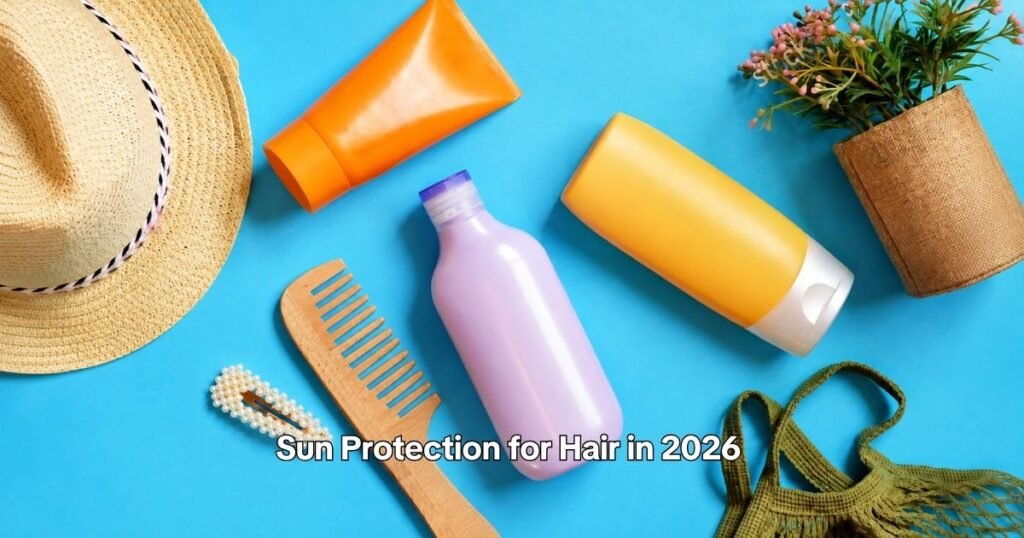
Sun protection for hair means two separate jobs: shielding the scalp, which is living skin that can develop cancer, and shielding the fiber, which is dead keratin that cannot repair itself. Use broad-spectrum SPF 30 or higher on the part, a UPF-rated hat, and a leave-in carrying a named UV filter.
Most guides on this topic stop at “wear a hat and drink water.” That advice is not wrong, but it treats a strand of bleached blonde hair and a strand of virgin black hair as the same material. They are not. We manufacture raw Vietnamese hair, and we spend our working hours looking at what happens to keratin under stress, so this guide covers the mechanism, the numbers, and the cases the consumer articles leave out: extensions, wigs, color-treated hair, and the scalp itself.
What UV radiation does to your hair, measured
UV light breaks hair through photo-oxidation. Sunlight strikes the sulfur-containing amino acid cystine, which forms the disulfide bonds holding keratin together, and cleaves it into cysteic acid. Tryptophan degrades. Lipids peroxidize. Melanin oxidizes and bleaches. Research published in the Journal of Photochemistry and Photobiology B confirmed all four processes running at once in irradiated hair fibers.
The result is a fiber that has lost tensile strength and gained porosity. You see it as dullness, roughness, split ends, and color that has drifted several shades warmer since June.
Sun protection for hair extensions and wigs follows a different rule
Growing hair has two recovery routes. Your scalp pushes fresh sebum down the shaft, coating it in lipid, and the damaged length eventually gets cut off and replaced by new growth. Extension hair and wig hair have neither. No follicle feeds them. Nothing regrows.
Every hour of UV exposure accumulates in the same strands across the entire install. Damage that a growing head would shed over eighteen months stays with a weft until it retires. This is the difference that changes the calculus: for extensions, sun exposure is not a cosmetic inconvenience, it is depreciation.
Three factory-side details matter here. Processing already removes some of the 18-MEA lipid layer that makes a cuticle water-repellent, so processed hair enters the summer with a thinner buffer than virgin hair. Bleached and lifted extension colors have degraded melanin, as covered above. And cuticle-aligned hair holds up better under UV plus friction than mixed-direction hair, because aligned scales lie flat instead of catching on each other once UV has roughened them. Anyone buying from a weft supplier should ask which of the three they are getting.
If you swim in your extensions or wear clip-ins to outdoor events all summer, the protocol below is not optional maintenance. It is the difference between a set that lasts a season and one that lasts three.
Scalp sun protection is a medical issue, not a styling one
This is the section the beauty guides skip, and it carries the highest stakes on the page.
Your scalp is skin, and it develops skin cancer. According to StatPearls, melanoma of the head and neck accounts for roughly 10 to 25 percent of all melanomas, and the scalp carries the worst prognosis of any site in that region. Scalp tumors tend to present with greater Breslow thickness and higher mitotic rates. Part of the reason is simple: you cannot see the top of your own head, so lesions get found late.
Hair provides real but partial cover. Dermatologists point out that skin under a full head of hair shows fewer freckles and less sun damage than exposed skin. The gaps are the part line, the hairline edges, thinning areas, and any shaved or braided section. Those are the spots that need sunscreen.
The American Academy of Dermatology sets the standard at broad-spectrum, water-resistant, SPF 30 or higher. SPF 30 blocks about 97 percent of UVB. The Skin Cancer Foundation names a UPF 50-plus hat as the strongest scalp protection available, and notes that a visor leaves the entire crown uncovered.
Add one habit: check your scalp monthly, or ask whoever cuts your hair to look. Stylists find scalp lesions that clients never see. Anything new, changing, bleeding, or refusing to heal goes to a dermatologist.
How to protect hair from sun: the six-step beach day protocol
Run these in order. The sequence matters more than the products.
- Saturate hair with clean water before you go out. Hair absorbs roughly a third of its weight in water. Strands already full of fresh water take on far less chlorinated or salt water, which is the carrier that drives oxidation deeper into the fiber. Soak the hair at a tap or shower until it stops feeling thirsty, then squeeze out the excess.
- Seal with a leave-in that carries a UV filter. Work a leave-in conditioner or cream through the mid-lengths and ends, where the oldest and most weathered hair sits. Look for benzophenone-4, ethylhexyl methoxycinnamate, or octocrylene on the ingredient list. These are real UV filters, not marketing language.
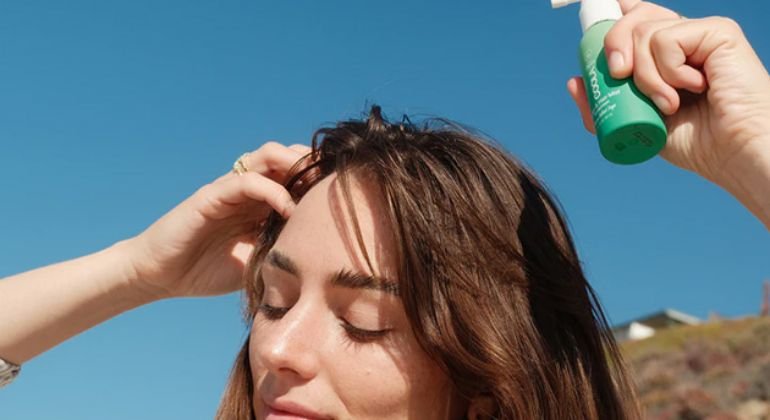
- Apply a broad-spectrum SPF 30 or higher to the scalp itself. Part the hair and treat the exposed skin, not the strands. A stick or gel format reaches a part line without greasing the roots. The American Academy of Dermatology recommends broad-spectrum, water-resistant SPF 30 or higher for all skin left uncovered by clothing, and a hair part is uncovered skin.
- Braid, twist, or bun the lengths. A braid or low bun cuts the surface area facing the sun and shields the interior strands with the exterior ones. Keep the tension loose. Tight styles worn in heat and sweat put strain on the follicle and can contribute to traction alopecia over time.
- Cover with a tightly woven or UPF-rated hat. A wide-brim hat shields the scalp, ears, and neck at once. Fabric labeled UPF 50 blocks the large majority of UV that reaches it. Hold a loose-weave straw hat up to the light: the light you see through it is the UV that reaches your scalp. Visors leave the entire crown exposed.
- Rinse and re-condition within an hour of leaving the sun. Chlorine, salt, and photo-generated free radicals keep reacting after you go inside. Rinse with cool water, then apply a conditioner or mask to restore slip to a cuticle that UV has roughened. Skip heat styling that day, since UV-treated hair has already lost tensile strength.
Which UV hair protection method actually does what
Most product pages blur the line between protecting skin, protecting fiber, and simply adding shine. Here is the honest breakdown.
| Method | What it covers | What it does | Where it falls short | Verdict |
| Wide-brim UPF 50 hat | Scalp, ears, neck, crown | Blocks UV before it reaches skin or fiber | Leaves lengths below the brim exposed | Strongest single measure |
| Broad-spectrum SPF 30+ on the part | Scalp skin only | Prevents sunburn and cumulative skin damage | Does nothing for the hair fiber | Medically necessary, not cosmetic |
| Leave-in with a UV filter | Mid-lengths and ends | Slows cystine oxidation and color fade | Washes off; needs reapplying after swimming | Best fiber-level option |
| Pre-soaking hair in clean water | Whole head | Cuts uptake of chlorine and salt water | No UV blocking on its own | Free, and most people skip it |
| Braid, bun, or protective style | Whole head | Reduces exposed surface area | Tight tension can strain follicles | Useful, keep it loose |
| Silicone-only shine serum | Surface of the fiber | Adds slip and light reflection | No UV filter unless the label names one | Cosmetic, not protective |
Reading a UV hair product label without getting sold
Three checks separate a working product from a scented conditioner with a beach photo on the bottle.
Look for a named UV filter. Benzophenone-4, ethylhexyl methoxycinnamate, octocrylene, and butyl methoxydibenzoylmethane are real filters with published absorption spectra. A label that says “UV defense” or “sun shield” with none of these in the ingredient list is selling a claim, not a filter.
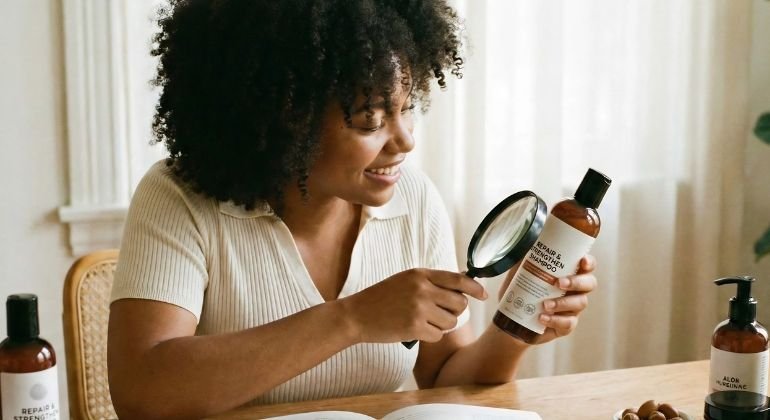
Ignore SPF numbers on hair products. SPF measures how long treated skin takes to redden. Hair is dead keratin and cannot redden, so an SPF number printed on a hair mist has no defined meaning. Reserve SPF for what goes on your scalp.
Check for antioxidants as a second layer. UV damage runs through free radicals. Vitamin E, panthenol, and polyphenol extracts mop up some of what gets through. They support a UV filter rather than replacing it.
One more habit worth building: UV damage and mechanical damage compound. A cuticle roughened by sun catches more on cotton overnight, which is part of why the benefits of silk pillowcases show up most for people who spend time outdoors.
The short version
UV breaks the disulfide bonds that give hair its strength, oxidizes the melanin that gives it color, and burns the scalp underneath. Dark virgin hair resists it better than bleached hair because melanin absorbs the hit. Extensions and wigs suffer the most because nothing replaces them. Cover the scalp with SPF 30 or higher and a UPF hat, seal the lengths with a leave-in carrying a named filter, and rinse the day off before it keeps reacting overnight.
Sourcing hair that holds up to a full summer? We manufacture cuticle-aligned, single-donor raw Vietnamese hair at our own factory, so we can tell you exactly how each batch was processed and what that means for its UV tolerance. Request a sample and wholesale catalog and see the fiber before you commit to an order.
Ready to find your perfect match? Contact us today for expert advice and exclusive discounts on premium human hair extensions.
📲Phone/WhatsApp: +1 (206) 698‑5133
🛜Instagram: RAW HAIR LUXURY COMPANY
🌐Tik Tok: RAW HAIR LUXURY
📧 Email: Rawhairluxury.us
🌐Website: rawhairluxury.com