
Raw Vietnamese Hair
How to Keep a Wig from Tangling

Aug
How to keep a wig from tangling comes down to controlling friction at three points: brush from the ends upward with a wide-tooth comb before and after every wear, add slip with a leave-in conditioner before the fiber dries out, and secure the nape whenever the hair meets a collar, seatbelt, or pillow.
Why a wig tangles when your own hair does not
Your hair shaft is wrapped in a cuticle: flattened cells that overlap like roof shingles, all pointing from root to tip. Because those scales point one way, hair slides easily in one direction and catches in the other. Researchers call this anisotropic friction, and it is the whole story behind wig tangling. When two strands slide against each other tip-to-tip, they glide. When they slide against the grain, the scale edges hook.

Two things keep that hooking under control on your own head. Your scalp produces sebum, which coats the shaft and lubricates it every day. And your hair carries a bound fatty acid layer on its outer surface that lowers friction. A wig has neither system. No scalp feeds it, and the surface layer wears away through brushing, washing, and heat without anything replacing it. Every wear removes a little more slip, and nothing puts it back except you.
That is why a wig care routine is maintenance rather than rescue. You are replacing, by hand, a lubrication system that a living scalp runs for free.
Tangling and matting are two different problems
Tangling means strands have crossed and looped around each other. A comb and some slip will open it. Matting means the cuticle scales have interlocked along their length and compressed into a felted pad, the same process that turns loose wool into felt. Conditioner can sometimes open early matting. Advanced matting does not come back, and cutting it out is the honest answer.
The distinction matters because the same wig can have both. A daily comb-out handles tangling. Once a section has gone stiff and will not separate under conditioner, you are past the point where technique helps.
Tangle triggers, what happens to the fiber, and the fix
| Trigger | What happens to the fiber | The fix |
| Collar and seatbelt friction | Repeated rubbing lifts cuticle scales at the nape; lifted scales hook into each other | Braid or tuck the bottom section before you sit |
| No sebum replacement | The wig gets no scalp oil, so the lubricating layer wears off and never returns | Leave-in conditioner, mid-strand to ends, on damp hair |
| Product buildup | Residue turns tacky, then glues neighboring strands into ropes | Clarify every fourth or fifth wash |
| Root-to-tip combing | One long stroke drags every small knot into a single dense knot | Short strokes, ends first, working upward |
| Cotton pillowcases and bonnets | Cotton grips the fiber and pulls moisture out of it overnight | Satin or silk bonnet, or satin pillowcase |
| Mixed-direction hair | Half the strands run tip-to-root, so scales face each other and lock | Buy cuticle-aligned single-donor hair |
| Hard water | Calcium and magnesium deposit on the shaft and roughen the surface | Chelating shampoo or a filtered final rinse |
How to keep a wig from tangling: the 7-step daily routine
This is the sequence our QC team uses on sample units that ship, get worn by stylists, and come back for inspection. It takes about four minutes a day.
- Finger-check before any tool touches the hair Run your fingers through the length from the ends up. You are looking for the two or three knots that a comb would drag into a bigger knot. Loosen those by hand first. This one habit prevents most of the damage people blame on their brush.
- Add slip while the hair is still damp Mist a leave-in conditioner from mid-strand to ends. The American Academy of Dermatology advises applying leave-in to damp hair rather than soaking wet or bone dry, and keeping it off the cap and scalp area where it builds up.
- Comb from the ends upward in short strokes Hold the section above the knot so the tension lands in your hand instead of the knots of the wig. Work a two-inch band at the ends until the comb glides, then move up two inches. Never pull a comb from root to tip in one pass.
- Use a wide-tooth comb on wet or damp hair, a loop brush on dry Wet fiber swells and loses stiffness, so a dense paddle brush concentrates force on individual strands. Switch to a wide-tooth comb or a wig loop brush until the hair is dry.
- Secure the nape before you dress, drive, or sit back Twist the bottom two inches into a low loose braid or tuck the length in front of your shoulders whenever a collar, coat, seatbelt, or chair back will rub the same spot for hours.
- Refresh at the midpoint of a long day Carry a folding wide-tooth comb. Sixty seconds of ends-up combing at lunch clears the micro-knots that turn into a felted patch by evening.
- Braid and bag it at night Take the wig off, comb it out, loose-braid the length, and store it on a stand or in a satin bag. If you sleep in your unit, use a satin bonnet or a satin pillowcase so the fiber slides instead of catching on cotton.
The nape is where wig tangles start
Look at any unit that has been worn for a month and the damage clusters in one place: the two inches above the neck, at the center back. That zone sits against your collar all day, traps heat and sweat, and rubs in short repeated strokes every time you turn your head. Short repeated strokes against the cuticle grain are the exact condition that lifts scales.
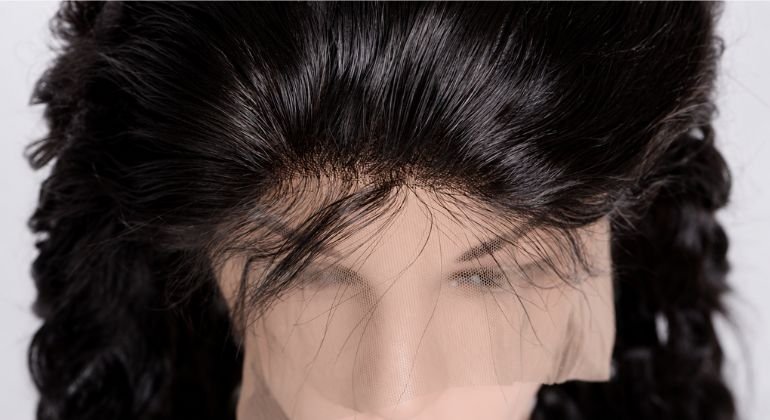
Three habits handle it. Twist the bottom section into a loose low braid when you will be seated for a long stretch, driving, or wearing a coat. Keep the length in front of your shoulders when you sit back in a chair. And check that zone first at your midday comb-out, because a knot caught at 1pm takes ten seconds and the same knot at 9pm takes ten minutes.
Length compounds this. A 24-inch unit gives the nape zone more weight and more travel than a bob does, so long full lace wigs need the braid habit more than short ones. The same friction logic applies to your own hairline: for the tension side of the problem, see our guide on protecting your edges when wearing wigs.
Wash day: the step most people get backwards
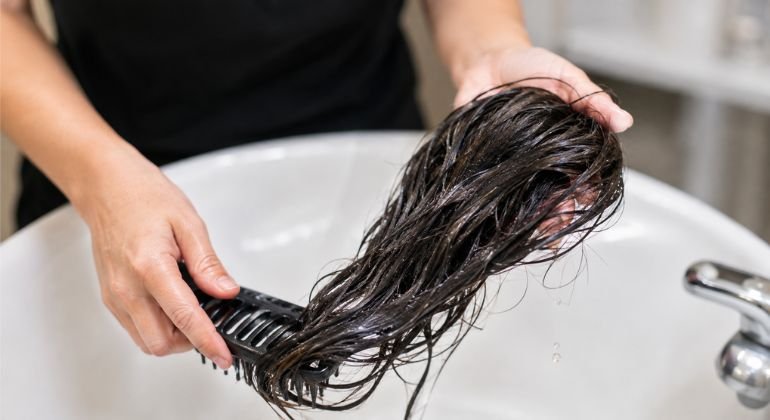
Most tangle damage happens during washing, not during wear. Wet hair swells, softens, and loses tensile strength, which makes it the worst possible moment for a dense brush. The American Academy of Dermatology’s guidance for healthy hair is to detangle wet hair with a wide-tooth comb, starting at the ends and working higher, and to blot with a towel or t-shirt rather than rubbing.
Apply that to a wig with three adjustments. Detangle the unit dry before it touches water, because water turns existing knots into tighter knots. Wash in one direction, stroking downward through the length instead of piling the hair on top of itself and scrubbing. And finish with a cool rinse, which helps the cuticle lie flatter than a hot rinse does.
Conditioner, leave-in, and what each one actually does
Rinse-out conditioner works by depositing positively charged ingredients onto hair, which carries a negative charge when it is damaged. That deposit lowers the friction between strands. Leave-in conditioner uses different chemistry designed to stay on the fiber. AAD dermatologists Zoe Draelos and Paradi Mirmirani both warn that the two are not interchangeable: rinse-out formulas often contain detergent, and leaving one on the hair can damage it. Diluting rinse-out conditioner in a spray bottle, a habit that circulates on social media, does more harm than good.
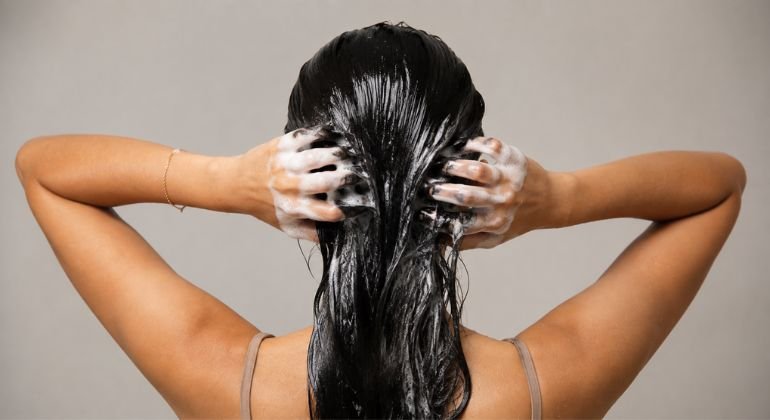
Their application guidance transfers to wigs cleanly. Apply leave-in to damp hair rather than dripping or dry, work it from mid-strand to ends, and keep it off the cap. Product that collects at the base turns tacky, and tacky roots are where the worst matting starts.
Water quality is an underrated variable
If your wig started tangling after you moved house or traveled, look at your water. Evidence on hard water and hair is genuinely mixed: a 2013 International Journal of Trichology study found no significant difference in tensile strength or elasticity between hair treated with hard water and distilled water, while a 2018 study in the same journal measured a statistically significant drop in tensile strength after hard-water treatment. What both camps agree on is deposition. Calcium and magnesium leave a film on the shaft, and a rougher shaft catches on its neighbors.
A chelating or clarifying shampoo every fourth or fifth wash removes those deposits along with product buildup. If your water is hard, a final rinse with filtered or bottled water costs pennies and is the single cheapest fix on this page.
How to detangle a wig that is already knotted
Do not start with a brush, and do not start dry.
- Lay the wig flat or mount it on a stand. Detangling a wig while it is on your head means you cannot see the knot and you pull against the cap.
- Saturate the tangled section with conditioner. Give it 20 to 30 minutes. Conditioner is doing the work here; your hands are only guiding it.
- Separate with your fingers first. Split the knot into two or three smaller knots. Repeat until the pieces are small enough that a comb will pass through.
- Comb the last two inches only. When the comb glides through that band, move up two inches and repeat.
- Hold above the knot every time. Anchoring the section means your hand absorbs the tension instead of the wefts.
- Rinse cool and air dry on a stand. Heat drying a freshly detangled unit re-roughens the surface you spent 30 minutes smoothing.
Budget half an hour for a badly tangled unit and stop when your patience runs out rather than forcing it. Forced detangling is how tangling becomes shedding.
What makes a wig tangle resistant before you buy it
Care technique has a ceiling, and that ceiling is set by how the hair was collected and processed. This is the part reseller blogs skip, because most of them never see the factory floor.
Cuticle alignment is the variable that matters most. Hair collected as a single ponytail from one donor keeps every strand running the same direction, so the scales lie flat against each other and slide. Hair collected loose from salon floors or brushes gets bundled with strands pointing both ways. Sew that into a weft and you have built friction into the product: half the strands are permanently running against the grain of their neighbors. It will comb out, and it will re-tangle faster each time.
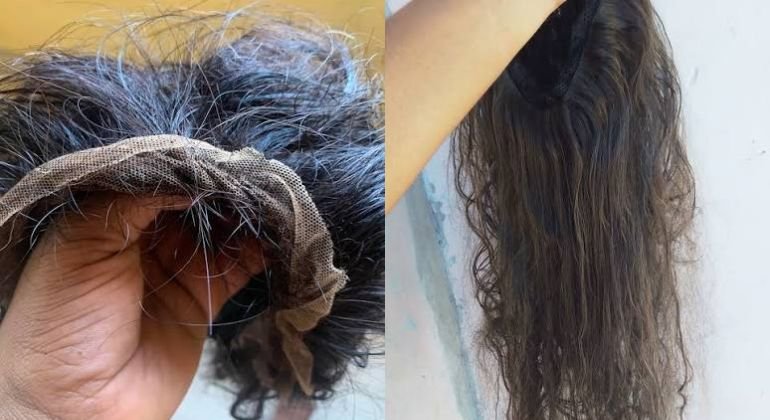
The second variable is processing. Stripping the cuticle with acid and coating the shaft in silicone produces hair that feels extraordinary in the package and for the first several washes. Once that coating rinses away, the bare cortex has no scale structure to keep strands apart, and the unit mats. A wig that was perfect for a month and then failed suddenly is usually this, not a care mistake.
How construction predicts tangle resistance
| Hair type | Cuticle status | Typical tangle onset | What happens over time |
| Cuticle-aligned single-donor human hair | Intact, all strands one direction | Slow, and reversible with a comb-out | Slip fades gradually; conditioning restores most of it |
| Mixed-batch hair sold as Remy | Intact but strands run both directions | Within weeks at the nape | Scales interlock; tangles return faster after each detangle |
| Acid-stripped and silicone-coated hair | Cuticle removed, silicone film applied | Excellent for 3 to 6 washes, then sudden | Once the coating rinses off, the bare shaft mats quickly |
| Synthetic fiber | No cuticle at all | Fast at friction points | Static plus heat from friction can fuse strands permanently |
Two questions separate a real answer from a sales script. Ask whether the hair is single-donor or mixed-batch, and ask whether the cuticle is intact or the hair has been acid-processed. A manufacturer can answer both. A reseller often cannot, because the hair passed through two or three hands before reaching them.
Demand for human hair keeps rising, which pulls more mixed-batch product into the market alongside the good stuff. Grand View Research valued the global wigs and extensions market at roughly USD 15.2 billion in 2025, with human hair holding about 65.6% of it and North America accounting for close to 40% of global revenue. In a market growing that fast, sourcing questions are the buyer’s only real filter.
Our one-donor bulk hair and weft hair lines are built around cuticle-aligned collection for exactly this reason. Wig makers who want to keep tangling out of the finished unit start upstream of the cap.
Five habits that guarantee tangles
- Combing from the roots down. One stroke gathers every small knot into one large one.
- Rubbing the wig dry with a bath towel. Terry loops grab lifted scales. Blot with a microfiber towel or an old t-shirt.
- Storing the wig folded in a drawer. Compression plus movement equals felting. Use a stand or a satin bag.
- Using more product to fix the problem product created. Buildup causes tangling. Adding oil on top of buildup accelerates it.
- Heat styling a dry, unconditioned unit. Heat on an unlubricated fiber roughens the surface that is already the problem. This also strips tone, which we cover in keeping wig color from fading.
Chlorine and salt water deserve their own mention. Both dehydrate the fiber and leave deposits, and both are avoidable with a pre-swim soak. Our guide to swimming with hair extensions covers the routine.
Frequently asked questions
Why does my wig tangle so fast at the nape?
The nape sits where the wig meets your collar, coat, and chair back, and it holds heat and sweat. Constant rubbing lifts the cuticle scales, and lifted scales interlock with each other. Braid or tuck that section whenever you will be seated or bundled up for more than an hour.
How to keep a wig from tangling overnight?
Comb the wig out before bed, braid the length loosely, and store it on a wig stand in a satin bag. If you sleep in your unit, wear a satin bonnet or swap to a satin pillowcase. Cotton wicks moisture out of the fiber and grips it while you turn.
How often should I wash a wig to stop it tangling?
Wash every 7 to 10 wears for daily wear, or every 3 to 4 wears if you use heavy product, exercise in it, or live somewhere humid. Washing too often strips slip. Washing too rarely lets product residue glue neighboring strands together.
Can a matted wig be saved?
Sometimes. Soak the matted section in conditioner for 20 to 30 minutes, then separate it a few strands at a time with your fingers, working from the ends. If the fiber has felted into a solid pad that will not open under conditioner, a stylist trim is the realistic outcome.
Do human hair wigs tangle less than synthetic wigs?
Cuticle-aligned human hair tangles less because every strand runs root-to-tip in the same direction, so the scales lie flat against each other. Synthetic fiber has no cuticle, but it generates static and melts under friction, which fuses strands into knots that will not comb out.
Does apple cider vinegar or fabric softener fix wig tangles?
A diluted vinegar rinse can lift mineral and product buildup, which helps. Fabric softener does not. It coats the fiber with a film that feels smooth for a day, attracts dust, and leaves the hair harder to detangle once it builds up over several wears.
Talk to the factory, not the middleman
If your unit tangles no matter how carefully you care for it, the problem is upstream of your routine. Thanh An Hair has manufactured cuticle-aligned, single-donor raw Vietnamese hair for roughly twenty years, and we sell factory-direct to salons, wig makers, and resellers worldwide.
Request a sample and our wholesale price list and check the cuticle direction yourself before you commit to an order.
Ready to find your perfect match? Contact us today for expert advice and exclusive discounts on premium human hair extensions.
📲Phone/WhatsApp: +1 (206) 698‑5133
🛜Instagram: RAW HAIR LUXURY COMPANY
🌐Tik Tok: RAW HAIR LUXURY
📧 Email: Rawhairluxury.us
🌐Website: rawhairluxury.com