
Thanh An Hair
How to Protect Edges When Wearing Wigs?
Aug
How To protect edges when wearing wigs, keep tension off the hairline itself. Braid your hair down loosely with the front row set back from your edges, wear a satin or silk-lined cap instead of cotton or nylon, secure the unit with an adjustable band rather than glue or front combs, and take the wig off at night.
We have manufactured wigs in Vietnam for two decades. The units that come back to our factory with stretched bands and worn elastic tell a consistent story, and it is not the one most blogs tell. The wig is rarely what damages a hairline. The braid pattern underneath, the adhesive at the front, and the way it comes off at night carry most of the blame.
Wigs Are the Low-Risk Option. What Goes Under Them Is Not.
One finding reframes this whole topic. When dermatologists rank styling practices by traction risk, wigs land at the bottom of the list alongside natural hair and loose styles. A prevention review in the International Journal of Women’s Dermatology puts tight buns, sewn-in weaves, cornrows and locs at the high-risk end and groups wigs with the gentlest options available.

So why do so many wearers watch their hairline thin anyway? The wig arrives with a supporting cast. Johns Hopkins researchers reviewing styling practices among Black women reported that cotton and nylon caps rubbing the hairline can harm follicles, and that units held down with clips and adhesives can cause significant breakage. The American Academy of Dermatology adds that rubbing from any head covering can lead to traction alopecia, particularly when the hair underneath has been pulled back tightly first. The covering contributes. The tight pull underneath does the real damage.
The Five Pressure Points That Damage Your Hairline
Every wig install creates a small number of places where force concentrates. Find yours in this table, then change that one thing.
| Pressure point | What it does to the follicle | Risk | Lower-risk swap |
| Cornrows started on the edge | Anchors the entire braid weight at the finest, shallowest follicles on your head | High | Start the front row 1 cm back; feed in extension hair gradually |
| Lace adhesive on skin | Bonds to the stratum corneum and to any baby hairs it touches; pulls both at removal | High | Glueless unit with an elastic band or a velvet grip |
| Cotton or nylon cap edge | Abrades baby hairs with every head turn and wicks moisture out of the hair it contacts | Medium | Satin or silk-lined cap, front edge rolled behind the hairline |
| Front combs on the cap | Concentrates point pressure at the temples, the second most common site of traction loss | Medium | Remove front combs; rely on the adjustable band at the nape |
| Oversized or heavy unit | Slides through the day, generating friction, and loads the cap perimeter unevenly | Medium | Correct circumference; request the unit weight in grams before ordering |
How to Protect Edges When Wearing Wigs: The Seven-Step Routine
Work through these in order. Steps three and seven prevent more damage than the other five combined.
- Measure before you buy. Take a tape around your head at the hairline, above the ears, and around the nape. A cap half an inch too small pulls its elastic into your temples every hour you wear it.
- Clean and condition the hairline first. Wash and moisturise your edges the night before an install, then massage a light oil into the hairline. Dry baby hairs snap under a fraction of the force healthy ones survive.
- Braid down loosely, starting behind the edges. Set the front row of cornrows about one centimetre back from your hairline and leave the baby hairs out. A braid anchors its entire weight at the first few follicles it grips.
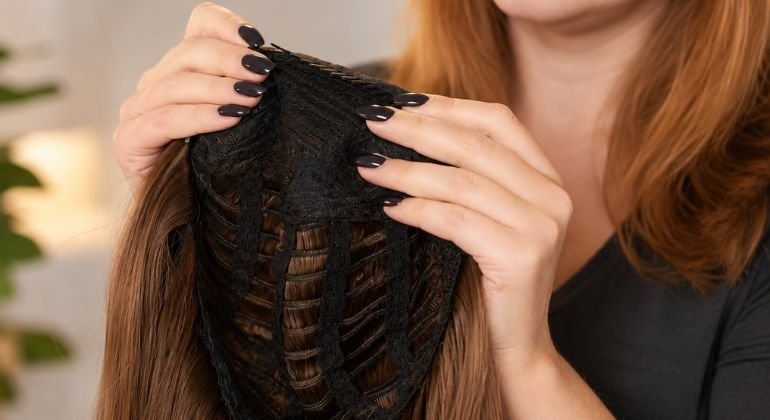
- Choose a satin or silk-lined cap. Roll the front edge back so it sits behind your hairline rather than across it. Skip cotton and nylon, which drag on baby hairs every time you turn your head.
- Secure with a band or grip, not combs. Position an adjustable band or velvet grip behind the hairline, and take out any front combs that bite into your temples. Nothing anchoring the wig should sit on the edges.
- Cap your wear time and sleep without it. Take the wig off at night. Overnight friction between cap and hairline compounds across weeks, and your scalp needs the airflow.
- Remove with a solvent, never by peeling. Saturate the lace with adhesive remover or oil, wait for the bond to soften, then lift from behind the ear forward. Wash out every trace of residue afterwards.
Choosing a Wig Cap Material That Will Not Sand Your Hairline
Cap material decides how much friction your edges absorb across a ten-hour day. Satin and silk-lined caps let hair slide instead of catching, and bamboo blends behave similarly while breathing better in heat. Mesh ventilates well, though an open weave can snag baby hairs, so check the edge finish before buying. Avoid cotton, which grabs and pulls moisture from the hair pressed against it. Nylon shares the friction problem without the absorbency.
Whatever you choose, roll the front edge back a few millimetres and pin it at the crown. Our wig cap range is stocked with this in mind.
What a Wig Factory Checks That a Reseller Never Mentions
Four specifications affect your hairline directly. Resellers rarely publish any of them, because they do not hold the production data. Ask anyway, and ask before you pay.

- Finished unit weight in grams. Weight loads the cap perimeter, and the perimeter includes your hairline. A high-density unit carries far more hair than a modest one at identical length. A factory can pull the figure off the QC sheet in minutes.
- Cap circumference against your measurement. An undersized cap keeps its elastic under permanent stretch, and that stretch presses on the temples every waking hour. Half an inch of error is enough to feel by evening.
- Band elasticity and recovery. Cheap elastic loses recovery within weeks, and the usual response is to tighten the adjuster. Each notch adds tension exactly where you can least afford it.
- Knot bleaching depth. Over-bleached knots weaken and shed, and shedding at the hairline pushes wearers toward more adhesive to hold the illusion together. That is how a factory quality problem becomes a dermatological one on your scalp.
We build our wig units from single-donor raw Vietnamese hair with the cuticle aligned in one direction, which keeps density honest: aligned hair reads as full at a lower weight than processed hair does. Our full lace and closure wig lines ship with knot and density specifications on request.
Early Signs Your Edges Are in Trouble
Traction alopecia moves through two phases. In the early phase the follicle is inflamed but intact, and hair returns once the tension stops. In the chronic phase, scar tissue replaces the follicle and no product on the market brings it back. The StatPearls clinical reference describes this biphasic pattern and lists perifollicular redness, hair casts, broken hairs and reduced density as the early markers.

The AAD tells patients to watch for broken hairs along the forehead, a hairline creeping backward, patches where the pull is tightest, stinging or pain, crusts, and a scalp that looks raised or tented. Dermatologists also look for the fringe sign: a standing band of short fine hairs at the very front margin while the hair behind it thins. In the study that named it, the fringe sign appeared in every patient whose traction involved the marginal hairline.
Any of these signs means the same thing. Stop the style and see a board-certified dermatologist. South African population data puts traction alopecia at up to 31.7% of adult women surveyed, which shows how quietly it progresses when nobody names it.
Taking the Wig Off Without Taking Your Edges With It
Removal causes damage that install gets blamed for. Four corrections to advice that circulates widely:
Skip the rubbing alcohol. Alcohol dissolves some adhesives, and it also strips the scalp barrier and dries out the baby hairs you are trying to protect. Use a purpose-made remover, or warm oil if you have nothing else.
Wait for the bond to release. Saturate the lace and give it several minutes. Most edge damage happens in the thirty seconds someone spends pulling on a bond that has not softened.
Patch test any new adhesive. A systematic review of scalp contact allergens in the journal Dermatitis lists wig adhesives among the documented causes, with acrylates showing up on patch testing. Apply a small amount to your inner forearm, cover it, and leave it three days before it goes near your hairline.
Clarify afterwards. Residue traps dirt and stiffens the hair it clings to. Wash it out, then moisturise the hairline while the scalp is damp.
If your edges need a real break, rotate to something that touches them less. Halo extensions sit on a wire behind the crown and skip the hairline entirely. Our guide on what to know before getting hair extensions applies the same tension logic across attachment methods.
Frequently Asked Questions
Can wearing a wig every day cause hair loss?
Daily wear does not cause hair loss on its own. Dermatology reviews of styling practices place wigs among the lowest-risk options for traction. The risk sits underneath: tight braids anchored on the hairline, adhesive on skin, a cap that rubs, and rough removal.
Are glueless wigs really better for your edges?
For most wearers, yes. A glueless unit moves the load to an elastic band you can position behind the hairline and removes adhesive contact with skin. Wig adhesives are a documented cause of scalp contact dermatitis, with acrylates showing up in patch testing.
What wig cap material protects edges best?
Satin and silk-lined caps cause the least friction. Johns Hopkins researchers flagged cotton and nylon caps rubbing the hairline as a source of follicle damage, and cotton also draws moisture from the hair it touches. Mesh breathes well but can snag baby hairs.
How do I know if my edges are already damaged?
The AAD lists broken hairs along the forehead, a receding hairline, bumps or crusts, stinging, and a tented scalp as early signs. Dermatologists also look for the fringe sign, a band of short fine hairs standing at the front while the hair behind it thins.
Do damaged edges from wigs grow back?
Early traction alopecia is reversible. It runs in two phases: a non-scarring stage where follicles recover once tension stops, and a chronic stage where scar tissue replaces the follicle. The dividing line is time under tension, not any product you apply.
How much should a wig weigh to protect edges when wearing wigs long term?
Ask your supplier for the finished unit weight in grams and compare it to the density you ordered. A 250% density unit carries far more hair than a 130% unit at the same length, and that weight loads the cap perimeter, hairline included. Most sellers never publish it.
Source Wigs From the Factory Floor
Thanh An Hair has manufactured raw Vietnamese hair units for twenty years and supplies salons, stylists and resellers factory-direct. We publish unit weights, cap measurements and knot specifications on request, because the stylists installing our wigs need those numbers to protect their clients’ hairlines. Contact our team for a wholesale catalogue and a spec sheet.
Ready to find your perfect match? Contact us today for expert advice and exclusive discounts on premium human hair extensions.
📲Phone/WhatsApp: +1 (206) 698‑5133
🛜Instagram: RAW HAIR LUXURY COMPANY
🌐Tik Tok: RAW HAIR LUXURY
📧 Email: Rawhairluxury.us
🌐Website: rawhairluxury.com