Raw Vietnamese Hair
How To Restore Hair Extensions After a Holiday
Jul
How to restore hair extensions after a holiday, clarify or chelate out the chlorine, salt and mineral buildup, deep condition the mid-lengths and ends, then air dry flat and store them dry. Because human hair extensions have no living cells, you cannot heal them, so restoration means stripping the damage away and resurfacing the fiber.
Two weeks of sun, saltwater and poolside lounging treat your extensions very differently from how they treat the hair growing out of your head. Your own hair receives sebum, blood supply and a living follicle that repairs and replaces it. An extension receives none of that. It is a finished fiber, so every bit of damage it collects on holiday stays until you physically remove it or cut it off. That single fact changes the whole recovery plan, and it is the part most guides skip.
This guide comes from a raw-hair manufacturer rather than a reseller, so it starts with what is actually happening inside the strand, then gives you a fiber-first routine that works across clip-ins, tape-ins, keratin bonds, wefts and raw single-donor hair. The global hair wigs and extensions market was valued at roughly USD 15.2 billion in 2025, with human hair prized for its longer usable life, according to Grand View Research. Getting recovery right is what protects that investment.
The 60-second recovery plan
- Detangle dry, ends first, before water touches the hair.
- Chelate, do not just clarify, to lift copper and hard-water minerals.
- Deep condition the mid-lengths and ends for 10 to 20 minutes.
- Rinse cool and blot, then air dry flat; skip the heat.
- Store bone dry, and trim or replace anything that snaps when wet.
Why hair extensions cannot heal themselves
A strand of hair, whether on your head or in a weft, is a cornified fiber made almost entirely of dead, keratin-rich cells, as the peer-reviewed literature on hair structure sets out (National Library of Medicine). There is no living tissue in the shaft to knit itself back together. On your scalp, that does not matter much, because the follicle keeps pushing out fresh hair and your scalp oils keep coating it. Cut that strand off, attach it as an extension, and the supply line is gone.
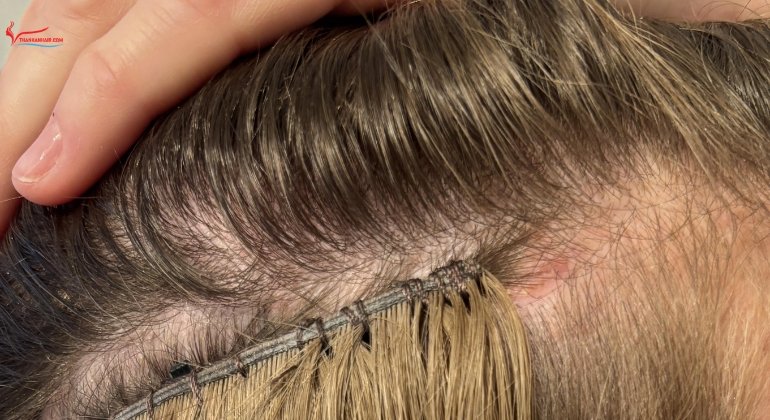
So when a product promises to “repair” your extensions, read it as resurface. The outer cuticle is a set of overlapping scales, and its smooth, ordered surface is what reflects light as gloss; once those scales lift or erode, light scatters and the hair looks dull. Sitting on top of the cuticle is a hydrophobic lipid layer built around 18-methyleicosanoic acid, known as 18-MEA, which gives healthy hair its slip and water resistance. Alkaline and oxidative damage strip that layer away, leaving a rough, thirsty, high-friction surface, which is exactly the “dry and straw-like” feeling you notice after a holiday (Hair Cosmetics: An Overview, NIH).
Restoration, then, is a two-part job: take off what the holiday added (minerals, copper, salt, oxidised residue), and put back what it stripped (moisture, slip, a smooth surface). You are not undoing the damage at a molecular level. You are cleaning the fiber and re-coating it so it looks and behaves like healthy hair again. Everything below follows from that.
What a holiday actually does to your extensions
“Sun, sea and sand” is not one problem, it is four, and each one calls for a different fix. Lumping them together is why generic aftercare advice underperforms. Here is what each exposure does at the fiber level, and the tool that genuinely addresses it.
| Holiday exposure | What happens inside the fiber | What you see | What actually fixes it |
| UV / sun | UVB breaks keratin disulphide bonds while UVA oxidises melanin and peroxidises the surface lipids | Color fade, brassiness, dryness, brittle ends | Deep conditioning, a trim, and UV or antioxidant protection next time |
| Chlorine + copper | Chlorine oxidises dissolved copper, which bonds to keratin; oxidised hair absorbs even more | Green or khaki cast, worst on blonde; harsh texture | A chelating shampoo (EDTA), then heavy moisture |
| Saltwater | Salt draws water out of the strand by osmosis and dries as crystals that roughen the cuticle | Crunchy, matte, tangled, dehydrated hair | Rinse fast, clarify, then deep condition to rehydrate |
| Hard water | Calcium, magnesium and iron deposit as a film that blocks moisture from entering | Dull, heavy, stiff hair; products stop working | A chelating shampoo; clarifying alone will not shift minerals |
Sun damage is the one people underestimate, because it works quietly. UV radiation degrades hair proteins and pigment through free-radical reactions, and the cuticle takes the worst of it because the outer layers absorb the highest dose (Photodamage determination of human hair, PubMed). By the time the color looks brassy, the structural weakening is already done. That is also why a few of the habits in our roundup of things to stop doing to your hair matter double for extensions.
How to restore hair extensions after a holiday, step by step
Work through these five steps in order. The sequence matters: detangle before you wet, strip before you condition, and dry before you store. Rushing any stage is where extensions get wrecked.
- Detangle dry, from the ends up
Before any water touches the hair, loosen knots with your fingers, then work a loop brush or wide-tooth comb from the ends up toward the roots. Salt and chlorine stiffen the fiber, so dragging a brush from the top down forces those hardened knots through the cuticle and snaps strands. Hold the weft or bond in one hand to take the tension off the attachment point. - Chelate or clarify out the buildup
If you swam in a chlorinated pool or the sea, or you live with hard water, reach for a chelating shampoo that lists EDTA, EDDS, citric acid or phytic acid. A standard clarifying shampoo lifts oil and product with surfactants, but surfactants cannot bind the copper and calcium ions that cause green tints and dullness. Massage through, leave for a minute, and rinse until the water runs clear. - Deep condition the mid-lengths and ends
Apply a rich mask or deep conditioner from roughly ear level down, keeping it off the wefts, tapes and keratin bonds so the attachments stay secure. Leave it on for 10 to 20 minutes. The mask smooths the hair because it is acidic and coats the fiber, not because of any temperature trick, so the timing and the product matter far more than a cold rinse. - Rinse cool, then blot instead of rubbing
Rinse with cool or lukewarm water. Cool water is gentler on color and bonds than a hot shower, but it does not seal the cuticle, so do not rely on an icy blast for shine. Press the water out with a microfibre towel or an old cotton t-shirt. Never wring, twist or scrub, which lifts the cuticle and creates permanent frizz. - Air dry flat, then store completely dry
Lay clip-ins and halo pieces flat on a towel or hang them on a holder away from direct sun and radiators. For bonded, taped or sewn-in hair, make sure the root and attachment dry fully. Store the extensions only when they are bone dry, in a breathable bag or their original box, to stop mildew and odor forming at the weft.
Chelating vs clarifying shampoo: which one you actually need
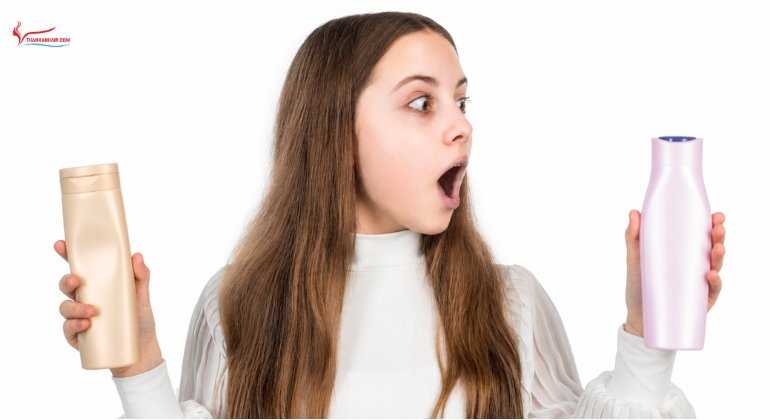
This is the correction that decides whether your recovery works. A clarifying shampoo uses strong surfactants to dissolve oil, sweat and product buildup. A chelating shampoo does that too, but it also contains binding agents such as EDTA, EDDS, citric acid or phytic acid that grab onto metal and mineral ions and rinse them away. Surfactants, however powerful, simply cannot lift calcium, magnesium or copper off the shaft. So if your problem is chlorine, hard water or a green tint, a clarifying shampoo will leave the actual cause sitting in your hair. Use a chelating formula for the post-holiday reset, then return to gentle sulphate-free washing day to day.
The cold-water cuticle myth (finish acidic, not icy)
You will read everywhere, including on competitor guides, that you should finish with a cold splash to “seal the cuticle.” It is a myth. The cuticle is dead keratin with no muscle to open or close, so it has no temperature switch. When researchers at TRI Princeton rinsed hair above and below body temperature and measured shine, the cold rinses did nothing, and warm water was actually slightly glossier. What genuinely flattens the cuticle is an acidic pH, which is why conditioners, masks and toners are formulated on the acid side of neutral. Cool water is still worth using because it is gentler on color and on keratin bonds than a hot shower, but the shine comes from your acidic mask, not from the chill.
How to remove a green tint from blonde extensions
Green hair after the pool is medically described as chlorotrichosis, and it is caused by insoluble copper deposits in light hair, not by chlorine itself (Pseudo Green Hair, NIH). The fix follows directly from the cause: use a chelating shampoo, because the EDTA in it binds the copper and pulls it out of the fiber. One or two focused washes usually lift most of the tint, and a purple toning shampoo afterward can neutralise any remaining warmth on blonde. Skip the ketchup and tomato-sauce hacks doing the rounds online; there is no real evidence the red pigment cancels the green, and the acids can further dry already-stressed hair. Because bleached and porous extensions soak up more copper, an intact, aligned cuticle is your best defence, which is where the hair you buy makes a real difference.
Restoration by extension type
How you run the routine depends on how the hair is attached. Clip-ins and halos come off, so you can treat them properly in a basin. Bonded, taped and sewn-in hair has to be treated on the head, which limits how much product you can use near the roots. Match your method to your set.
| Extension type | Remove to treat? | Best restoration approach | Watch out for |
| Clip-in | Yes, fully | Detach, wash and deep condition off-head, lay flat to dry | Never sleep or swim in them; do not scrub the wefts |
| Halo | Yes, fully | Treat off-head on a holder, same as clip-ins | Keep the wire dry and uncreased while it dries |
| Tape-in | No, worn continuously | Treat on-head; keep mask and oil well below the bonds | Oils and heavy masks near the tape loosen the adhesive |
| Keratin tip (I, U, K, flat) | No, bonded | Treat on-head; condition lengths only; low heat | Sun and chlorine weaken keratin bonds, so rinse fast |
| Weft (hand-tied / machine) | Sew-ins stay in | Treat as installed; dry the wefts through completely | Trapped moisture at the weft can mildew or smell |
| Raw single-donor | Depends on install | Responds best; cuticle runs one way and stays intact | Still not self-healing; protect the cuticle you paid for |
Drying is where recovery is quietly won or lost, whatever the attachment. Wet hair is at its most fragile, and heat compounds the damage a holiday already caused, so our full walkthrough on how to dry hair extensions without heat damage is worth reading alongside this. If you wear a halo and want to restyle after recovery, the same low-heat logic runs through curling halo extensions like a pro.
When restoration will not work: the honest replacement test
A manufacturer will tell you what a reseller often will not: sometimes the hair is past saving, and no mask will change that. Because the fiber cannot rebuild itself, structural damage is permanent. Run this quick test before you spend on more products. Take a single wet strand and stretch it gently. Healthy hair stretches a little and springs back. If it stretches like chewing gum and stays limp, the keratin bonds inside have broken down. Look for mid-shaft splits rather than just split ends, and feel for a spongy, mushy texture when the hair is wet. If you see those signs across the set, the kind thing to do for your look is to retire that hair and start fresh. Choosing better hair the second time, covered in our guide to buying hair extensions, is what stops you repeating the cycle.
How to protect your extensions on the next holiday
Recovery is easier when there is less to recover from. Prevention costs almost nothing and doubles the useful life of a set.
- Wet the hair with clean water before you swim. Saturated hair absorbs far less chlorinated or salt water, because the fiber can only hold so much; it is the simplest barrier there is.
- Rinse immediately after the pool or sea. The longer copper, salt and minerals sit, the deeper they set. A quick fresh-water rinse at the poolside does most of the work.
- Braid it or tie it up. A loose braid or bun cuts tangling and friction and keeps ends out of the sun and off your salt-damp shoulders.
- Add a leave-in barrier. A leave-in conditioner or light oil coats the cuticle so there is less room for minerals to bind. The American Academy of Dermatology notes leave-in conditioner is safe to keep in the hair between washes.
- Shield from UV. A hat or UV-protective spray limits the photo-oxidation that fades color and weakens the strand in the first place.
The bottom line
Restoring hair extensions after a holiday is not about healing the hair, because a finished fiber cannot heal. It is about removing what the sun, salt and pool left behind, then re-coating the strand so it looks and moves like healthy hair again. Chelate before you clarify, condition on the acid side rather than chasing an icy rinse, dry flat and slow, and be honest about hair that is genuinely spent. Do that, and a good set keeps looking expensive for far longer.
The single biggest lever, though, is the hair you start with. Raw, single-donor hair with a cuticle that all runs one direction resists copper, holds gloss and survives recovery in a way that heavily processed, mixed-cuticle hair never will. Thanh An Hair has manufactured exactly that kind of cuticle-aligned raw Vietnamese hair for two decades, factory-direct to salons and wholesale buyers worldwide.
Sourcing hair your clients can actually recover after summer? Talk to Thanh An Hair about a wholesale sample and feel the difference an intact, aligned cuticle makes.
Contact Thanh An Hair today for expert consultation and the most competitive price list.
- WhatsApp/Hotline: (+84) 973 522 855
- Official Website: https://thanhanhair.com/
- Instagram: @thanhanhair
- Email: thanhanexport@gmail.com