
Thanh An Hair
How to Get a High Contrast Hair Look With Hair Extensions (2026 Guide)
Jul
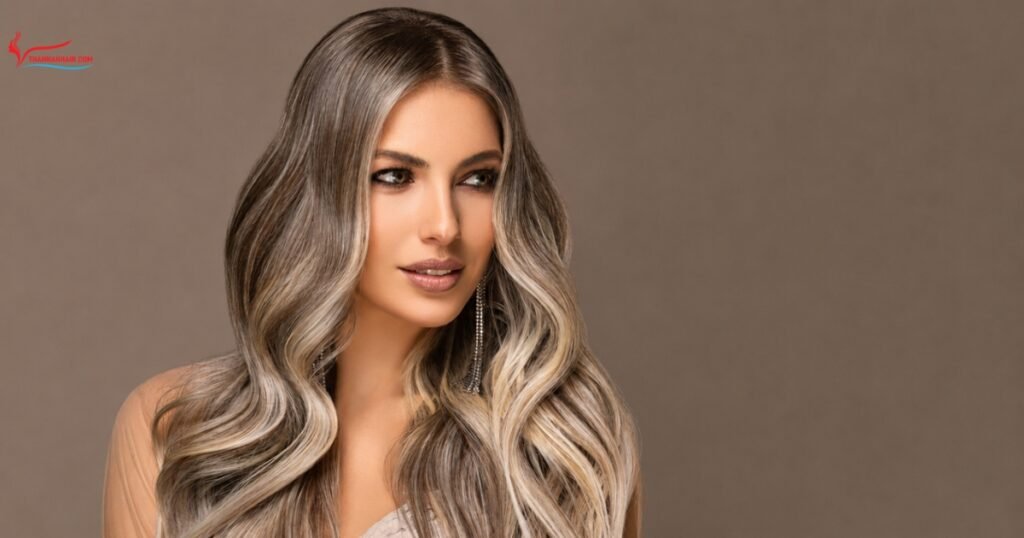
To get a high contrast hair look with hair extensions, add pre lightened or vividly colored strands that sit at least three shades away from your base color, then ribbon them through the mid lengths and ends. Hair extensions deliver the multi tonal contrast instantly, with no bleach and no damage to your own hair.
Subtle balayage owned the last decade. High contrast hair owns this one. Chunky highlights, split dye, and two tone colors are everywhere again, rebuilt with a sharper, more deliberate edge. The catch is that the boldest versions of the look usually depend on lightening hair to platinum or silver, and that is exactly where hair gets damaged. Extensions solve the problem. This guide covers the color science behind contrast, the fastest way to fake it without bleach, and how to place the pieces like a colorist.
What Is High Contrast Hair?
High contrast hair pairs two or more tones separated by a wide gap on the hair color level scale. Colorists rate depth from level 1, which is black, to level 10, the lightest blonde. Contrast is simply the distance between the tones you combine. Shades one or two levels apart give soft, low contrast dimension. Shades three or more levels apart, or opposite ends of the scale, give the bold, graphic effect people mean by high contrast hair color.
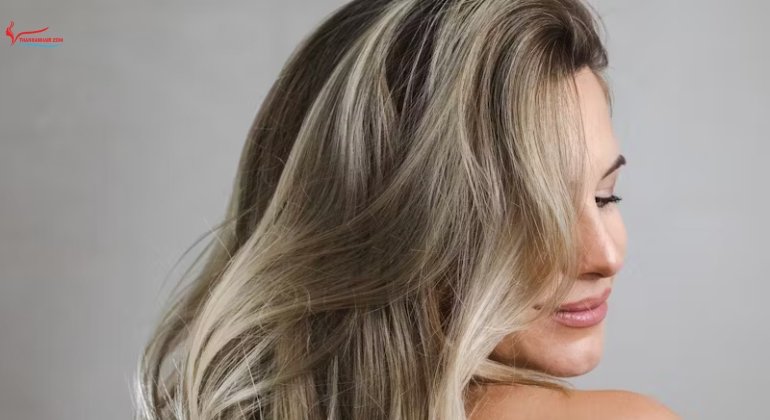
That level gap is why the trend is so striking, and why it is tricky to do safely on your own hair. The American Academy of Dermatology recommends staying within three shades of your natural color and going darker rather than lighter, because the further you push, the more the hair suffers. High contrast dimensional hair color deliberately breaks that rule. Extensions are how you break it without breaking your hair.
Why Extensions Beat Bleach for High Contrast Color
The pieces that create the contrast are almost always pre lightened. To reach clean platinum, silver, or a true pastel, hair has to be lifted several levels, and the lift is where the damage lives. Research on bleached hair fibers shows that oxidation decomposes the melanin and breaks the disulfide bonds in keratin, so the cuticle scales separate and the cortex turns porous and weak (Applied Microscopy, 2024). The AAD says it plainly: the lighter you go, the more damage you do.
Damage is only half the story. Shine is the other half. An intact cuticle is what keeps the hair surface smooth and glossy; once bleaching lifts and fractures those scales, light scatters instead of reflecting and the hair looks dull (Annals of Dermatology review, 2023). That is the paradox of do it yourself high contrast hair: the same lift that creates the bright tone strips the gloss that makes the look read as expensive. Hair strength also depends on cuticle integrity, and chemical damage raises fiber friction until strands tangle and snap (Hair Cosmetics: An Overview, PMC).
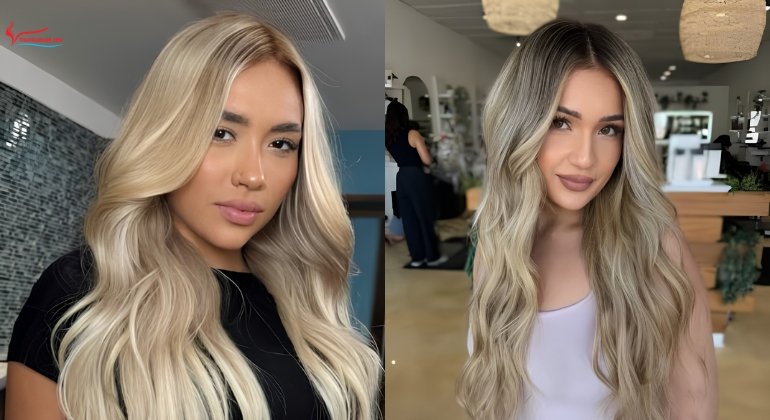
Extensions move the color onto separate strands. Your own hair keeps its cuticle. The bright pieces can be swapped when they fade, and a quality human hair weft holds tone and gloss far longer than bleached native hair.
This is where the source of the hair matters more than the color chart. We manufacture raw, single donor hair, and on the production floor the pattern is consistent: contrast only reads as premium when every strand runs in the same cuticle direction and lifts evenly. Hair gathered from mixed sources and stripped in an acid bath to hide tangling loses that alignment, and no toner brings the shine back. If you want the glossy two tone finish, the light pieces have to start from healthy, aligned hair, not just the right shade.
Four Ways to Get a High Contrast Hair Look
You can reach high contrast hair by lightening your own strands, by clipping in colored pieces, by wearing semi permanent installed extensions, or with a short lived dye. They differ most in damage, cost, and how easily you can undo them.
| Method | Damage to your hair | Reversible? | Upfront cost | How long it lasts | Best for |
| Bleaching and coloring your own hair | High: lifts and fractures the cuticle | No, grows out over months | Medium to high (salon) | Regrowth shows in 3 to 5 weeks | A committed change you will maintain |
| Colored clip in extensions | None | Yes, remove any time | Low to medium | Reusable for months to years with care | Trying the look, events, weekend switches |
| Colored tape in or weft extensions | Minimal: no lift to your own hair | Yes, removed by a stylist | Medium | 6 to 10 weeks per install; hair reusable | Consistent contrast, less daily effort |
| Semi permanent dye on your hair | Low to moderate: bright tones on dark hair still need lift | Fades over weeks | Low | 4 to 8 washes | Subtle, short lived color on lighter bases |
Choosing the Right Contrasting Hair Extensions
The best extension type depends on how bold you want the contrast and how long you want it to stay. Low commitment looks favor clip ins; everyday contrast favors tape, weft, or bonded methods. Match the attachment to the effect you are after.
- Clip in extensions: the fastest way to test high contrast hair. Pop in a few platinum or pastel pieces for the weekend, add a money piece, or build chunky ribbons, then take them out at night.
- Tape in extensions: thin, flat wefts that sit close to the head for seamless two tone color and hidden panels of a contrasting shade.
- Weft and sew in extensions: sewn to a braided base for full head density, ideal for a bold split dye or wall to wall contrast.
- Keratin and nano tip extensions: individual bonded strands that let a colorist place fine streaks exactly where the contrast should fall.
- Halo extensions: a single wire set piece that adds a one step dip dye or ombre effect in seconds.
| Extension type | How it attaches | Commitment | Best contrast style |
| Clip in | Snap in wefts, no tools | Minutes, fully temporary | Money piece, chunky ribbons, festival streaks |
| Tape in | Thin adhesive wefts | 6 to 8 weeks | Seamless two tone, hidden color panels |
| Weft (sew in) | Sewn to a braided base | 6 to 10 weeks | Full head density, bold split dye |
| Keratin or nano tip | Individual bonded strands | 3 to 4 months | Precise color placement, fine streaks |
| Halo | Single wire set piece | Seconds, temporary | One step dip dye or ombre effect |
High Contrast Color Pairings to Try in 2026
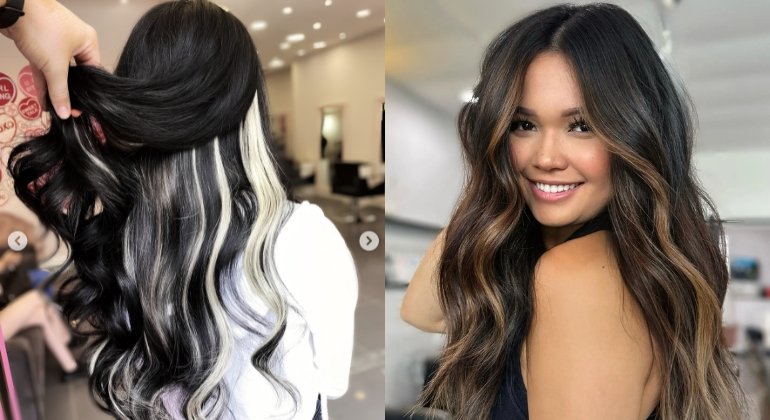
The strongest pairings balance a deep anchor tone against a bright or vivid accent, then match the accent to your undertone. Cool undertones suit platinum, silver, ash, and jewel tones; warm undertones glow next to copper, gold, honey, and caramel.
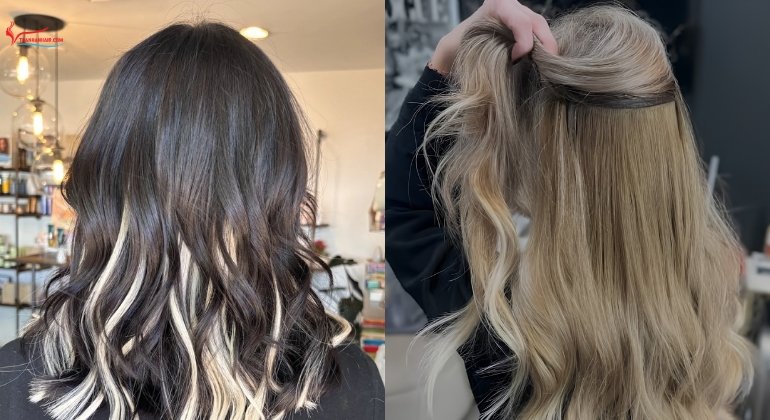
- Black hair with blonde extensions: the timeless showstopper. Jet or off black roots melting into icy platinum lengths, or a few blonde pieces threaded through dark mid lengths for softer drama.
- Money piece on a dark base: two bright face framing pieces beside the part. It is the most wearable entry point to high contrast hair and flatters almost everyone.
- Split dye: one side dark, the other bright. The boldest commitment to contrast, and easy to fake with clip ins on one side only.
- Chunky highlights and ribbons: thick platinum, honey, or copper stripes framing the face, a modern nod to the 90s.
- Color streaks for brown hair: copper, red, pink, or purple pieces slid through a brown base for depth without any bleach, perfect for festivals or a party.
- Vivid on dark: sapphire blue or hot pink against a black base for an editorial, high fashion finish. Test the tone with clip in pieces before you commit.
How to Place High Contrast Extensions, Step by Step
To place high contrast extensions, match your base and choose a shade at least three levels away, section the hair, anchor the dark layer first, then ribbon the bright pieces through the mid lengths and sandwich them between darker sections for a blended finish.
- Step 1. Match your base and pick a contrast shade. Find your natural level on the 1 to 10 hair color scale, where 1 is black and 10 is the lightest blonde. Choose extension pieces at least three levels away from your base, or a vivid fashion tone. The wider the gap, the higher the contrast.
- Step 2. Section the hair cleanly. Part the hair where you want the contrast to fall, then split it into horizontal sections from nape to crown. Clean sections decide whether the finished look reads as intentional or accidental, so take your time with the parting.
- Step 3. Anchor the base layer first. Clip or place your darker base wefts low and close to the scalp. This dark anchor is what makes the lighter pieces pop, and it hides the attachment points of everything you add on top.
- Step 4. Ribbon the contrast pieces through the mid lengths. Weave the lighter or brighter strands through the mid lengths and ends, then sandwich each bright piece between two darker sections. The sandwich diffuses the color line so the contrast looks blended rather than blocky.
- Step 5. Add a face framing money piece. Place two brighter pieces at the front, one on each side of the part, to frame the face. A money piece gives you high contrast where it shows most and is the easiest contrast placement to try first.
- Step 6. Blend with heat, then seal for shine. Curl or wave the whole head so the tones mix, keep heat moderate, and finish with a light serum. Cuticle aligned human hair extensions take heat like your own strands and reflect light for the glossy, expensive looking finish.
Caring for High Contrast Extensions
High contrast looks live or die on the light pieces staying bright and glossy, so care centers on toning and gentle handling. Use a purple or toning shampoo on the platinum and silver strands to hold off brassiness, and wash less often than you think you need to.
Protect the hair from heat. The AAD advises air drying where possible and keeping heat tools moderate, and always pairing them with a heat protectant. Store clip in and halo pieces flat or hung so they do not tangle, and brush from the ends up with a loop or soft bristle brush. Because quality human hair extensions keep an aligned cuticle, they reflect light and resist tangling far longer than over processed hair, which is what keeps the contrast reading as expensive month after month.
Frequently Asked Questions
What is high contrast hair?
High contrast hair pairs two or more tones separated by a wide gap on the hair color level scale, such as a black base with platinum lengths or a vivid streak against brown. The bigger the distance between the shades, the higher the contrast and the more dimensional the hair looks.
Can you get high contrast hair without bleach or damage?
Yes. Pre lightened or vividly colored hair extensions add the contrast on separate strands, so your own hair is never bleached. You get platinum, silver, or fashion tones against your natural base with zero lift, and you can remove or swap the color whenever you want.
How many shades apart is high contrast hair?
As a rule of thumb, tones three or more levels apart on the 1 to 10 scale read as high contrast, while one or two levels apart looks like soft, low contrast dimension. Opposite ends of the scale, like level 1 with level 10, give the boldest two tone effect.
Which hair extensions are best for high contrast color?
Clip in extensions are best for trying the look with no commitment, tape in and weft extensions suit consistent everyday contrast, and keratin or nano tips allow precise streak placement. All of them work only as well as the hair quality, so choose cuticle aligned human hair.
Do high contrast hair extensions work on dark or black hair?
They work especially well. A dark base is the ideal anchor for platinum, silver, copper, or pastel pieces, because the depth of the base makes light extensions look brighter. This is the classic dark hair with blonde extensions effect, achieved with no bleach on your own hair.
How do you keep high contrast extensions looking glossy?
Wash gently, use a purple or toning shampoo on the light pieces to control brassiness, keep heat moderate, and always use a heat protectant. Shine comes from an intact, aligned cuticle, so quality raw hair extensions stay glossy far longer than bleached native hair.
Get the Look With Hair That Holds Its Color
High contrast hair is a statement, and the statement only works when the hair is healthy and the color stays glossy. As a factory direct raw hair manufacturer, Thanh An Hair supplies single donor, cuticle aligned human hair that takes bright tones cleanly and keeps its shine. Order a color matched sample to check the quality against your base before you commit, or, if you run a salon or stock extensions, contact us for factory direct wholesale pricing.
Contact Thanh An Hair today for expert consultation and the most competitive price list.
- WhatsApp/Hotline: (+84) 973 522 855
- Official Website: https://thanhanhair.com/
- Instagram: @thanhanhair
- Email: thanhanexport@gmail.com