
Raw Vietnamese Hair
Why Is My Hair Flat? 10 Causes and 2 Home Tests to Find Yours

Aug
Why is my hair flat? Ten causes explain most cases, and they sort into three groups: weight sitting on the strand, styling that presses roots down, and a change in the hair or the follicle. Two tests you can run at home separate the three groups in about 24 hours. The group you land in decides whether you need a clarifying wash or a dermatologist.
Most guides on this topic hand you a list of ten habits and leave you to guess which one applies. That guess costs months. A woman whose roots collapse because her conditioner sits too high needs a different wash on Tuesday. A woman whose part has widened over two years needs a referral. Both read as flat hair in the mirror, and the advice that fixes one does nothing for the other.
Why is my hair flat? Start with two home tests
Both tests are free and take a day. Run them before you buy anything.
Test 1: the 24 hour shed count
Collect every hair you lose across one full day, including hairs from your brush, your pillow and your clothes, and skip washing during the collection. Then count. StatPearls places the threshold at 100 or more hairs in 24 hours as a signal of telogen effluvium, the diffuse shedding that follows illness, surgery, childbirth, crash dieting or iron deficiency by roughly three months. Repeat the count weekly for three weeks. A falling number means the shed is already resolving.
Test 2: the part and ponytail check
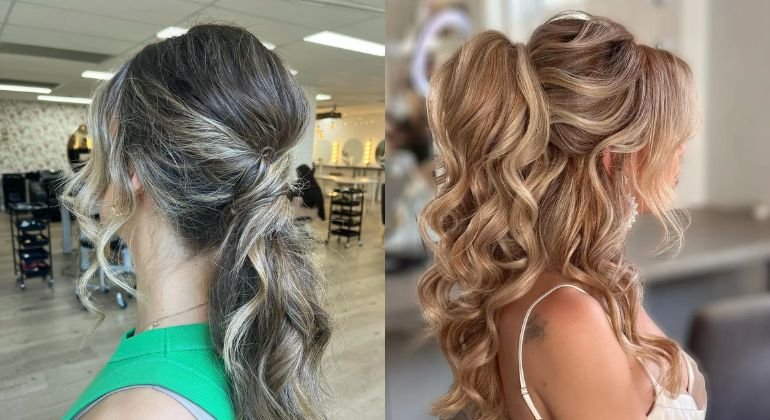
Part your hair down the centre, stand in the same spot under the same light, and photograph the part straight down. Measure your ponytail circumference with a tape on the same day. Repeat monthly. The American Academy of Dermatology names a widening part and a thinner ponytail as the two changes women notice first with female pattern hair loss, which it identifies as the most common cause of hair loss in women.
Two home tests mapped to the likely cause group and your first move
| 24 hour shed count | Part and ponytail over months | Likely group | First move |
| Under 100 hairs | Stable | Buildup or styling (causes 1 to 7) | Clarifying wash, then change one styling habit |
| 100 or more, recent onset | Stable, whole head reads thinner | Shedding (cause 9) | Look back three months for a trigger and ask about ferritin and thyroid labs |
| Under 100 hairs | Part widening, temples receding | Miniaturization (cause 10) | See a dermatologist; treatment works best early |
| 100 or more | Part widening | Both patterns can run together | Dermatologist first, styling changes second |
Buildup: the flat hair that one wash reverses
Four of the ten causes put mass on the strand. Each one responds to a clarifying wash inside a single day, which makes them worth ruling out first.
1. Conditioner sitting at the root
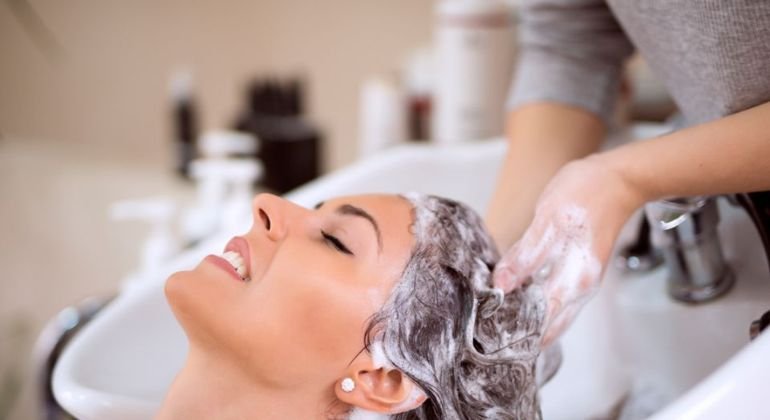
Rinse out conditioners work by depositing cationic polymers and silicones that cling to the cuticle. Across your mid lengths that deposit reads as slip and shine. Within two inches of the scalp it reads as weight, and the root loses the stiffness it needs to hold an angle. Apply conditioner from the ears down and give the change two weeks before you judge it.
2. Sebum on a stretched wash schedule
Your scalp produces sebum at a steady rate whatever your hair does. Fine hair offers less surface area per square centimetre of scalp, so the same output coats a smaller mass and shows sooner. Advice that lumps applied hair oil together with your scalp’s own sebum misses this. Oil on mid lengths and ends rarely flattens a root. Sebum at the root does, and the fix is wash frequency rather than avoiding oil.
3. Hard water mineral deposits

Minerals in your tap water deposit on the cuticle every time you wash. A scanning electron microscopy study in the Indian Journal of Dermatology, Venereology and Leprology washed hair for three weeks in water at 287 to 533 ppm calcium carbonate and found significantly higher magnesium deposition than the soft water control at 50 to 250 ppm. Calcium showed no significant difference, and the microscope found no surface damage. Other groups report reduced tensile strength after hard water exposure, so the damage question stays open. The deposit itself is settled, and for flat hair the deposit is enough: minerals add mass and dull the surface that reflects light.
4. Dry shampoo layered without a reset
Dry shampoo absorbs oil with starch or silica. Every application leaves powder behind, and the powder stays until water removes it. Three days of layering builds a cast at the root that grips the scalp rather than lifting off it. Use it for one day between washes, then wash.
Styling habits that press the roots flat
5. Drying with air aimed downward

Air from above lays each root in the direction it already wants to fall. Rough dry to roughly 80 percent with the nozzle pointed at the scalp from underneath, then finish in your usual direction. Root direction sets while the hair cools, so those last few minutes decide the shape you keep all day.
6. The same parting for years
Wear a part in one place for months and the roots settle into that exit angle. Move the part two centimetres and you buy several days of lift while the roots resist the new direction. The effect is modest and it reverses the moment you go back, so treat it as a free adjustment rather than a cure.
7. Iron and brush choices at the root
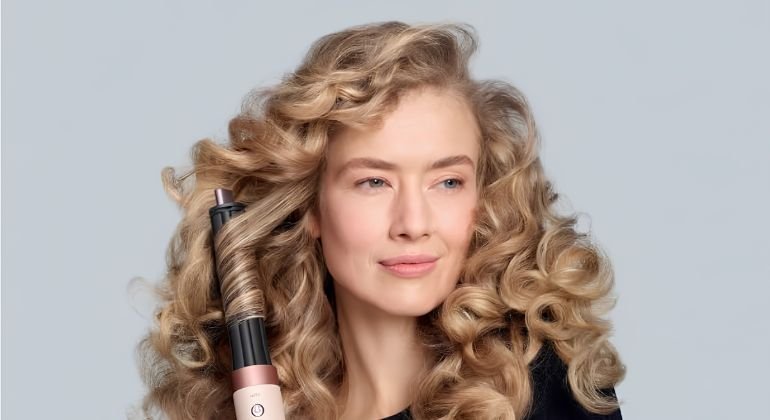
A flat iron closed within a centimetre of the scalp presses the root down along with the mid length. Start the plates two to three centimetres out. Brush diameter matters more than bristle spacing for lift: a round brush of 40 to 50 mm rolls a root up and away from the scalp, where a paddle brush drags it flat. Our guide to how to choose a hairbrush for your hair type covers the match between bristle stiffness and strand diameter.
Fine hair vs thin hair: the distinction that changes the fix
Fine describes the diameter of one strand. Thin describes how many strands grow per square centimetre of scalp. You can be fine and dense, coarse and sparse, or any mix of the two. Articles that use the words interchangeably send readers toward the wrong shelf, because a fine strand at normal density is a cosmetic problem and falling density is a medical one.
8. Fine strands at normal density
Nothing has changed and nothing is wrong. Your strands carry less bending stiffness, so they collapse under their own length sooner than coarse hair does. Length control does more here than any product: a blunt line at the collarbone holds a shape that the same hair cannot hold at mid back.
9. Density falling because of shedding
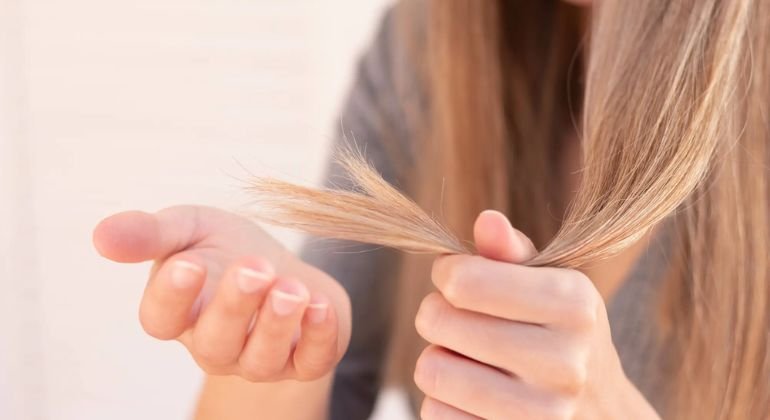
In a healthy scalp about 85 percent of follicles sit in the growing anagen phase and 15 percent in the resting telogen phase. StatPearls notes that a follicle grows anagen hair for close to four years and then rests for about four months. Metabolic stress pushes a large batch into telogen at once, and the shed lands roughly three months later, with a range of one to six months. Acute telogen effluvium is self limiting and runs under six months by definition, and regrowth can take a further six months before you see it.
10. Miniaturization at the follicle
Female pattern hair loss shrinks follicles over years, so each replacement strand emerges finer than the one before. The AAD describes it as progressive, with the part widening and the temples receding, and notes that treatment delivers the best results when it starts at the first sign. Minoxidil at 2 or 5 percent is the most recommended option and needs six to 12 months before you can judge whether it works. Volumising shampoos help hair hold moisture and reduce breakage, and the AAD is explicit that they cannot regrow hair or stop the loss progressing.
Fine strands, low density, shedding and miniaturization compared
| Fine strands | Low density | Telogen effluvium | Female pattern hair loss | |
| What changed | Nothing, lifelong | Nothing, lifelong | Onset over weeks | Onset over years |
| 24 hour shed count | Normal | Normal | 100 or more | Normal to mildly raised |
| Part width | Stable | Stable and wide | Stable | Widening |
| Ponytail circumference | Stable | Stable and thin | Drops fast | Drops over years |
| Resolves without treatment | Not applicable | Not applicable | Yes, under six months | No |
| First step | Cut, product and root lift | Cut, product and added hair | Find the trigger, request labs | Dermatologist |
Hair extensions for fine hair: the weight arithmetic most guides skip
Added hair fixes flat hair caused by fine strands or low density, and it makes both worse when the format concentrates load. We manufacture these formats, and the number that predicts damage is grams per anchor point, followed by grams per anchoring strand. Total weight on the head tells you less than either.
Work the arithmetic yourself. Take an install of 150 g spread across 200 point attachments. That is 0.75 g hanging on each bond. If your stylist gathers 30 of your own strands into each bond, every strand carries 0.025 g. On sparse hair the stylist gathers fewer strands per bond, because fewer are there to gather. Drop to 15 strands per bond and the load on each one doubles to 0.05 g while the total weight on your head has not moved. Low density raises per strand tension through the denominator, which is why the same install that sits comfortably on dense hair pulls on hair that is already thinning. These figures illustrate the method; confirm the actual per bond weight and bond count with whoever installs your hair.
How each attachment format carries weight on fine or low density hair
| Format | Load pattern | Fit for fine or low density hair | Watch for |
| Hand tied weft | Distributed along a sewn row | Good when rows are short and beads sit apart | Rows run longer than the section can carry |
| Genius weft and flat weft | Distributed, no bulk ridge at the seam | Good; the flat seam lies close to the scalp | Over long rows on a sparse section |
| Invisible tape | Distributed across a 4 cm tab | Good; the tab spreads load over a wide base | Tabs set too high toward the part line |
| Nano ring | Point load on one small bundle | Workable at a low bond count and shorter lengths | Fewer strands per ring as density falls |
| I tip and flat tip | Point load on one small bundle | Workable with light lengths and spaced placement | Bonds set within 1 cm of the scalp |
| Clip in | Removable, worn for hours rather than weeks | Best first trial for flat hair | Wearing the same clip position daily |
| Topper | Distributed across a base with several clips | Strong option for a widening part | A clip line that never moves |
Distributed formats spread the same weight across a base instead of a bundle. Hand tied weft hair carries load along a sewn row, invisible tape in hair spreads it across a 4 cm tab, and a hair topper puts it on several clips across a base, which suits a widening part. Point formats such as nano ring hair extensions still work on fine hair at a reduced bond count and shorter lengths. For a first trial, clip in hair extensions answer the question in an afternoon with nothing to remove later.
When to stop self treating and see a dermatologist
Book an appointment if your part keeps widening month over month, your temples recede, your 24 hour count stays above 100 past six months, or any style causes pain, stinging, crusting or tenting. Ask about ferritin, iron saturation and thyroid function if the shedding started within six months of an illness, a surgery, a birth or a period of restricted eating. StatPearls flags that iron saturation is the most sensitive marker and that a normal ferritin result does not rule out iron deficiency, which is worth knowing before you accept a clear blood panel as the end of the conversation.
Talk to our team about a sample set matched to fine hair work.
Ready to find your perfect match? Contact us today for expert advice and exclusive discounts on premium human hair extensions.
📲Phone/WhatsApp: +1 (206) 698‑5133
🛜Instagram: RAW HAIR LUXURY COMPANY
🌐Tik Tok: RAW HAIR LUXURY
📧 Email: Rawhairluxury.us
🌐Website: rawhairluxury.com