
Thanh An Hair
What Is Balayage Hair? Lift Levels, Real Cost and Upkeep
Aug
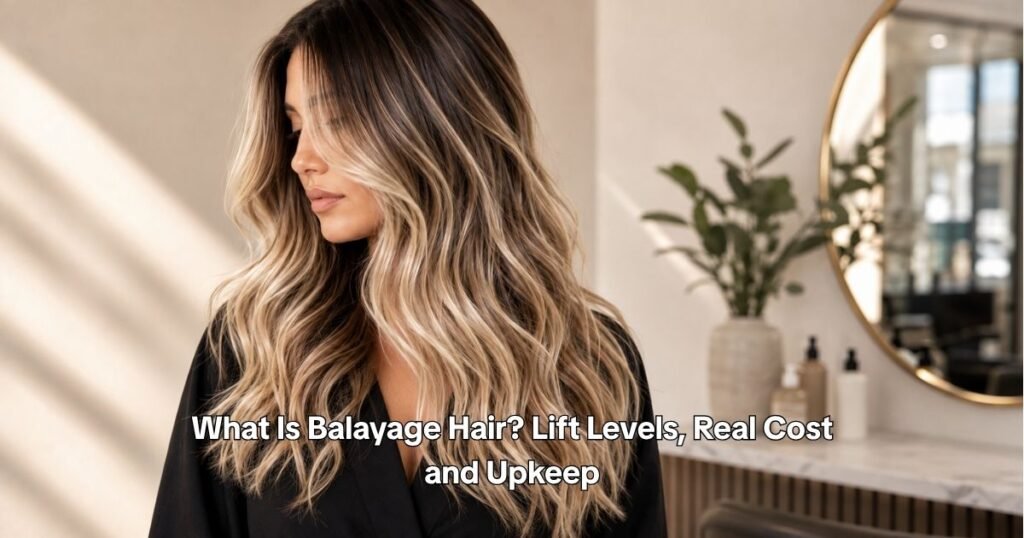
Balayage hair is hair lightened by freehand painting rather than foil sectioning. A colorist sweeps lightener down the surface of each section, heavy at the ends and feathered toward the root, so no hard regrowth line ever forms. Most balayage lifts 2 to 4 levels in one session and holds its shape for 4 to 6 months.
That definition is the easy part. What almost no guide tells you is how far your specific starting shade can travel in one appointment, what the lightener does to the fiber at a measurable level, or what the service costs in a US salon. We manufacture raw Vietnamese hair and lighten it in-house every week, so this guide covers the parts you only learn by processing hair at volume.
What is balayage hair and where does the name come from?
Balayage takes its name from the French verb balayer, to sweep. Say it bah-lay-AHZH, with the last consonant soft, like the s in measure.
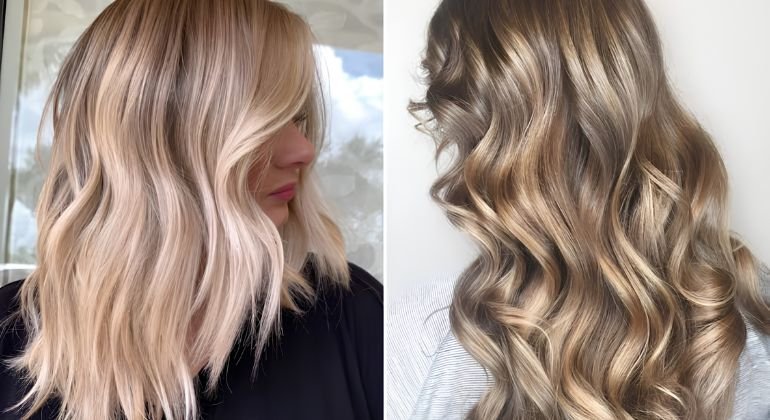
The technique itself is simple to describe and hard to execute. Your colorist loads a brush, then drags it down the outside of a section without wrapping it. The lightener processes in open air, which slows it down and keeps the edges diffuse. Foil traps heat and forces a uniform result to the very edge of the sectioned strand. Painting does the opposite: it fades out wherever the brush ran light.
The root is where the money is. Foils start color at the scalp, so six weeks later you own a visible line where new growth meets lightened hair. Balayage begins its heaviest deposit several inches down and feathers upward into nothing. New growth blends into that transition instead of cutting across it, which is the entire reason the look survives a busy schedule.
How balayage differs from ombre, foilyage, and babylights
Salon menus blur these. They are separate techniques with separate maintenance costs.
Balayage vs highlights and the other blended techniques
| Technique | How it is applied | Where lightness sits | Regrowth line | Retouch window |
| Balayage | Freehand painted, open air, no foil | Surface of mid-lengths to ends | None | 4 to 6 months |
| Traditional highlights | Sectioned and wrapped in foil | Root to tip, full strand | Hard line at the root | 6 to 8 weeks |
| Foilyage | Painted, then wrapped in foil for extra lift | Mid-lengths to ends, brighter | Soft | 3 to 5 months |
| Ombre | Solid horizontal gradient | Bottom third only | None | 5 to 8 months |
| Babylights | Very fine foiled weaves | Root to tip, fine strands | Soft line at the root | 8 to 10 weeks |
| Reverse balayage | Darker tones painted onto a lightened base | Roots and mid-lengths | None | 3 to 4 months |
Reverse balayage runs the same motion backward. Instead of lightening, your colorist paints deeper tones through a base that has already been lifted, to rebuild a shadowed root and pull an over-blonded head back toward something wearable.
How many levels can balayage lift your hair?
Balayage lifts 2 to 4 levels on virgin hair in a single session. Anyone promising you a level 2 to level 9 jump in one appointment is either planning to overprocess your ends or planning to send you home orange.
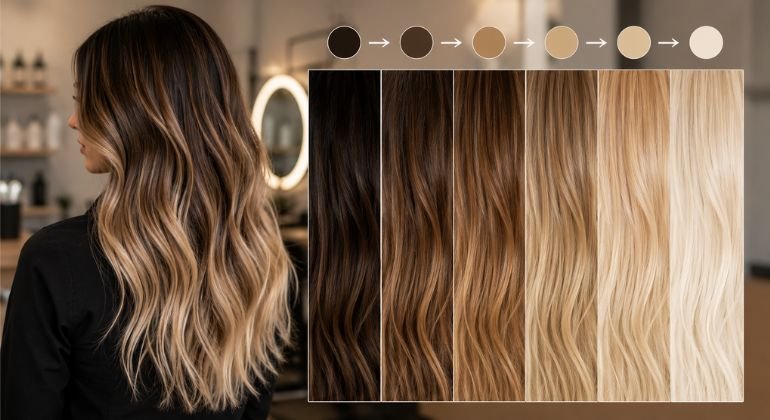
Colorists number hair from level 1 (black) to level 10 (lightest blonde). Every level you climb strips melanin and exposes the warm pigment sitting underneath it. Dark hair holds enormous amounts of red and orange, which is why lifting it is a two-stage job: bleach removes the pigment, toner cancels what the bleach exposed.
Realistic one-session lift by starting level, and the pigment it exposes
| Starting level | Realistic result in one session | Underlying pigment exposed | Toner needed |
| Level 1 to 2 (black) | Level 4 to 5, warm brown | Red to red-orange | Blue or green base |
| Level 3 to 4 (dark brown) | Level 6 to 7, caramel | Orange | Blue base |
| Level 5 to 6 (medium brown) | Level 8 to 9, honey to beige | Orange to gold | Blue-violet |
| Level 7 to 8 (dark to medium blonde) | Level 9 to 10, cool blonde | Gold to pale yellow | Violet |
The American Academy of Dermatology puts a hard number on the trade-off. Their guidance is to stay within three shades of your natural color, because lightening more than three shades requires higher volumes of peroxide, which causes more hair damage. Balayage sits right at that edge by design. A colorist who tells you to split a big change across two appointments is following the evidence, not upselling you.
Does balayage hair damage the fiber? What the lab data shows
Yes, and the numbers are specific. Bleach opens the cuticle, then oxidises the cysteine bonds that hold the fiber together, converting them into cysteic acid. That reaction also attacks the thin fatty layer bonded to the outside of every cuticle scale.
Research published in Cosmetics found that more than 80% of 18-MEA is removed in a single bleaching treatment. 18-MEA is the lipid that makes healthy hair water-repellent and slippery. Strip it and the surface turns water-loving and high-friction, which is the physics behind hair that tangles, squeaks, and refuses to comb.
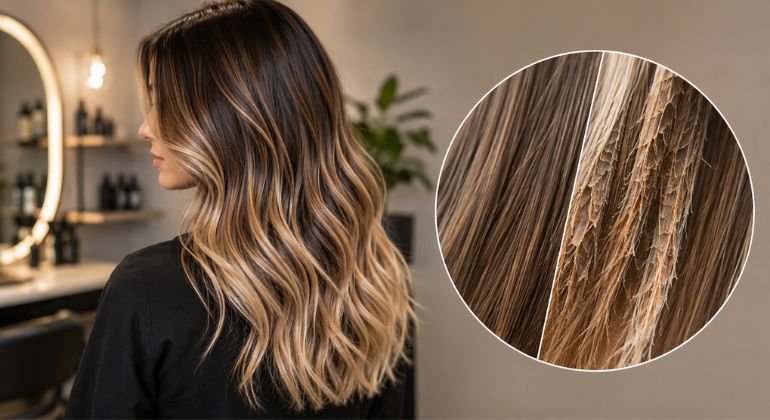
A 2025 study in Dermatology Research and Practice weighed the loss. Untreated natural black Asian hair measured 8.703% total lipid, dropping to 5.506% after bleaching. Electron microscopy of the same samples showed lifted cuticle scales, surface pitting, and visible bond breakage.
Here is the balanced read. Balayage damages less of your head than a full-head lightener does, because the lightener never touches your scalp and your root stays virgin. The sections that do get painted take the same chemistry as any bleach. That is the trade you are making: less total area processed, identical intensity where it lands.
The AAD also advises you to have only one chemical service at a time. If you want a keratin treatment or a relaxer as well, schedule it two weeks apart from your color, not on the same afternoon.
Can you get the balayage look with hair extensions?
Yes, and for a large share of clients it is the better route. Extensions deliver the dimension without putting a single drop of peroxide on your own hair.
The fiber science matters here in a way most extension sellers never explain. The same Cosmetics review reports that Asian hair carries roughly 2% lipid against 3% for Caucasian and 6% for African hair, while Asian fibres show the highest linear mass and tensile strength. Vietnamese raw hair is dense and strong, which is why it survives lift that would wreck softer fiber. It also runs lean on lipid, which is why toner discipline and lipid replacement are not optional on a lightened set.
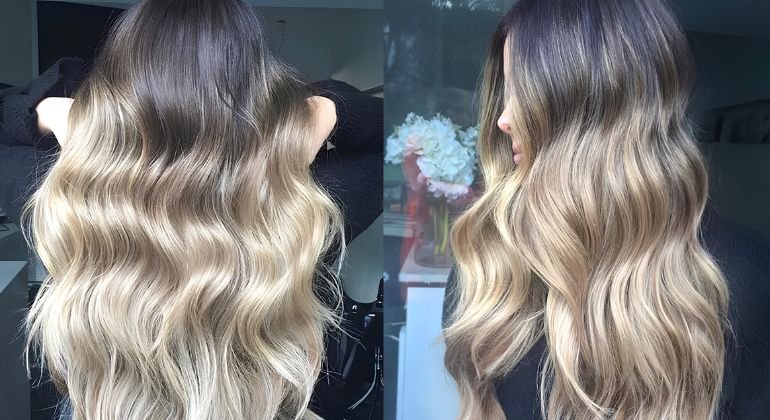
Three ways to build the look:
- Order pre-colored ombre or balayage-effect hair. We lighten bulk hair before it is ever built into a weft or a bond, so the lift happens under controlled conditions with a strand test on the exact batch. Ombre and piano blends on our color ring are made this way.
- Blend two shades at install. Set a base of your natural depth through the back, then place lighter weft hair or tape-in wefts around the face and through the mid-panels. Nothing gets bleached, and you can move the brightness at the next move-up.
- Add removable brightness. Clip-in pieces in a lighter shade give you the sun-kissed effect for an event and come out the same night.
Why you should never bleach a finished extension set
Colorists ask us this every week, so here is the answer from the production side.
Extension hair has no follicle behind it. Your own hair receives sebum daily, which partially replaces what washing removes. A weft receives nothing, so every lipid the bleach strips is gone for good. Add the fact that lightener degrades keratin bonds and dissolves tape adhesive, and you are risking a full set to save a shade adjustment.
Match at the color ring instead. The rule we give resellers: match extensions to the client’s regrowth shade, not to their lightened ends. Ends fade. Roots do not. If you match to a fading end, the set reads wrong within six weeks. This holds for keratin tip hair and every attachment format we make.
Sourcing balayage-ready hair for your salon or brand
Thanh An Hair has manufactured raw Vietnamese hair for two decades from our own factory, shipping factory-direct to more than 300 partner businesses and 50,000 customers worldwide. We lighten, tone, and quality-check in-house, so the ombre and balayage-effect blends on our color ring come off a controlled batch rather than a middleman’s guess.
Request a color ring and wholesale pricing and tell us the base shade you match most often. We will send the closest pre-colored blends alongside our raw natural shades so you can hold them against your clients’ regrowth in real light.
Ready to find your perfect match? Contact us today for expert advice and exclusive discounts on premium human hair extensions.
📲Phone/WhatsApp: +1 (206) 698‑5133
🛜Instagram: RAW HAIR LUXURY COMPANY
🌐Tik Tok: RAW HAIR LUXURY
📧 Email: Rawhairluxury.us
🌐Website: rawhairluxury.com