
Thanh An Hair
Vietnamese Hair for Wigs: Why It Is the Best Choice
Aug
Vietnamese hair for wigs earns its reputation on three measurable traits: a thick, compact cuticle layer that survives knot bleaching, a cylindrical strand cross section that lays flat against a lace cap, and single donor collection that keeps color and density consistent across a whole unit. Those traits matter more in a wig than in any other hair product.
Most articles answering this question repeat the same claims. Vietnamese women wash their hair with herbs. The hair grows long in the mountains. The market grows thirty percent a year. None of those claims carry a source, and none of them explain what a wig maker actually needs.
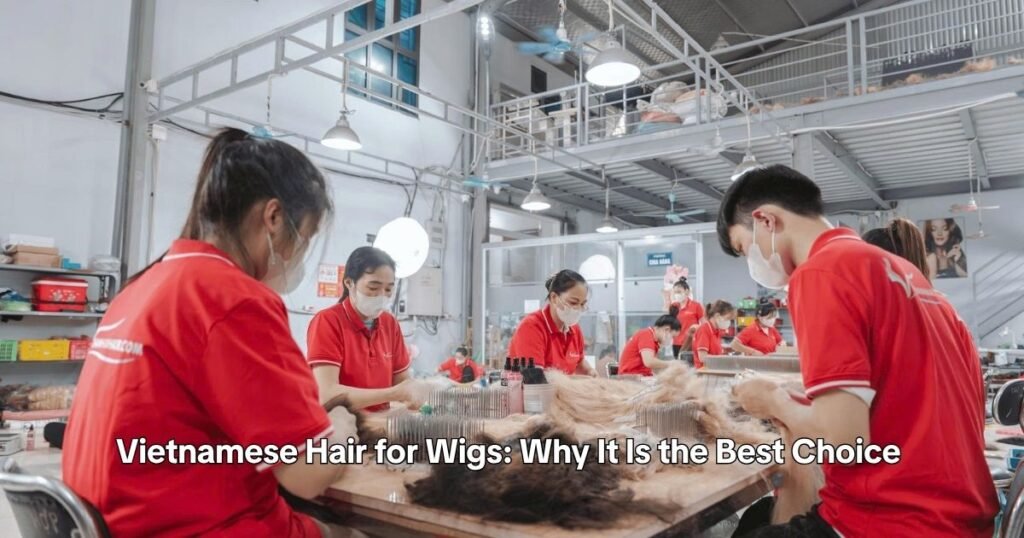
We manufacture wig hair in Vietnam, so this piece takes a different route. It looks at what the fiber science says, what the export data shows, what a wig demands that a weft does not, and how you test a sample before you spend money. It also names the cases where Vietnamese hair is the wrong pick, because a supplier who claims their material wins every comparison is selling, not advising.
What makes Vietnamese hair different at the fiber level?
Vietnamese hair belongs to the East Asian hair group, and that group has been measured in the dermatology literature. A review published in Clinical, Cosmetic and Investigational Dermatology and indexed on PubMed reports that the cuticle layer in Asian hair sits thicker and packs more compactly than the cuticle layer in Caucasian hair, and that Asian hair records the highest hardness and elastic modulus of the three groups studied.
That finding drives most of what follows. The cuticle is a single layer of flattened, keratin filled cells that overlap like roof shingles along the outside of the strand, as described in the StatPearls anatomy reference. Everything a wig maker does to hair, from ventilating knots into lace to lifting a unit to blonde, attacks that layer first.

Cuticle thickness and what it buys you
A thicker cuticle gives a colorist more margin. Peroxide bleaching does not stop at the surface. Research on bleached fibers published in Applied Microscopy found that excessive bleaching separates cuticle scales, opens holes in the cuticle cells, and exposes the cortex underneath. Once the cortex sits exposed, the strand loses moisture, gains friction, and starts to break.
Wig units take more of this abuse than extensions do. Knot bleaching lightens the tiny knots at the base of each ventilated strand so the parting reads like scalp. That process puts lightener directly on the most stressed point of every single strand in the unit. Hair with a thin or already stripped cuticle turns to gum at that point.
Cross section, and why a round strand lays flatter
Asian hair carries a rounder, more cylindrical cross section than African or most Caucasian hair, which tends toward an ellipse. A round strand resists bending in every direction equally, so it falls straight down from the knot rather than kicking sideways. On a lace cap, that reduces the crown bulk that makes a cheap unit look obviously artificial.
The same roundness has a cost. Round strands resist holding a curl set. A wig maker building a tight curly unit from raw Vietnamese hair needs steam processing to lock the pattern, which is why our texture range runs through a steam line rather than a chemical perm.
Vietnamese hair vs Indian, Brazilian, and Chinese hair for wig construction
The table below compares the four hair origins a US wig maker encounters most often. It reflects how each type behaves on a lace cap rather than how it looks in a bundle photograph.
Hair origin compared on the attributes that matter to wig construction
| Attribute | Vietnamese hair | Indian hair | Brazilian hair | Chinese hair |
| Typical sourcing | Single donor, direct collection | Pooled temple donation | Mixed donor, salon collection | Mixed donor, industrial collection |
| Cuticle direction | Aligned root to tip | Often aligned, batch dependent | Frequently mixed | Frequently stripped |
| Strand diameter | Thick, cylindrical cross section | Medium, fine to medium | Medium to thick | Thick, often acid treated |
| Response to knot bleaching | Predictable, lifts evenly | Variable across the pool | Uneven, patchy lift | Poor, gums at high lift |
| Density held to the ends | High on double drawn | Moderate | Moderate | Low to moderate |
| Natural base color | Consistent dark brown to black | Dark brown, varies by region | Warm dark brown | Uniform black after processing |
| Best wig application | Full lace, HD frontal, custom color units | Textured and curly units | Body wave and wavy units | Volume budget units |
Read the table as tendencies, not laws. A careful Indian supplier selling genuinely aligned single donor hair beats a careless Vietnamese supplier selling acid stripped stock. Origin narrows your odds. It does not guarantee an outcome, which is why the sample test further down matters more than the country name on the invoice.
How to verify raw Vietnamese hair before you order
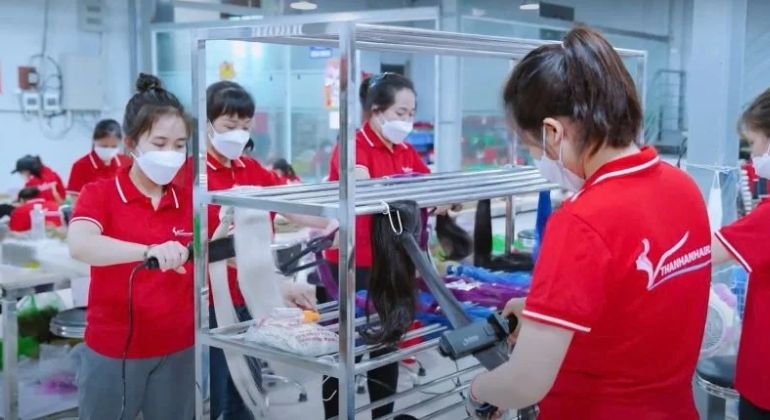
Vietnam has more hair factories than it has good hair factories. Every claim in this article is testable on a sample pack, and a sample pack costs less than one wasted wig order. Work through these five steps before you commit.
- Step 1. Run the strand direction test
Pull one strand from the sample and slide your fingernail from tip to root, then root to tip. Cuticle-intact hair feels smooth in one direction and gives light resistance in the other. Hair that feels identical both ways has had its cuticle stripped with acid, which is the most common shortcut in the wig supply chain. - Step 2. Wash out the coating
Shampoo the sample twice with a clarifying shampoo and let it air dry with no conditioner and no product. Silicone coating washes off in two rounds. If the sample turns coarse, dull, or squeaky after washing, the softness you felt in the package came from the coating rather than the fiber. - Step 3. Bleach a test section to 613
Lift a small section to a pale blonde using the same developer volume your wig team uses for knot bleaching. Watch for gumminess and stretch. Raw single donor hair reaches 613 and keeps its structure. Blended donor hair lifts unevenly because each donor’s cortex responds to peroxide at a different rate. - Step 4. Check the density taper
Hold the bundle at the weft or bind point and run your hand down to the ends. Measure how much thickness you lose. Double drawn hair keeps most of its density to the last two inches, which is what a wig cap needs. Single drawn hair thins out and leaves the perimeter of a unit looking sparse. - Step 5. Wet, dry, and comb three times
Cycle the sample through three wash and air dry rounds, combing from the ends upward each time. Count shed strands after the third round. Hair that sheds steadily at this stage will shed faster once it is ventilated into lace, because knotting puts more mechanical stress on each strand than a weft does.
Run all five on any supplier, ours included. A factory confident in its material will send a sample knowing you plan to bleach it.
When is Vietnamese hair the wrong choice for a wig?
Four cases, stated plainly.
Fine haired blonde clients. A client with fine, naturally light hair needs a unit built from fine European or Slavic hair. Vietnamese strands run thick. Lifting them to a level 9 or 10 and then trying to match a fine hairline produces a unit that reads heavy against the client’s own hair.
Tight coily texture units. For 4B and 4C pattern units, hair that carries the pattern naturally holds it better through wash cycles than steam processed straight hair does. Vietnamese hair can be steamed to a curl, and it holds well, but a supplier who sells naturally coily stock has the better material for that specific job.
Entry price units. Raw single donor Vietnamese hair costs what it costs. If your customer buys a wig at a low retail price point, the margin does not exist. Say so rather than selling processed hair as raw.
Very long lengths at full density. Above 30 inches, single donor Vietnamese ponytails at full double drawn density get scarce and expensive. Lead times stretch. Plan for it or choose a shorter length.
Test our hair before you buy a wig order
Every claim above survives a sample test, and that is the only claim worth making. We manufacture wig hair in Vietnam and sell factory direct to salons, stylists, and resellers, with no trading house between our line and your order. Our full lace wig and lace frontal wig lines both build from single donor stock.
Request a wig hair sample pack
Already have a unit in rotation? Read our guide on how to keep a wig from tangling, or read about our factory.
Ready to find your perfect match? Contact us today for expert advice and exclusive discounts on premium human hair extensions.
📲Phone/WhatsApp: +1 (206) 698‑5133
🛜Instagram: RAW HAIR LUXURY COMPANY
🌐Tik Tok: RAW HAIR LUXURY
📧 Email: Rawhairluxury.us
🌐Website: rawhairluxury.com