
Raw Vietnamese Hair
How to Care for African American Hair
Aug
How to care for African American hair comes down to five habits: wash every 7 to 14 days with a gentle shampoo, condition every wash, seal damp strands with a leave-in and oil, detangle in sections with slip, and sleep on satin. If a style hurts while it is being installed, ask the stylist to loosen it.
Most advice on this topic stops at “moisturize more.” That is not wrong, but it skips the part that decides whether your hair gets longer: the mechanical load you put on each strand between wash days. Below is a routine built from published dermatology guidance and fiber-testing data, plus the parts of extension care that a factory sees and a retailer never does.
Why African American Hair Breaks More Easily
Afro-textured hair grows from a retro-curved, S-shaped follicle and emerges with a flattened elliptical cross-section rather than a round one. Every bend along the coil is a stress concentration point, and researchers reviewing the genomics and biomechanics of textured hair describe it as more vulnerable to breakage because of that curvature rather than weaker in its protein makeup (Cosmetics, 2024).
Three consequences follow, and they explain most of what happens on your bathroom floor:
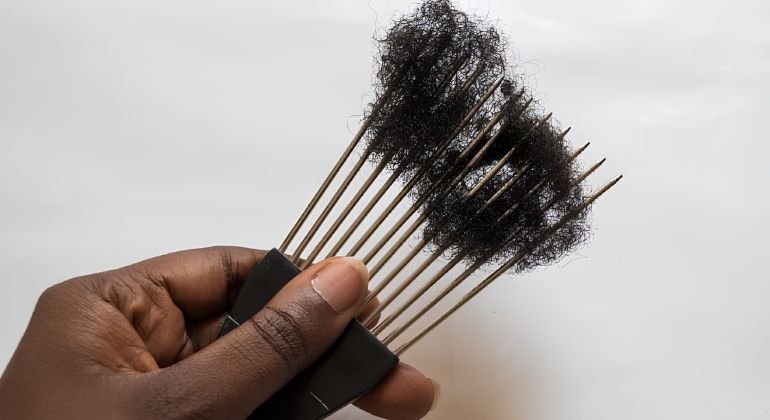
- Sebum cannot travel. Scalp oil migrates easily down a straight fiber. On a coil it stalls near the root, which is why hair can feel dry at the ends while the scalp feels greasy.
- Fatigue, not tension, breaks hair. Strands rarely snap from one hard pull. They fail after thousands of small bends during combing and styling. Fatigue testing shows Afro-textured fibers fail far faster than straighter hair across the range of shear forces that combing produces.
- Wet hair is weaker hair. Failure rates climb with moisture content, which is why aggressive detangling in the shower does more damage than people expect.
Growth rate matters less than people think. Measured African hair growth averages about 256 micrometers per day, roughly 0.9 cm a month, against about 396 micrometers for Caucasian hair, with lower follicle density as well (British Journal of Dermatology). You cannot change that number. You can change how much of it you keep.
[INSERT: real attributable quote from Thanh An Hair founder or QC lead on cuticle direction checks during sorting. Do not publish this section without it.]
How Often to Wash African American Hair
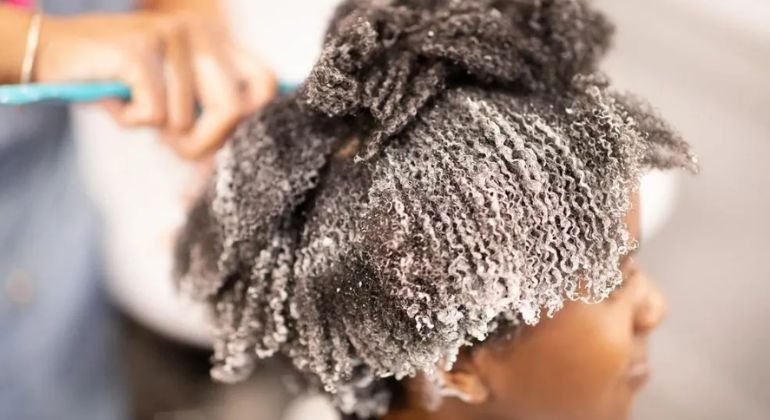
Wash once a week or every other week. That is the direct recommendation from the American Academy of Dermatology, which also notes that more than half of African American women name thinning or hair loss as their top hair concern. Buildup left on the scalp is drying; over-washing strips the lipid layer. The useful question is not “how often” in the abstract but “how often for what I am doing.”
| Your situation | Cleanse every | Use | Why |
| Loose natural hair, light product use | 10 to 14 days | Sulfate-free shampoo | Matches the AAD window and preserves scalp lipids |
| Heavy gels, butters or holding creams | 7 days | Clarifying wash monthly, gentle otherwise | Film-forming stylers trap sebum and flakes |
| Sweating four or more times a week | 5 to 7 days | Co-wash between shampoos | Salt residue irritates the scalp and dries the shaft |
| Braids, cornrows or a sew-in | 10 to 14 days | Diluted shampoo in an applicator bottle | Scalp still needs cleansing; braids need spacing to dry |
| Dandruff or seborrheic dermatitis | As your dermatologist directs | Medicated shampoo on the scalp only | Treating the scalp overrides the standard schedule |
| Relaxed or heat-straightened hair | 7 to 10 days | Protein-balanced system | Processed strands hold less water and fail sooner |
The Wash Day Routine, Step by Step
Budget about two hours for a full wash day and treat it as maintenance rather than a chore you rush. The order below exists to keep force off the strand at every stage.
- Section and pre-treat before water touches your hair. Split dry hair into four to six twisted sections. Work a light oil or a slippery conditioner through each section and finger-detangle from the ends upward. Detangling a whole head at once is what turns shed hair into knots, and knots are where strands snap.
- Cleanse the scalp, not the lengths. Apply shampoo to the scalp in parts and massage with the pads of your fingers for 60 seconds. Let the runoff clean the lengths as you rinse. Coating coils in surfactant strips the lipids that keep them pliable.
- Condition every single wash. Rinse-out conditioner goes on every time you shampoo, and the ends get the most of it. Ends are the oldest part of the strand and have survived the most combing cycles, so they fail first.
- Deep condition with gentle heat for 20 minutes. Once or twice a month, swap the rinse-out for a deep conditioner or a hot oil treatment. Cover with a cap and add warmth from a hooded dryer or a warm towel. Heat opens the cuticle enough for the conditioning agents to reach the cortex.
- Rinse cool and blot dry. Finish with a cool rinse to lay the cuticle flat, then squeeze water out and blot with a microfiber towel or cotton T-shirt. Rubbing with terry cloth lifts the cuticle and creates the frizz you will spend the next hour fighting.
- Layer leave-in, cream, then oil on damp hair. Work products through soaking-damp sections in that order. The leave-in delivers water, the cream holds it, and the oil slows evaporation. Applying oil to dry hair seals dryness in rather than moisture.
- Dry stretched and under low tension. Air dry in twists, braids or banded sections rather than in a shrunken pile. Stretched drying cuts the tangling that happens as coils dry into each other, which means fewer strands lost at the next detangling session.
Detangling Without Breakage
This is where the two facts above collide. Wet hair is mechanically weaker, but dry combing drags a comb through knots and produces the snags that shear fibers. The resolution is not “wet” or “dry” but slip and sequence: hair saturated with conditioner, worked in small sections, fingers before any tool, ends before roots, and no comb until the section already runs clear.
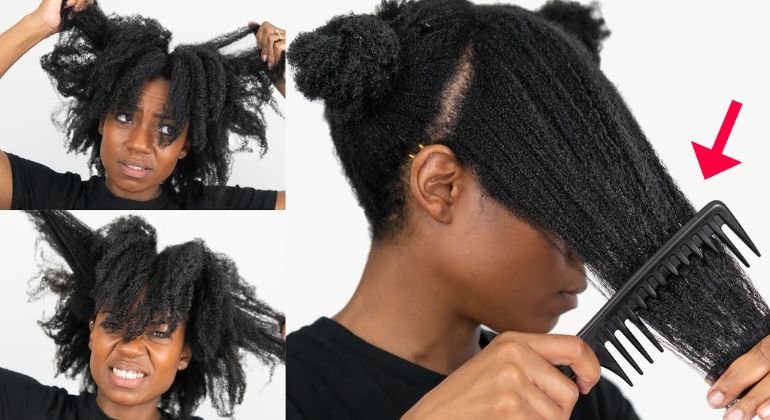
Use a wide-tooth comb or a flexible detangling brush, never a fine-tooth comb on coils. If you hit a knot, stop pulling and separate it with more conditioner and your fingers. A single forced pass through a matted section can cost more length than a month of growth.
Moisture or Protein? Reading What Your Hair Needs
Half of the frustration in Black hair care comes from treating a protein problem with more moisture, or the reverse. Stretch a wet strand gently. Hair that stretches a long way and stays limp needs protein. Hair that snaps quickly with almost no stretch needs moisture.
| What you notice | Likely cause | What to do | How often |
| Mushy, overly stretchy when wet | Protein deficit | Protein or keratin treatment, then a moisturizing conditioner | Every 4 to 6 weeks |
| Snaps with almost no stretch, feels straw-like | Moisture deficit | Deep conditioner with heat, 20 to 30 minutes | Twice a month |
| Rough, tangles within hours of styling | Raised cuticle | Acidic rinse, cool final rinse, satin at night | Every wash |
| Product sits on top and flakes | Buildup or low porosity | Clarify, then apply products to warm damp hair | Monthly |
| Shedding with white bulbs attached | Normal shedding cycle | Nothing; distinguish from breakage, which has no bulb | Ongoing |
| Thinning at the hairline | Tension damage | Stop the style and see a dermatologist | Immediately |
Nighttime Protection Is Not Optional
Cotton pillowcases pull water out of hair and generate friction across seven or eight hours, every night. That is roughly 2,500 hours a year of low-level abrasion on fibers that already fail under repeated small loads. Satin or silk removes the friction, and a bonnet removes it more reliably than a pillowcase because it moves with you.
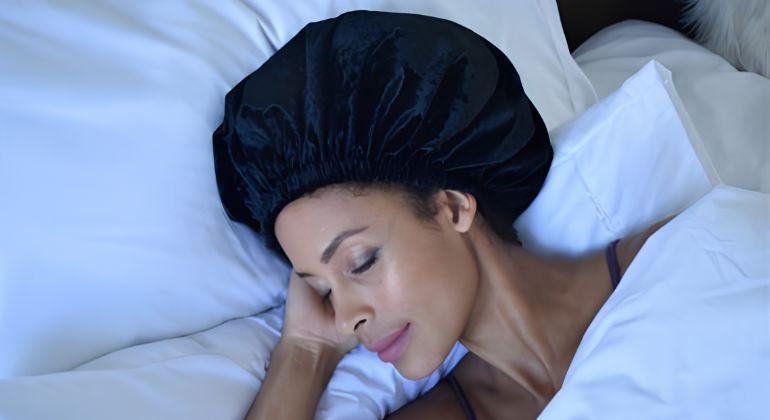
For loose natural hair, gather it loosely on top of the head in a soft scrunchie, or twist it into four to six chunky sections. For longer extensions or a wig install, a loose braid plus a satin bonnet prevents the overnight tangling described in our guide on keeping a wig from tangling.
How to Care for African American Hair Across a Month
A routine you can actually repeat beats an ideal one you abandon in March. Here is what a sustainable month looks like.
| Week | Wash day | Midweek | Every night |
| 1 | Full wash, deep condition with heat, restyle | Water-based refresh spray, scalp oil if dry | Satin bonnet, hair stretched or twisted |
| 2 | Co-wash or gentle shampoo, rinse-out conditioner | Refresh; check hairline for tenderness | Satin bonnet |
| 3 | Full wash, protein or keratin treatment, then moisture | Light refresh only; protein weeks need less product | Satin bonnet |
| 4 | Clarify, deep condition, trim visible split ends | Refresh; take down or rotate any protective style | Satin bonnet |
When to Stop Reading and See a Dermatologist
Home care handles dryness, tangling and breakage. It does not handle hair loss. Book an appointment if you see a widening part at the crown, a receding hairline with a fringe of broken hairs, patches with no visible follicle openings, or a scalp that stays tender, scaly or itchy between washes. Central centrifugal cicatricial alopecia and traction alopecia both scar if they run long enough, and both respond far better when caught in the first months. The AAD notes that even slight noticeable thinning can mark the start of hair loss.
Sourcing Hair That Survives This Routine
Every habit above assumes the fiber can take it. Thanh An Hair has manufactured raw Vietnamese hair for about two decades, sorting single-donor bundles by cuticle direction rather than buying pre-processed hair from a market. If you supply salons or clients with textured hair, the difference shows up on wash four, not day one.
Request a factory-direct sample and wholesale catalog
Ready to find your perfect match? Contact us today for expert advice and exclusive discounts on premium human hair extensions.
📲Phone/WhatsApp: +1 (206) 698‑5133
🛜Instagram: RAW HAIR LUXURY COMPANY
🌐Tik Tok: RAW HAIR LUXURY
📧 Email: Rawhairluxury.us
🌐Website: rawhairluxury.com