
Thanh An Hair
How to Use Dry Shampoo on Hair Extensions Without Damaging Them
Jul
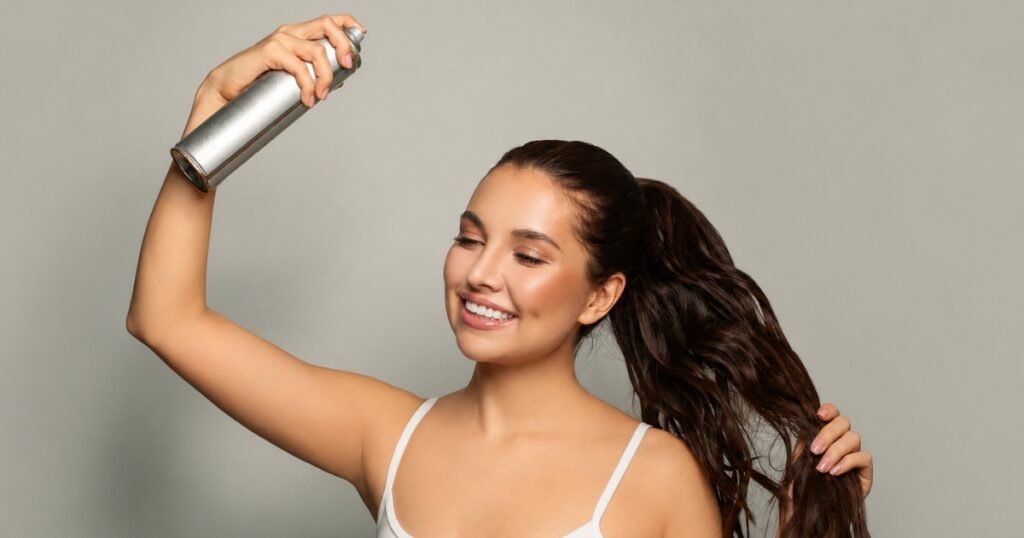
To use dry shampoo on hair extensions, spray it onto your roots and natural hair only, holding the can 8 to 10 inches away, then wait 30 to 60 seconds and brush it through. Keep it off every tape, bond, ring, and clip, and never let it stand in for a proper wash.
Extensions live away from your scalp’s oil supply, so the rules that work on growing hair do not map cleanly onto them. This guide comes from a factory that has produced raw human hair for 20 years, and it covers the technique, the mistakes, and the formulas that keep your investment soft.
Why dry shampoo matters more for hair extensions
Your own hair is coated and conditioned by sebum, the oil your sebaceous glands push up along each strand. As the physiology reference library StatPearls describes it, that sebum lubricates the hair and forms a protective, water-repellent layer over the cuticle. Extensions do not get this. Clip-ins come off your head between wears, and the free-hanging lengths of tape, weft, and keratin bonds sit far below the follicle line, so scalp oil never reaches them.
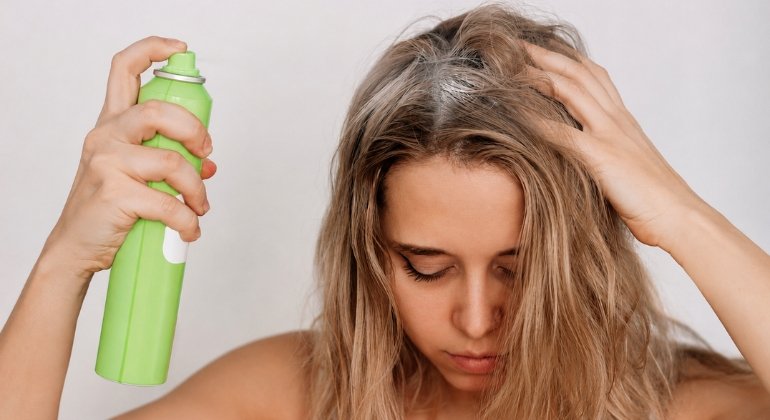
That one fact drives every care decision. Because extensions cannot replenish themselves, every wash strips moisture they have no way to replace, which is what leaves older extensions dry and quick to tangle. Dry shampoo helps by stretching the gap between washes. Use it well and you protect the softness and lifespan of the hair. Use it badly and you swap greasy roots for gritty buildup around your bonds. Good extension aftercare is mostly about washing less often without letting product pile up.
How to apply dry shampoo on hair extensions, step by step
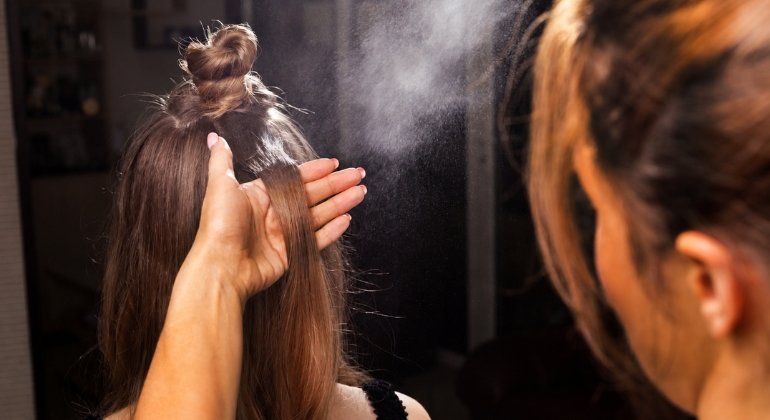
Clean-looking roots come from technique, not volume. Work through these seven steps.
- Brush first. Detangle gently from the ends up so the product lands on smooth hair rather than knots.
- Section the top. Part the crown and hairline into a few horizontal sections, since these oil up first.
- Shake the can. This mixes the formula so it sprays evenly instead of in patches.
- Hold it back. Keep the nozzle 8 to 10 inches (20 to 25 cm) from your scalp. Spraying close dumps product in one spot and leaves a chalky cast.
- Mist the roots only. Use short bursts at the scalp and natural hair. Stay clear of every tape, clip, ring, and keratin bond.
- Wait 30 to 60 seconds. Give the starches time to absorb the oil before you touch anything.
- Massage and brush through. Work it in with your fingertips, then brush with a soft bristle brush to clear residue and blend the roots.
Dry shampoo by extension type
Where you spray, and how careful you need to be, changes with the attachment. This is the part most guides skip.
| Extension type | Where to apply | Keep it away from | Refresh window |
| Clip-in | Natural hair before you clip in; remove pieces to refresh them separately | The wefts and clip bases | 2 to 3 days between washes |
| Tape-in | Parting and crown roots, brushing downward | The adhesive panels (dry shampoo weakens the bond) | Every 2 to 3 days |
| Keratin I-tip, U-tip, flat tip | Light mist at the roots, nozzle held well back | The keratin bonds (buildup adds weight and dulls them) | Every 2 to 3 days |
| Nano and micro ring | A little at the scalp, then brush downward | The rings and join points | Every 2 to 3 days |
| Weft and weave | Along the parting and scalp between the tracks | The sewn or bonded track | 2 to 3 days |
| Halo | Natural hair, then set the halo on top (most freedom here) | Nothing critical, but keep the wire clean | As needed |
The mistakes that ruin extensions
A few habits cause almost all dry shampoo damage.
- Spraying the bonds. Product on tape adhesive or keratin tips breaks them down and causes slippage. Aim at roots and natural hair only.
- Treating it as a wash. The American Academy of Dermatology is blunt on this: dry shampoo absorbs oil but does not clean hair, so you still need water and shampoo. It hides grease. It does not remove sweat, dirt, or styling residue.
- Letting buildup sit. Because the powder stays on the hair, repeated use without a real wash coats the fiber and clogs the scalp. The AAD notes that clumped, visible product can block scalp pores and trigger itching or irritation. Around bonds, the same buildup adds weight and dulls the hair.
- Piling it on. More product does not mean cleaner roots. It means a gritty, coated feel. Build up gradually instead.
As a rule, do not lean on dry shampoo for more than two days in a row without washing. When you do wash, a sulfate-free formula treats the cuticle more kindly than a stripping one.
Choosing a dry shampoo, plus a safety note
For extensions, lightweight and residue-free beats everything. Look for formulas without heavy drying alcohols, which pull moisture from hair that cannot get it back. Tinted versions suit dark hair and skip the white cast.
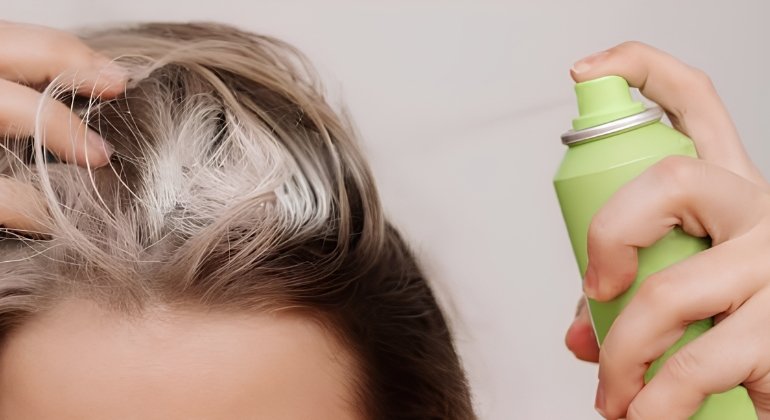
Format matters too. In October 2022 the FDA published a voluntary recall of 19 aerosol dry shampoos from brands including Dove, Nexxus, Suave, TIGI, and TRESemme over potentially elevated benzene, and Procter and Gamble recalled more than 30 aerosol haircare products for the same reason. The contamination traced back to the aerosol propellant, not the starch, and the FDA said exposure at the levels found was not expected to cause harm. Even so, it is a fair reason to buy from reputable brands and to consider non-aerosol pumps or loose powders, which give you more control and carry no propellant.
| Format | How it works | Watch for | Best for |
| Aerosol spray | Fine, fast mist | Chalky cast if held too close; propellant | Quick all-over refresh |
| Non-aerosol pump | Targeted spray, no propellant | Slightly wetter application | Precise root work near bonds |
| Loose powder | Dusted onto the roots | Messy and easy to overdo | Dark roots and spot control |
| Foam | Rubbed into the roots | Can weigh hair down | Fine hair that wants grip |
Extra grip is a real bonus here. A light dusting at the roots adds texture that helps clip-ins and fine hair hold their place. If you wear extensions because your natural hair is fine, that grip is worth knowing about, and our guide to the best hair extensions for fine hair covers the low-tension methods that pair well with it.
How to clear dry shampoo buildup
When wash day comes, cleanse the scalp thoroughly to lift every trace of product. After two or three days of dry shampoo, shampoo the roots twice: the first pass breaks down the residue, the second cleans properly. Keep the water lukewarm, condition the mid-lengths and ends, and let extensions air dry when you can. Your scalp and your hair both hold up longer for it.
Frequently asked questions
Can you put dry shampoo directly on hair extensions?
No. Spray dry shampoo onto your scalp and natural hair only, never onto the wefts, tape, clips, rings, or keratin bonds. Product on the hair itself builds up fast, and product on the attachments weakens them over time. Keep the mist at the roots and brush it downward.
How often can you use dry shampoo on hair extensions?
Use it to bridge two, at most three, days between washes, not longer. Extensions cannot shed buildup the way growing hair does, so relying on dry shampoo for days on end coats the fiber and clogs your scalp. Treat it as a refresh between washes, not a replacement for them.
Does dry shampoo damage hair extensions?
Not when you use it correctly. Damage comes from three habits: spraying it onto bonds or tape, letting residue accumulate without washing, and choosing formulas heavy in drying alcohol. Keep the product off the attachments, wash the buildup out on schedule, and pick something lightweight and residue-free.
What is the best dry shampoo for human hair extensions?
The best formula is lightweight, residue-free, and low in drying alcohol. Tinted versions suit darker hair and avoid a white cast. Non-aerosol pumps and loose powders give you precise control near bonds. Whatever you choose, buy from a reputable brand and apply it sparingly rather than in heavy layers.
Can you use dry shampoo on tape-in or bonded extensions?
Yes, on the parting and crown roots, but never on the adhesive or keratin bonds. Dry shampoo and tape adhesive do not mix, since the powder degrades the bond and leads to slippage. Hold the nozzle well back and brush downward so no product migrates toward the attachments.
How do you get dry shampoo buildup out of extensions?
Wash the scalp thoroughly with a gentle, sulfate-free shampoo, focusing on the roots. After several days of use, cleanse the roots twice so the first pass loosens the residue and the second clears it away. Follow with conditioner on the lengths, and avoid stretching your washes too far apart.
Care for extensions that are built to last
Dry shampoo protects your extensions only as far as the hair quality allows, and hair that is built well handles daily care better. At Thanh An Hair we have manufactured raw Vietnamese human hair for salons and wholesale buyers for 20 years. Explore our full range of extensions, from tape-in to clip-in to keratin bonds, or contact our team for factory-direct wholesale pricing and a sample.
Contact Thanh An Hair today for expert consultation and the most competitive price list.
- WhatsApp/Hotline: (+84) 973 522 855
- Official Website: https://thanhanhair.com/
- Instagram: @thanhanhair
- Email: thanhanexport@gmail.com