
Raw Vietnamese Hair
Not All Cheap Hair Extensions Are Created Equal: The Hidden Truth Suppliers Won’t Tell You
Mar
The global hair industry has become increasingly competitive, pushing many wholesalers and salon owners to prioritize pricing when sourcing products. As a result, cheap hair extensions have gained significant attention, often perceived as a strategic way to maximize profit margins while remaining competitive in the market.
However, this assumption oversimplifies a much more complex reality. While some cheap hair extensions are genuinely cost-effective due to efficient sourcing and direct manufacturing, others are inexpensive because of substandard materials and aggressive cost-cutting. The challenge for buyers is distinguishing between these two categories, as suppliers often present them in nearly identical ways. This is where many businesses make critical sourcing mistakes.
Why Cheap Hair Extensions Don’t Always Mean the Same Thing
Factory Direct vs. Middlemen Pricing
Not all cheap hair extensions are priced low for the same reason, and one of the most important distinctions lies in how the product moves through the supply chain.
Suppliers offering factory-direct pricing typically control the entire production process, from raw hair sourcing to final manufacturing. By eliminating intermediaries, they are able to reduce operational costs while maintaining consistent quality standards. This is how many manufacturers create what can be considered affordable luxury, where the price reflects efficiency rather than compromise.
Vietnamese factories, for example, are well known for this model. Suppliers like Thanh An Hair operate with direct sourcing and in-house production, allowing them to offer stable quality at competitive prices without relying on excessive markups.
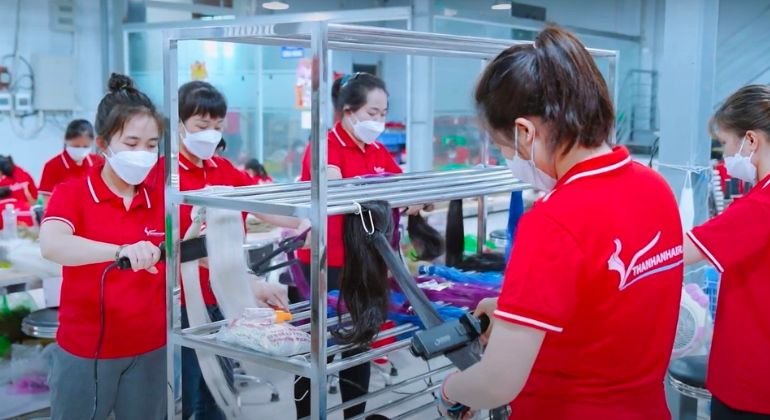
In contrast, products that pass through multiple middlemen often carry hidden inefficiencies. Each layer in the supply chain adds a margin, which can either increase the final price or push manufacturers to cut costs at the production stage. When this happens, the reduction usually affects raw materials, processing methods, or quality control.
As a result, two suppliers may offer cheap hair extensions at similar price points, but one is delivering factory-direct value, while the other is compensating for a fragmented supply chain with compromised quality.
For professional buyers, identifying whether a supplier operates directly or through intermediaries is a critical step in evaluating real product value.
>>> Read more: The Benefits of Buying Hair Extensions from a Factory for Your Salon’s Profitability
Affordable Luxury vs. Low-Grade Cheap Hair Extensions
Beyond supply chain structure, the concept of value plays an equally important role in understanding cheap hair extensions.
Not all low-priced hair should be treated the same. There is a clear difference between products positioned as affordable luxury and those that are simply low-grade.
Affordable Luxury hair is typically produced with a balance between cost efficiency and quality control. The raw hair is still carefully selected, cuticles are preserved or properly aligned, and processing is minimized to maintain durability. While the price remains competitive, the product is designed to perform consistently over time.
On the other hand, low-grade cheap hair extensions are usually the result of aggressive cost-cutting. This may involve mixing multiple hair sources, removing cuticles through chemical treatments, or applying coatings to create a temporary appearance of smoothness.
At the point of purchase, both types can look similar. However, the difference becomes evident after use. Affordable Luxury hair maintains its texture, softness, and manageability, while low-grade hair tends to lose its structure, tangle more easily, and require frequent replacement.
From a wholesale perspective, this distinction is critical. Products that seem inexpensive initially may generate higher long-term costs due to shorter lifespan and increased customer complaints.
Understanding whether a product represents true value or simply a lower price point is what separates experienced buyers from those who rely solely on cost.
>>> Read more: Hair Extensions Price in Vietnam: What You Should Know Before Buying
The Dark Side of Low-Cost Human Hair Extensions: What Are You Actually Buying?
Non-Remy Hair vs. Remy Hair Structure in Cheap Hair Extensions
The internal structure of the hair is one of the most critical factors affecting performance.
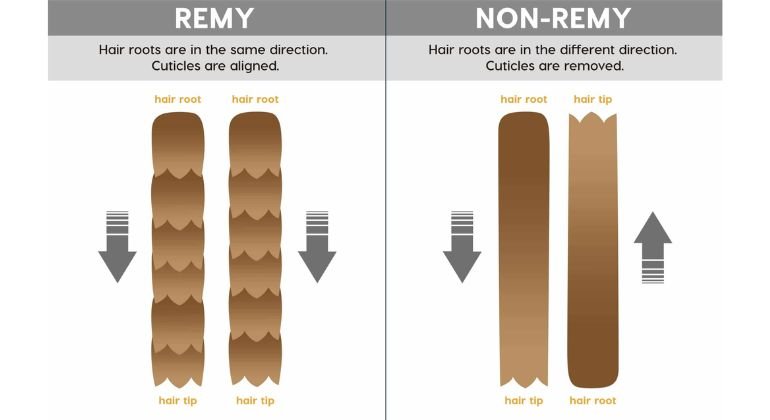
High-quality remy hair maintains cuticle alignment, ensuring that all strands flow in the same direction. This reduces friction and allows the hair to remain smooth over time.
In contrast, many cheap hair extensions use non-Remy hair, where cuticles are either misaligned or removed entirely. This leads to increased friction between strands, causing tangling almost immediately after washing.
What initially feels soft and manageable can quickly become difficult to maintain, not because of usage, but because of structural limitations.
The Hidden Fibre Blending in Cheap Hair Extensions
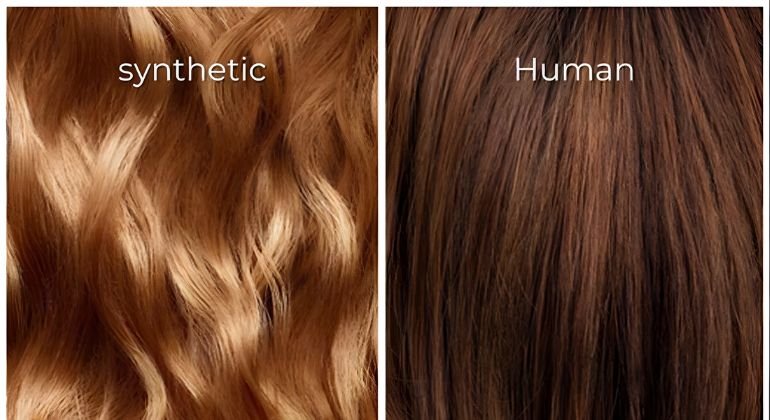
To achieve lower pricing, some manufacturers blend human hair with synthetic fibers or other low-cost materials.
This practice is rarely disclosed clearly, yet it significantly impacts performance. While the hair may look natural at first, synthetic components behave differently under heat and repeated washing. They may lose shape, become stiff, or even melt when exposed to styling tools.
This is one of the most common reasons why certain cheap hair extensions fail to meet professional standards despite their appealing appearance at the point of sale.
Acid Processing and Silicone Coating: The Temporary Perfection
One of the most overlooked processes in low-cost production is chemical treatment.
Hair is often subjected to acid baths to remove cuticles and create a uniform texture. While this improves visual consistency, it weakens the structural integrity of the strands.
To restore a smooth feel, manufacturers apply silicone coatings that create temporary shine and softness. This gives the impression of affordable luxury, even when the underlying quality is compromised.
However, after two to three washes, the coating fades. What remains is hair that is prone to dryness, tangling, and breakage.
This is not a sudden decline in quality. It is the original condition of the hair being revealed.
3 Red Flags to Watch Out For When Buying Cheap Hair Extensions
Unrealistically Low Factory Prices
Competitive factory prices can be a strong advantage, especially when working with factory-direct suppliers. However, when cheap hair extensions are priced significantly lower than the general market range, it is important to approach with caution.
In the hair industry, there is a relatively stable cost associated with sourcing, sorting, and processing real human hair. These steps require time, labor, and controlled conditions to maintain quality. When prices fall far below this baseline, the difference is often made up through compromises in materials or production methods.
In many cases, this may involve using mixed or lower-grade hair, reducing quality control, or relying on chemical processing to quickly standardize appearance. While the product may still look appealing at first, its performance over time often reflects these shortcuts.
For buyers, the key is not to avoid affordable pricing but to understand the reason behind it. True factory direct suppliers can offer competitive rates through efficiency, while unusually low prices often indicate hidden trade-offs in quality.
Inconsistent Texture and Color Distribution
Consistency plays a critical role in evaluating cheap hair extensions, particularly for professional use.
High-quality hair is carefully sorted and processed in controlled batches, ensuring that each bundle maintains a uniform texture, thickness, and color tone. This consistency allows the hair to blend naturally and respond predictably to styling.
In contrast, low-grade extensions often show subtle inconsistencies. Some sections may feel thicker or coarser, while others appear thinner or softer. Color variations can also occur, especially when hair is dyed in bulk without attention to undertones.
These inconsistencies are typically the result of mixing hair from multiple sources without proper standardization. While this reduces production costs, it creates a product that lacks cohesion and reliability.
Over time, these differences become more noticeable during installation and styling. The hair may not blend seamlessly, and the final result can appear uneven, which directly affects customer satisfaction.
Noticeable Chemical Odor
One of the most immediate indicators of low-grade processing in cheap hair extensions is a strong chemical odor.
Hair that has been properly cleaned and processed should have little to no noticeable smell. However, when extensions carry a sharp or lingering chemical scent, it often points to intensive treatments such as acid processing or industrial dyeing.
These methods are commonly used to alter the appearance of lower-quality hair, making it look smoother or more uniform. However, they can also weaken the structure of the hair and leave behind residues if not handled properly.
Beyond the initial smell, this can affect both performance and user experience. Hair that has been heavily processed tends to become dry, tangle more easily, and lose its natural movement after a few washes.
In some cases, chemical residues may also cause discomfort or irritation, particularly for users with sensitive scalps. For wholesalers and salon owners, this is not just a product issue but a reflection of overall quality and reliability.
>>> Read more: How to Buy Hair Extensions Online in 2026: The Ultimate Guide to Choosing High Quality Human Hair
How to Test Hair Extensions Like a Professional Buyer
The Burn Test
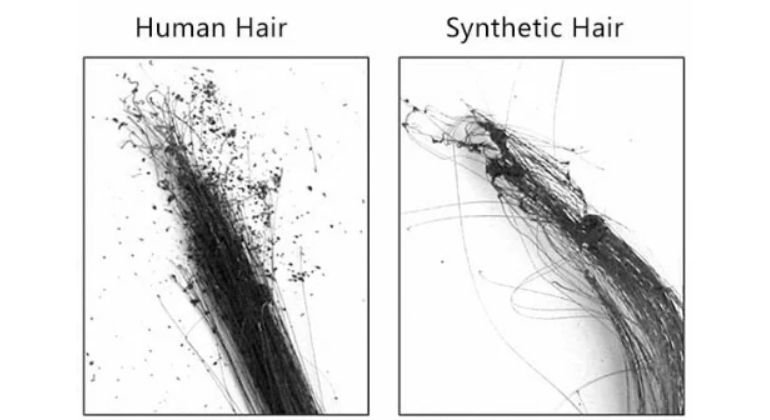
The burn test is commonly used to distinguish between real human hair and synthetic fibers.
Human hair burns into fine ash and produces a smell similar to burnt protein, while synthetic materials melt and emit a plastic-like odor. This simple method can reveal hidden blending in cheap hair extensions.
The Wash Test
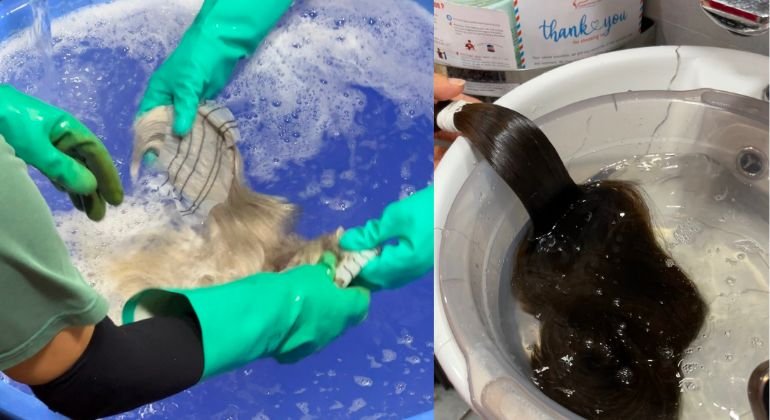
Washing removes any surface coatings and exposes the true condition of the hair.
High-quality extensions maintain smoothness and structure, while low-quality hair often becomes tangled or dry immediately after washing. This is particularly effective in identifying silicone-coated products.
The Bleach Test
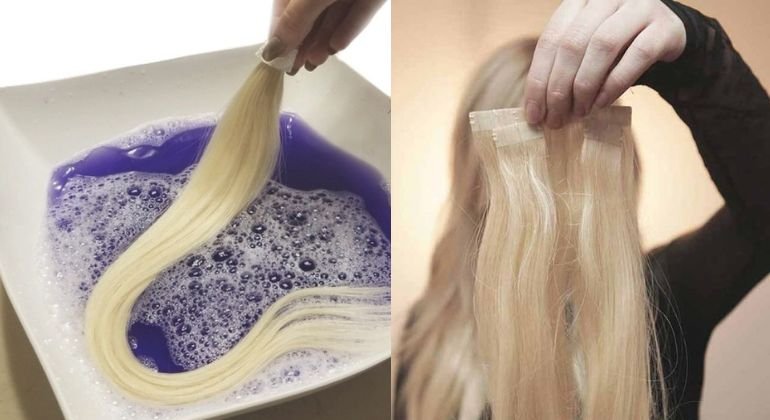
The bleach test evaluates the resilience of the hair under chemical exposure.
Hair that maintains integrity during controlled bleaching is more likely to be high quality. In contrast, low-grade hair may weaken, break, or produce uneven results.
This test is especially important for wholesalers who offer customization services.
Conclusion
The growing popularity of cheap hair extensions reflects the demand for competitive pricing in the beauty industry. However, not all low-cost products offer the same value.
Understanding the difference between low-quality hair and affordable luxury at factory prices is essential for making informed sourcing decisions. By evaluating material integrity, processing methods, and long-term performance, buyers can avoid the hidden risks associated with inferior products.
Rather than focusing solely on price, successful wholesalers prioritize consistency, reliability, and supplier transparency.
Manufacturers like Thanh An Hair demonstrate that it is entirely possible to achieve this balance. By combining direct factory sourcing with strict quality control, they offer hair extensions that meet both performance expectations and budget requirements, allowing businesses to grow sustainably in a competitive market.
>>> Read more: The Ultimate Guide to Hair Extension Manufacturing in Vietnam: How Thanh An Hair Supplies the Global Market
Contact Thanh An Hair today for expert consultation and the most competitive price list.
- WhatsApp/Hotline: (+84) 973 522 855
- Official Website: https://thanhanhair.com/
- Instagram: @thanhanhair
- Email: thanhanexport@gmail.com