
Raw Vietnamese Hair
Pixie Haircut for Women: Types, Fit and Grow-Out Timeline
Aug
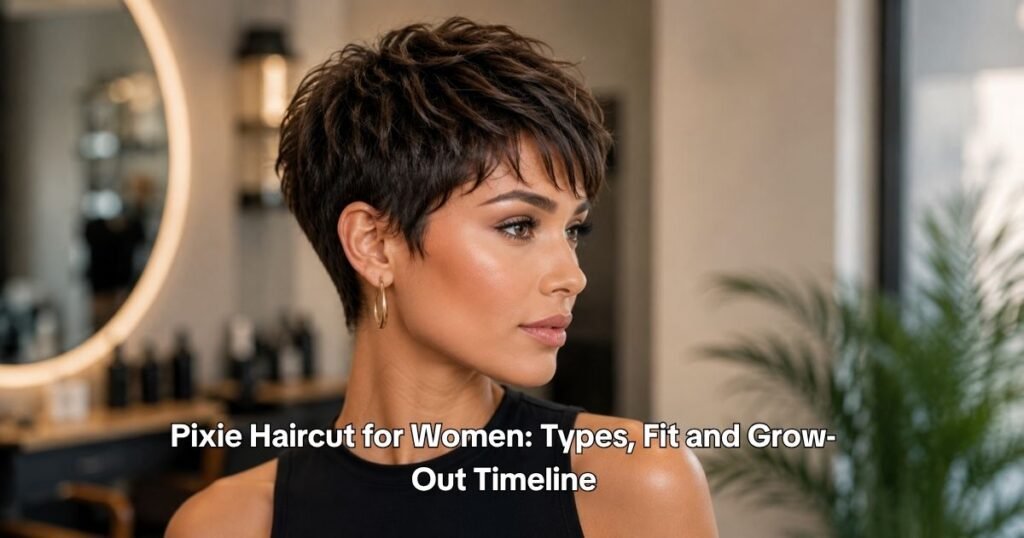
A pixie haircut for women crops the back and sides to 0.5 to 1.5 inches and leaves 2 to 4 inches on top. Hair density and growth pattern decide whether it suits you more than face shape does. Growing one back to a chin-length bob takes 9 to 20 months, depending on your measured growth rate.
Most pixie guides tell you the cut works on heart, round and square faces, then hand you a styling product list. That advice skips the two things that decide whether you walk out of the salon happy: how many hairs per square centimetre you have, and which way they grow at your crown and nape.
This guide gives you the measurements stylists cut to, a density test you can do at home in a minute, and a grow-out timeline calculated from published growth-rate data rather than guesswork. Thanh An Hair has manufactured raw hair extensions for about 20 years, so the section on which attachment method works at which length comes from the hardware dimensions we produce, not from a blog.
What is a pixie haircut and what lengths define it?
A pixie haircut is a short cut with the nape and sides cropped shorter than the top, creating a deliberate weight imbalance that lifts the shape away from the neck and jaw. The name comes from Audrey Hepburn’s crop in Roman Holiday (1953), and the silhouette has stayed in salon rotation since.

Vague words like “short” and “cropped” cause most bad haircuts. Pixie haircut lengths are easier to discuss as numbers, so here is what a stylist actually works to.
Standard pixie cut lengths by section
| Section | Typical length | What it controls |
| Nape | 0.25 to 0.75 in (0.6 to 2 cm) | How clean the neckline reads; grows out fastest visually |
| Sides and over the ear | 0.5 to 1.5 in (1 to 4 cm) | Whether ears show; how wide the head looks |
| Occipital (back of crown) | 1.5 to 2.5 in (4 to 6 cm) | Round shape at the back of the head |
| Top and crown | 2 to 4 in (5 to 10 cm) | Volume, styling range, day-to-day versatility |
| Fringe or front piece | 2 to 6 in (5 to 15 cm) | Face framing; the single biggest style variable |
Ask for these in inches or centimetres at your consultation. “Short back and sides with length on top” gets interpreted five different ways by five different stylists.
Will a pixie cut suit you? Density and growth pattern beat face shape
Face shape matters less than the industry claims. A pixie exposes your scalp, hairline and neck, so the variables that decide the result are how much hair you have per square centimetre and which direction it grows. Both are measurable at home.
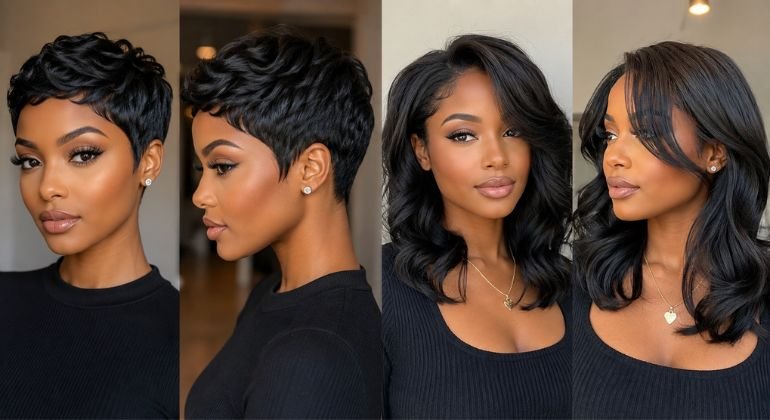
Published phototrichogram data shows how wide the range runs. In a study of African volunteers published in the British Journal of Dermatology, scalp density varied from 90 to 290 hairs per square centimetre across individuals, with a group mean of 190 plus or minus 40, compared with 227 plus or minus 55 in a matched Caucasian group (Loussouarn, 2001). A woman at 90 hairs per square centimetre and a woman at 290 need completely different pixie shapes.
The 60-second density test
- Part your hair down the centre in front of a mirror in bright, direct light.
- Look at how wide the scalp line reads. Under about 2 mm means high density. Around 5 mm means medium. Wider than 1 cm means low density.
- Gather all your hair into a ponytail at the crown and measure the circumference with a soft tape. Under 5 cm is fine or low density. Around 10 cm is medium. Over 12 cm is thick.
What the result means. Low density suits a shorter, tighter pixie with blunt lines, because layering removes weight you cannot spare. High density suits a longer, more layered pixie, because bulk needs somewhere to go or the shape turns mushroom-shaped above the ears.
Map your cowlicks before you book
A cowlick is a patch where hair grows at a sharply different angle to the hair around it. At long lengths, weight flattens them. At pixie lengths, nothing holds them down, and a cowlick you never noticed becomes the thing you fight every morning.
Wash your hair, apply nothing, let it air dry completely and take photos of your crown, hairline and nape. Check for a crown whorl, a hairline cowlick that pushes the fringe sideways, and nape hair that grows upward or fans outward. Show those photos to your stylist. A good cutter designs around a whorl instead of fighting it, which usually means leaving 1 to 2 cm more length at that spot.
Six types of pixie haircut for women, with the lengths behind them
The types of pixie cuts you see named online describe weight distribution and length rather than different haircuts. This table gives the measurements and the hair type each shape suits.
Pixie cut types compared by length, density fit and upkeep
| Type | Top length | Side and nape length | Best density | Trim interval |
| Classic pixie | 2 to 3 in (5 to 8 cm) | 0.5 to 1 in (1 to 2.5 cm) | Medium to high | 4 to 6 weeks |
| Short pixie cut (micro) | 1 to 2 in (2.5 to 5 cm) | 0.25 to 0.5 in (0.6 to 1 cm) | Any, best on high | 3 to 4 weeks |
| Long pixie cut | 3 to 5 in (8 to 13 cm) | 1.5 to 2.5 in (4 to 6 cm) | Any | 6 to 8 weeks |
| Choppy or textured pixie | 2.5 to 4 in (6 to 10 cm) | 1 to 2 in (2.5 to 5 cm) | Medium to high | 5 to 7 weeks |
| Shaggy or messy pixie | 3 to 4.5 in (8 to 11 cm) | 1.5 to 2.5 in (4 to 6 cm) | Medium | 6 to 8 weeks |
| Pixie mullet or bixie | 2.5 to 4 in (6 to 10 cm) | Sides 1 in, nape 3 to 5 in | Any | 6 to 10 weeks |
Start long if this is your first pixie. A long pixie can be cut shorter at the next appointment. A micro pixie cannot be reversed for months. If you are unsure, the bixie haircut keeps more nape length and gives you an exit route in either direction.
How to style a pixie cut: two finishes, step by step
Short hair sits where you dry it. Direction of airflow matters more than product volume, and the whole routine should take under six minutes.
Sleek finish
- Towel-dry to damp, not dripping. Product on soaking hair dilutes and slides off.
- Work a pea-sized amount of smoothing cream through the top and crown only. Keep it off the nape and sides, which need grip rather than slip.
- Blow-dry with a small round brush, directing airflow from root to tip and following the direction you want the hair to sit. Aim the nozzle down the hair shaft to close the cuticle.
- Finish with a light shine mist held about 30 cm away. Closer than that and short hair goes flat.
Textured finish
- Apply a root-lift spray to damp roots at the crown, then rough-dry with your fingers, lifting hair against its natural fall.
- Flip your head forward for the last 30 seconds of drying to set lift at the root.
- Warm a rice-grain amount of matte paste between your palms until it disappears, then press it into the ends in pinching motions. Never rake it through, which drags the shape flat.
- Leave the fringe until last so you can judge how much movement the rest of the cut already has.
Pixie cuts on curly and coily hair: what changes
Most pixie guides mention straight and wavy hair, then stop. Curl pattern changes three practical things.
Shrinkage sets the real length. Tight coils can appear 60 to 75 percent shorter than their stretched length. A cut that measures 8 cm stretched may read as 2 to 3 cm dry. Ask your stylist to cut curl by curl on dry hair and to state lengths as stretched measurements so you both mean the same thing.
Density distribution is rarely even. Coily hair often has lower density at the temples and hairline. A stylist who takes the sides too tight there exposes sparse patches. Ask for the perimeter to stay 1 cm longer than the standard spec.
Growth patterns are more pronounced. Coily nape hair frequently grows upward, which makes a graduated nape sit proud instead of flat. A rounded nape rather than a tapered one solves it.
How long does it take to grow out a pixie cut?
Growing a pixie to a chin-length bob takes roughly 9 to 13 months for hair growing at typical Caucasian rates, and 14 to 20 months for African-textured hair. The commonly quoted “six to nine months” is optimistic for almost everyone.
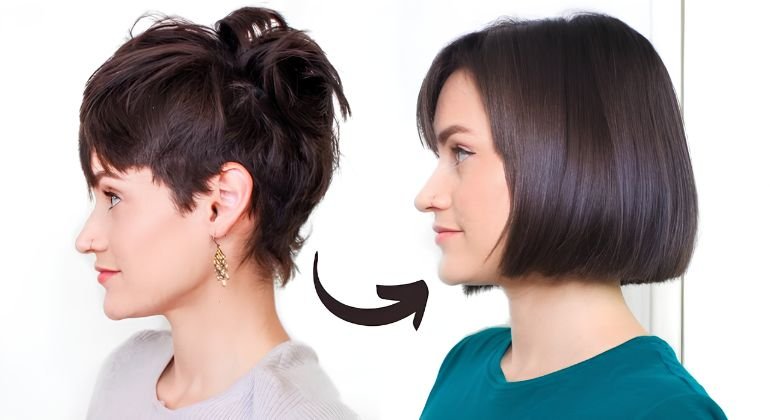
Those figures come from measured growth rates rather than estimates. Loussouarn’s phototrichogram study recorded African hair growing at 256 plus or minus 44 micrometres per day and Caucasian hair at 396 plus or minus 55 micrometres per day. Converted to monthly growth, that is about 0.65 to 0.91 cm per month and 1.04 to 1.37 cm per month respectively. Over a full year the gap works out to roughly 5 cm of length.
The table below starts from a nape and sides at 2 cm, which is where a classic pixie sits, and calculates the months needed to reach each milestone.
Pixie grow-out timeline, calculated from measured growth rates
| Milestone | Length needed | Caucasian hair | African-textured hair |
| Ear-length, bixie stage | 8 cm (3.1 in) | 4 to 6 months | 7 to 9 months |
| Jaw-length short bob | 13 cm (5.1 in) | 8 to 11 months | 12 to 17 months |
| Chin-length bob | 15 cm (5.9 in) | 9 to 13 months | 14 to 20 months |
| Collarbone lob | 25 cm (9.8 in) | 17 to 22 months | 25 to 36 months |
Calculated by Thanh An Hair from the growth rates reported in Loussouarn (2001), using plus or minus one standard deviation to give a range. Individual rates vary. Asian hair generally sits at the faster end of the published spread.
Keep trimming while growing out a pixie cut. It sounds backwards, but the sides and nape reach an awkward stage where they flick outward while the top stays flat. Trimming the sides every 8 to 10 weeks while leaving the top and nape untouched lets the shorter sections catch up in proportion. The destination shape is usually a micro bob, and stylists steer toward it deliberately rather than waiting.
Which hair extensions work at each pixie grow-out stage
Extensions are the part every pixie article skips. The rule is physical rather than aesthetic: your natural hair has to be long enough to cover the attachment point, or the hardware shows.
Each method has a fixed piece of hardware with fixed dimensions. Your hair needs to be roughly three times the depth of that hardware for the attachment to disappear. As a manufacturer, we can state the numbers directly.
Minimum natural hair length by attachment method
| Method | Attachment size | Minimum natural length | Unlocks at grow-out month |
| Topper or crown piece | Clips at the parting, sits on top | 2 in (5 cm) | Works during the pixie itself |
| Nano ring | Bead about 2.5 mm | 3 in (8 cm) | Month 4 to 9 |
| Tape-in | Tab about 4 cm wide by 0.8 cm deep | 4 in (10 cm) | Month 6 to 12 |
| Clip-in weft | Clip base 2 to 3.5 cm | 4 in (10 cm) | Month 6 to 12 |
| Keratin or K-tip | Bond about 1 cm | 4 in (10 cm) | Month 6 to 12 |
| Halo | Wire sits across the crown | 5 in (13 cm) | Month 8 to 15 |
| Hand-tied weft | Row plus bead foundation | 6 in (15 cm) | Month 10 to 18 |
The practical sequence looks like this. During the pixie stage itself, a topper adds crown density without touching the perimeter. From around month four, nano rings can fill the gap between short sides and a longer top. From month six, clip-ins let you switch length on and off. Once you pass 15 cm, hand-tied wefts become the smoothest option.
Cuticle direction matters more at short lengths. On long hair, a mismatched cuticle takes weeks to tangle noticeably. On a 10 cm blend, every strand sits in the visible zone, so cuticle-aligned single-donor hair is the difference between a blend that reads natural and one that mats within days.
Keeping short hair safe under extensions
Short hair gives an attachment less anchor, which means tension concentrates on fewer follicles. The American Academy of Dermatology is direct about the warning signs: if a style feels painful, it is too tight. Watch for stinging, crusts on the scalp, tenting where sections of scalp lift, broken hairs around the forehead and a receding hairline. Those signs point to traction alopecia, which becomes permanent if the pulling continues.
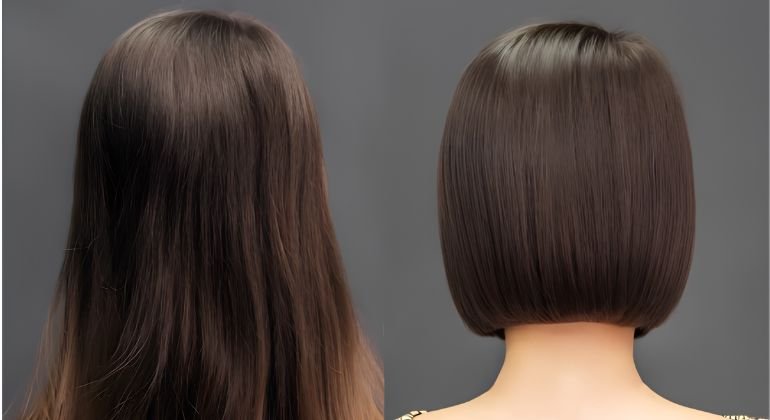
AAD guidance for wearing extensions safely also recommends limiting wear to two or three months before giving hair a break, having the fitting done professionally, asking the stylist to loosen any area that hurts, and removing clip-ins before washing. Losing 50 to 100 hairs a day is normal, so judge shedding against that baseline rather than panicking at the first strands in the sink.
This section covers general hair care, not medical advice. If you notice thinning, scalp pain or patches of loss, see a board-certified dermatologist.
What a pixie actually costs to maintain
Pixies get sold as low-maintenance. Daily styling time does drop, often to under six minutes. Salon frequency moves the other way.
Annual salon visits and daily styling time by length
| Length | Trim interval | Cuts per year | Daily styling |
| Micro pixie | 3 to 4 weeks | 13 to 17 | 3 to 5 minutes |
| Classic pixie | 4 to 6 weeks | 9 to 13 | 4 to 6 minutes |
| Long pixie cut | 6 to 8 weeks | 7 to 9 | 5 to 8 minutes |
| Shoulder-length | 10 to 12 weeks | 4 to 5 | 10 to 20 minutes |
A classic pixie needs roughly twice the salon visits of shoulder-length hair. Budget for that before you cut, because a grown-out pixie between appointments is where most regret starts.
What to ask your stylist
- “What length will you leave at the nape, sides, crown and fringe, in centimetres?”
- “Where are my cowlicks, and how are you cutting around them?”
- “Given my density, should this be blunter or more layered?”
- “Will you taper or round the nape, and which suits my growth direction?”
- “How will this look at week five, before my next appointment?”
- “If I hate it, what is the shortest path back to a bob?”
The week-five question is the useful one. Any cut looks good on the day. A cut designed to hold its shape through the whole cycle is a different piece of work.
Source your grow-out hair from the factory
Thanh An Hair manufactures cuticle-aligned raw Vietnamese hair in Vietnam and ships factory-direct to salons, stylists and resellers worldwide. If you fit extensions for clients working through a pixie grow-out, we supply toppers, nano rings, tape-ins, clip-ins and hand-tied wefts in the short lengths that stage actually needs.
Request a colour ring and factory price list
Ready to find your perfect match? Contact us today for expert advice and exclusive discounts on premium human hair extensions.
📲Phone/WhatsApp: +1 (206) 698‑5133
🛜Instagram: RAW HAIR LUXURY COMPANY
🌐Tik Tok: RAW HAIR LUXURY
📧 Email: Rawhairluxury.us
🌐Website: rawhairluxury.com