
Raw Vietnamese Hair
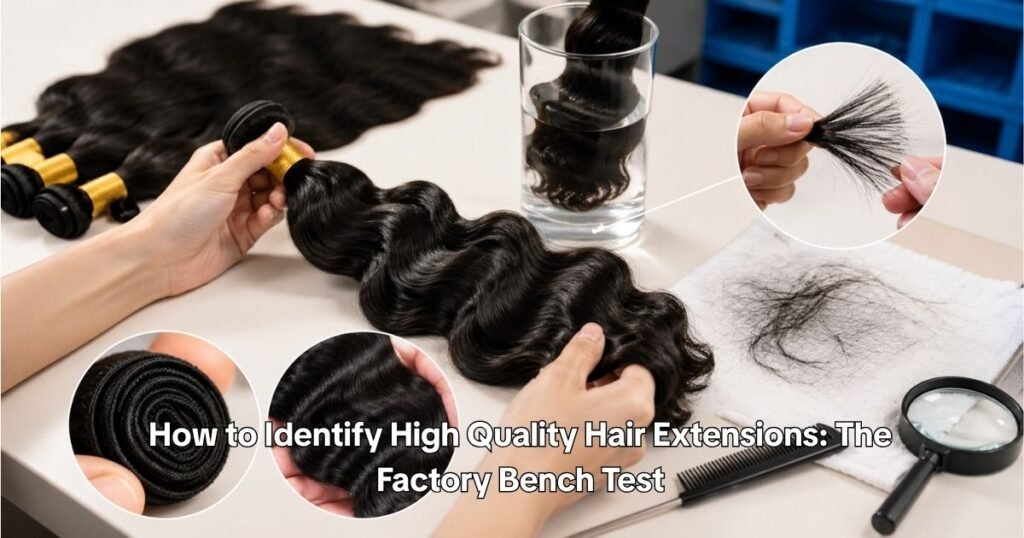
How to Identify High-Quality Hair Extensions: The Factory Bench Test
Aug
How to identify high-quality hair extensions: check four things in order, cuticle direction, end taper, surface coating, and weft construction. Slide your fingers up a strand and feel for resistance. Grip the bundle at four heights and compare thickness. Wash once with clarifying shampoo. Then tug the weft seam. Low-grade hair fails at least one of these.
Most buying guides stop at “look for Remy hair” and “avoid synthetic.” That advice was useful a decade ago. The supply chain has since gotten good at making bad hair pass a showroom inspection, and a silicone film will survive every test a customer runs in a store. What follows is the sequence our quality control team runs on incoming raw material before it reaches a weft machine, adapted so you can run it on a sample at your own station.
What Actually Separates High-Quality Hair Extensions From the Rest
Four variables decide how a bundle behaves at month three. Everything else is packaging.
Cuticle direction. The cuticle is a single layer of flattened cells that overlap like shingles on a roof, per the StatPearls histology reference. When every strand in a bundle points root-to-tip in the same direction, those shingles glide past each other. When strands run both ways, the scales catch, and the bundle mats from the inside out. This is the entire difference between hair that lasts and hair that does not.
Donor count. A single donor bundle comes off one head. Texture, diameter, and porosity match by definition, so the bundle takes color evenly and behaves as one fiber. Multi-donor Remy hair is cuticle-aligned but still blends heads, which is why two bundles from the same order can lift to different tones.
Processing load. Chemical treatment is measurable damage, not a matter of opinion. Researchers measuring protein loss found untreated virgin hair leaked about 1.12 micrograms per gram, while chemically straightened hair leaked roughly 2.5, and glyoxylic acid treatment pushed it to 3.5 (Velasco et al., PMC). Every acid bath used to strip cuticles or force a texture spends part of the fiber’s remaining life.
Weft construction. The fiber can be flawless and the bundle still fail if the weft returns are loose. Construction is where a factory either protects the material or wastes it.
How to Identify High-Quality Hair Extensions in Six Bench Tests
Run these in order on a sample. The whole sequence takes about fifteen minutes plus drying time, and any single failure is enough to reject a supplier.
- Check cuticle direction with the finger slip test
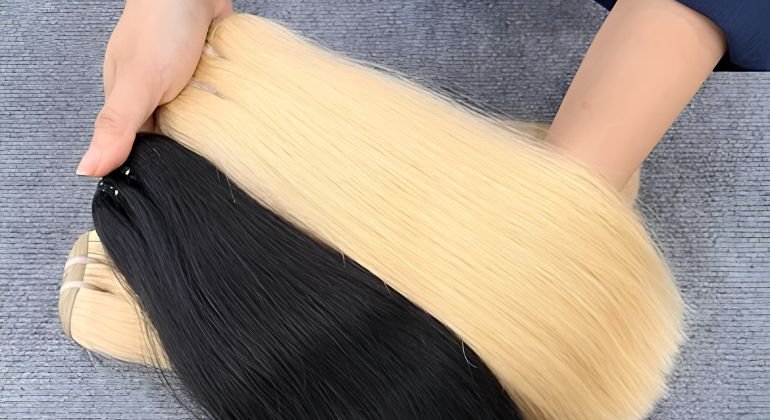
Hold the bundle at the weft. Slide your fingers down toward the ends, then back up toward the weft. Cuticle-aligned hair feels smooth on the way down and gives slight resistance on the way up. If both directions feel identical, the cuticle layer has been stripped in an acid bath. - Run the four-point grip test for end taper
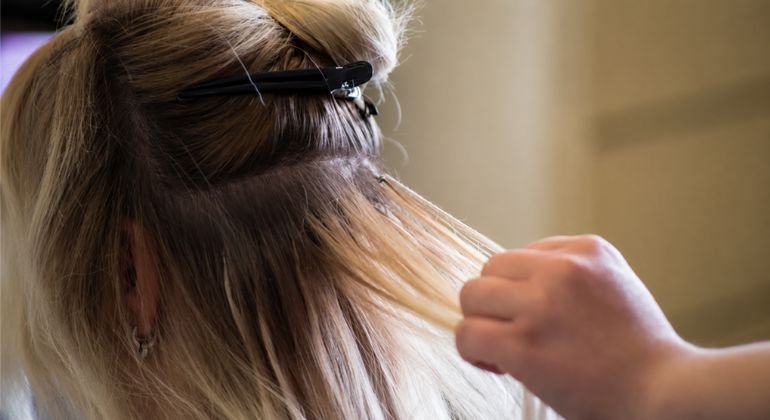
Grip the bundle just below the weft, then at one third, two thirds, and just above the tips. Single drawn hair thins visibly at each step. Double drawn hair holds close to the same diameter until the final inch or two. - Strip the coating with a clarifying wash
Wash a small section twice with a sulfate clarifying shampoo and skip the conditioner. Air dry it. Silicone-coated hair turns coarse and flat. Raw hair keeps most of its hand feel, because the shine comes from an intact cuticle rather than a film. - Run the wet tangle test
Submerge the washed section, swish it thirty times, then lift it and comb from the ends upward. Count the snags. Cuticle-aligned hair clears in two or three passes. Mixed-direction hair mats near the mid-shaft and fights the comb. - Inspect the weft seam under tension
Pull the weft apart along its length with steady pressure, then rub the seam between thumb and forefinger. A sound machine weft will not gap or release strands. Loose returns and visible glue lines predict shedding inside the first month of wear. - Test texture memory with heat
Flat iron a small section at 350 F, then wash it and let it air dry. Raw hair returns to its own texture. Heavily processed hair stays limp, or the color drifts warm, which tells you the strand was lifted to a pale level and re-dyed.
One caution on the burn test that circulates on social media. It separates human hair from synthetic, which is a real question, and it tells you nothing about grade. Non-Remy hair collected off a salon floor burns exactly like single donor hair off one head.
Raw Single Donor vs Remy vs Processed Hair: A Side-by-Side Comparison
These three grades get sold under overlapping language. The table separates them by what you can verify rather than by what the label claims.
| Attribute | Raw single donor | Remy (multi-donor) | Non-Remy / processed |
| Cuticle direction | Intact, one direction, one head | Aligned, blended heads | Mixed or stripped in acid |
| Donor count | One | Several to many | Unknown, often collected loose |
| Chemical load | None to minimal | Light to moderate | Heavy acid and dye |
| End taper | Natural taper, or double drawn to order | Varies by lot | Thin, wispy, often padded at the weft |
| Response to lightening | Predictable, even | Uneven between bundles | Breaks or goes brassy |
| Typical failure mode | Wear at the attachment point | Tonal mismatch across bundles | Matting at mid-shaft by week four |
| Best fit | Custom color work, long wear, salon clients | Volume retail at a controlled price | Costume and short-term use |
Our one donor bulk hair sits in the first column, and our standard weft hair lines span the first two depending on the order. We say that plainly because a factory that claims every SKU is raw single donor is telling you something about its honesty, not its capability.
Seven Questions That Separate a Factory From a Reseller
Ask these on a first call. The answers tell you who you are actually buying from.
- Which province does your raw hair come from, and who collects it? A factory names the region. A reseller names a country.
- Can I see the weft machines? Ask for unedited video, not a stock photo. Construction is the part that cannot be outsourced invisibly.
- What is the grams-per-weft tolerance on a repeat order? A real number with a range beats any adjective.
- Do you sell single donor as a distinct SKU, or is everything “raw”? Honest segmentation signals honest sourcing.
- What acid or steam process does this texture go through? Steam-set texture and acid-set texture age differently. A factory knows which one it ran.
- Will you send a paid sample from the same lot as my bulk order? The word that matters is lot.
- What is your remedy if the wet tangle test fails on arrival? Written terms, before money moves.
Thanh An Hair has run production in Vietnam for around two decades, and our teams still answer these on every first call. If you want to compare construction types before you ask, hand tied weft, clip in hair, and full lace wig pages set out how each is built.
Put the Checklist to Work
Every test above works on a sample you already have. Run the six-step sequence on your current supplier’s hair this week, then run it on someone else’s, and let the results decide rather than the packaging. Hair that holds up under a clarifying wash and a wet comb will hold up on a client.
If you want a control sample to test against, request a paid sample pack from our factory floor and put it through the same sequence. Contact Thanh An Hair to request a sample from a current production lot, and tell us which grade you want to compare.
Ready to find your perfect match? Contact us today for expert advice and exclusive discounts on premium human hair extensions.
📲Phone/WhatsApp: +1 (206) 698‑5133
🛜Instagram: RAW HAIR LUXURY COMPANY
🌐Tik Tok: RAW HAIR LUXURY
📧 Email: Rawhairluxury.us
🌐Website: rawhairluxury.com