
Raw Vietnamese Hair
The Best Hair Extensions for Thick Hair: A Manufacturer’s 2026 Guide
Jul
The best hair extensions for thick hair are high-density weft and weave sets, multiple-bond keratin methods such as I-tip and flat-tip, and heavy double-drawn clip-in sets of roughly 200 grams or more. Thick hair asks the extensions to match two things at once: overall density, measured in grams, and the diameter of each strand, known as caliber. Match both and the seam disappears.
Hair extensions for thick hair compared
Here is how the main methods perform on medium to thick, dense hair. Weights shown are the practical minimum most stylists reach for on thick hair, not the lightest option a brand sells.
| Method | Typical weight for thick hair | Blends on dense hair | Reusable | Application | Best for |
| Machine or hand-tied weft | 150 to 300 g across several wefts | Excellent | Yes | Salon (sew or bead) | Maximum density, worn-down styles |
| Clip-in (double or triple weft) | 200 to 300 g full head | Very good | Yes | At home | Removable volume and length |
| Tape-in | 100 to 200 g, double-sandwiched | Good | Yes (retape) | Salon | Flat, seamless mid-lengths |
| Keratin I-tip / flat-tip | 150 to 250 g in many bonds | Excellent | Yes | Salon | Coarse hair, up-styles, movement |
| Nano ring | 150 to 250 g in many rings | Very good | Yes | Salon | Discreet roots, less tension per bond |
| Halo (single wire) | 120 to 180 g one piece | Fair on very thick hair | Yes | At home | Quick volume, occasional wear |
The two numbers that decide everything: density and caliber
Most guides treat “thick hair” as one thing. It is really two independent measurements, and confusing them is the single biggest reason extensions fail to blend.
Density is how many hairs grow per square centimetre of scalp. High density is what people usually mean by thick. It tells you how many grams of extension hair you need so the added hair does not look sparse next to your own.
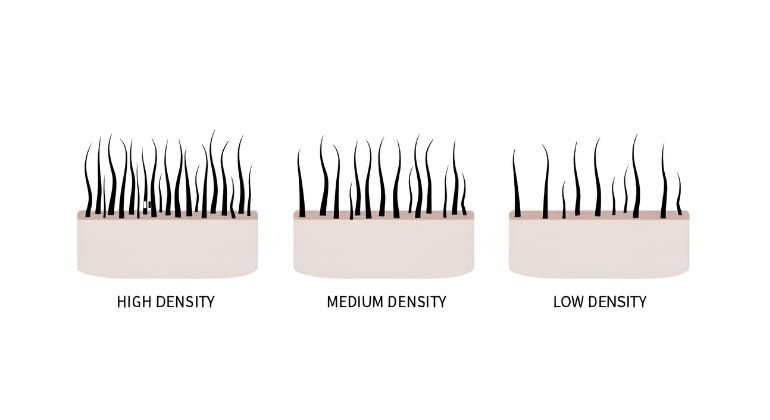
Caliber is the diameter of a single strand, measured in microns. Trichology research places fine strands below roughly 50 microns, medium strands between about 50 and 90 microns, and coarse strands above 90 microns. Studies of hair density and diameter across populations show the two vary independently and are shaped largely by genetics, which is why one person can have dense but fine hair while another has sparse but coarse hair. You can read the underlying measurement work in this quantitative trichoscopy study on hair density and diameter.
Extensions have to match both. Get the grams right but the caliber wrong, and silky, fine-diameter extension hair slides straight through coarse natural hair and separates. Match the caliber but skimp on grams, and the ends look thin. Thick, coarse hair needs extension hair with a comparable strand diameter and enough weight behind it. This is where the raw material matters more than the marketing: undamaged raw hair keeps its natural diameter, while heavily processed hair that has been acid-bathed and silicone-coated is often stripped thinner than it started, so it reads as “fine” against dense hair no matter how many grams you add.
The best hair extension methods for thick hair
Wefts and weaves: the density workhorse
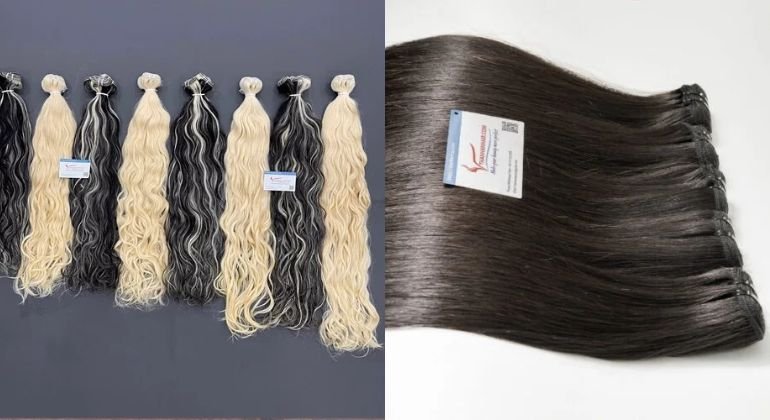
For sheer density matching, sewn or beaded weft hair is hard to beat. A weft covers a wide section with a single continuous track, so a handful of wefts delivers the 150 to 300 grams thick hair usually needs. Hand-tied wefts lie flatter than machine wefts and suit finer sections near the crown, while machine wefts pack in more grams per row for the back and sides. The trade-off is that a thick sewn row can show if you wear tight up-styles, so many stylists blend wefts through the body of the hair and switch to smaller bonds around the hairline.
Clip-ins: removable volume for thick hair
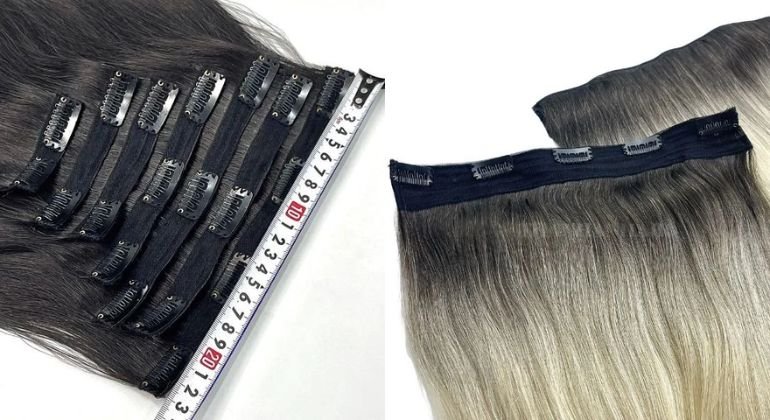
Clip-ins get unfairly dismissed for thick hair, but the failure is almost always weight, not the method. A standard 100 to 130 gram set will not blend into dense hair. A double-weft or triple-weft clip-in set of 200 grams or more will. Because clip-ins clip into your own hair with no bonds or tape, they place no long-term tension on the follicle, which makes them the gentlest option for anyone worried about their scalp. They are ideal if you want length and volume you can take out at night.
Keratin I-tip and flat-tip: the coarse-hair favourite
When hair is both dense and coarse, individually bonded strands blend most naturally. I-tip and flat-tip keratin extensions are installed strand by strand, so the added hair moves with your own and disappears even in a high ponytail. Thick hair needs a high bond count to reach full coverage, often 150 to 250 grams total, but each bond carries only a little weight, which spreads the load across the scalp instead of concentrating it. They are reusable across several installs, making them a strong long-term value.
Tape-in: flat and invisible, with limits
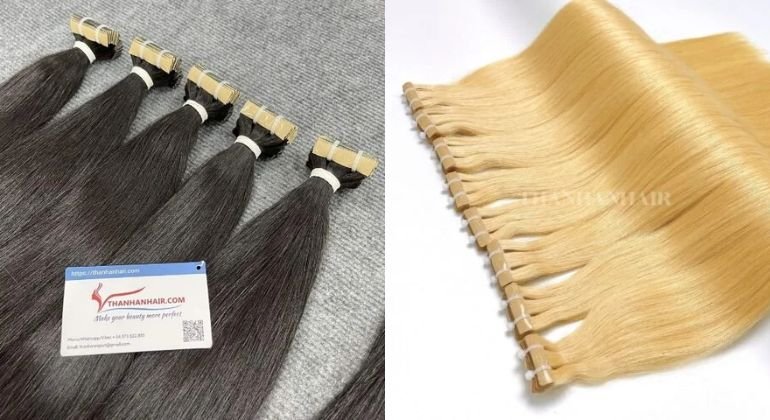
Tape-in extensions lie almost flat to the head, which is why they read as seamless on mid-length styles. On thick hair the trick is to sandwich two tapes around a section of your own hair to carry the density, and to use enough panels. Tape works beautifully on straight and wavy hair of medium caliber. On very coarse or very heavy hair, the adhesive can struggle to hold the weight, so wefts or bonds are the safer choice.
Halo: fast, but not for the thickest hair
A halo sits on a single wire and drops one layer of hair over your own. It is brilliant for quick volume on fine to medium hair, but a single piece rarely carries enough grams to blend into genuinely thick hair, and the top layer of your own dense hair can bury it. Treat the halo as an occasional-wear convenience rather than a thick-hair solution.
Double-drawn is not optional for thick hair
Even at the right weight and caliber, extensions look thin at the bottom if they are single-drawn. In a single-drawn bundle the strands are mixed lengths, so the hair is full at the top and tapers to a few thin ends. That taper is exactly the “wispy ends” thick-haired clients complain about.
Double-drawn hair has most of the shorter strands removed by hand, so the bundle stays close to the same thickness from root to tip and finishes with a full, blunt end. Super double-drawn takes this further for the most uniform result. If your natural hair is thick and blunt, you need double-drawn or super double-drawn hair to match it, and this is worth confirming with any supplier before you buy. Our single-donor bulk hair is drawn to keep that end-to-end thickness, which is what lets it blend into dense hair. If you are new to grading terms, our explainer on what Remy hair is covers how cuticle direction and drawing affect the finished look.
How to match extensions to thick hair, step by step
- Test your density and caliber. Part your hair to see how much scalp shows (density) and roll a single strand between your fingers (caliber). Thick, coarse hair is dense with strands you can clearly feel.
- Choose a method that matches your density. High density points to wefts, a heavy clip-in set, or a high bond count, not to a single lightweight piece.
- Match the grams. Plan for roughly 200 grams or more for a full head of thick hair, and more again for extra length.
- Match the caliber and choose double-drawn. Pick raw hair of a similar strand diameter to your own, drawn double so the ends stay full.
- Match texture and colour. Match your natural texture, then colour-match at the mid-lengths and ends where the blend shows most.
- Blend with layering. A light layer or point-cut through the join removes any hard line between your hair and the extensions.
- Protect the scalp. Distribute weight, avoid over-tightening bonds at the hairline, and give your hair rest periods between installs.
Can extensions damage thick hair? What the dermatology says
Thick hair tempts you to add a lot of weight, and that is exactly where the risk lies. Traction alopecia is hair loss caused by sustained pulling force on the hair shaft, and dermatologists have documented it in patterns that match where heavy wefts were attached, as reported in the Journal of the American Academy of Dermatology. It is avoidable with sensible weight and placement.
The American Academy of Dermatology advises wearing heavy or tightly attached styles, including extensions and weaves, only some of the time, and removing anything that causes pain or tension at the roots. Losing 50 to 100 hairs a day is normal, so a few shed strands on removal is not a warning sign, but soreness, redness, or little bumps along the hairline are. To keep dense hair healthy, spread the weight across many bonds rather than a few heavy ones, keep the hairline loose, rotate your method, and take breaks between installs. Peer-reviewed work by Billero and Miteva in Clinical, Cosmetic and Investigational Dermatology reinforces that early, gentle changes usually reverse the damage before it becomes permanent.
Why raw Vietnamese hair suits thick, coarse hair
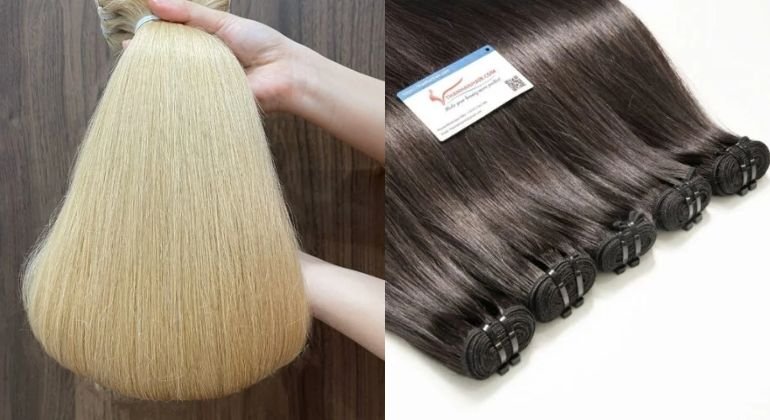
Raw hair collected from a single donor and left unprocessed keeps its natural strand diameter, which tends to sit in the medium to coarse band that dense hair needs to match. Because it is not acid-stripped or heavily coated, it holds that caliber and its own cuticle, so it behaves like the wearer’s own hair rather than a silky overlay that separates. Sold factory-direct and available double-drawn across straight, wavy and curly textures, it gives salons and resellers a base that blends into thick hair without the thinning that aggressive processing causes. This matters for the fastest-growing part of the market: according to Grand View Research, the global hair wigs and extensions market was valued at about USD 15.22 billion in 2025 and is projected to reach USD 31.13 billion by 2033, with human hair the largest segment at roughly 65.6 percent, and North America the largest region.
Frequently asked questions
How many grams of hair extensions do I need for thick hair?
For a full head of thick hair, plan for roughly 200 grams or more, and add weight again if you want significant length. In practice that is several wefts, a double-weft or triple-weft clip-in set, or a high count of keratin bonds. A standard 100 to 130 gram set is built for fine to medium hair and will not blend into dense strands.
What is the best extension method for very thick, coarse hair?
Sewn or beaded wefts and individually bonded keratin I-tips or flat-tips blend most naturally on very thick, coarse hair because they deliver both high density and a matching strand caliber. Whichever you choose, use double-drawn or super double-drawn hair so the ends stay full rather than tapering to wispy tips.
Do clip-in extensions work on thick hair?
Yes, as long as the set is heavy enough. A double-weft or triple-weft clip-in set of 200 grams or more blends into dense hair, while a lightweight 100 to 130 gram set will not. Clip-ins are also the gentlest option, since they clip into your own hair and place no lasting tension on the follicle.
Why do my extensions look thin at the ends?
Thin, wispy ends are the signature of single-drawn hair, where mixed strand lengths make the bundle taper toward the bottom. Switch to double-drawn or super double-drawn hair, which keeps a near-uniform thickness from root to tip and finishes with a full, blunt end that matches thick natural hair.
Can hair extensions damage thick hair?
They can if they are too heavy or attached too tightly, which can lead to traction alopecia, a tension-related hair loss the American Academy of Dermatology links to heavy or tight styles. Spread weight across many bonds, keep the hairline loose, remove anything that hurts, and take breaks between installs to keep dense hair healthy.
Are Vietnamese raw hair extensions good for thick hair?
They are well suited to it. Raw Vietnamese hair tends to fall in the medium to coarse diameter range that dense hair needs to match, and because it is unprocessed it keeps that caliber and its cuticle instead of being stripped thin. Bought double-drawn and factory-direct, it blends into thick hair and holds up over time.
Match your clients’ thick hair with factory-direct raw hair
Thanh An Hair has produced single-donor raw Vietnamese hair for two decades, drawn double for full ends and available in every texture. Request a sample bundle or a wholesale colour match and see how it blends into dense, coarse hair.
Contact Thanh An Hair today for expert consultation and the most competitive price list.
- WhatsApp/Hotline: (+84) 973 522 855
- Official Website: https://thanhanhair.com/
- Instagram: @thanhanhair
- Email: thanhanexport@gmail.com