
Raw Vietnamese Hair
Best Hair Extensions for Curly Hair: Top 3 by Curl Type
Oct
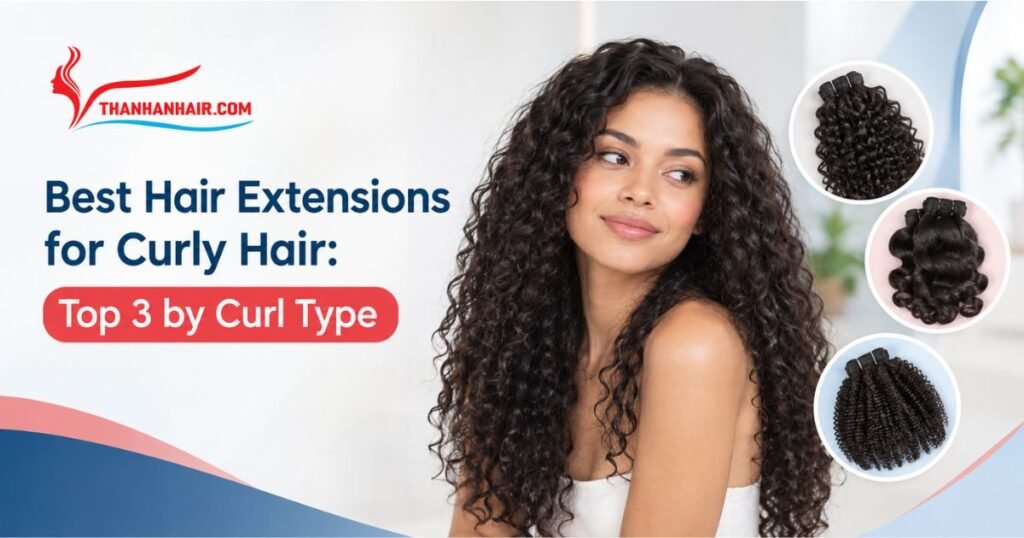
The best hair extensions for curly hair are sew-in wefts, clip-ins and tape-ins, in that order for most curl types. Sew-ins give the most secure blend for 3A to 4C curls, clip-ins add volume with zero commitment, and tape-ins suit looser 2C to 3B waves. Texture match matters more than method.
We have made raw Vietnamese hair at our family factory for close to two decades, and we steam-set every curly texture we sell. That work shows us what most extension guides skip: how a curl behaves after the third wash, why some bundles mat at the nape while others stay soft, and why curly buyers so often order the wrong length. This guide ranks the top 3 methods, shows which texture fits each curl type, and covers how to wear curly hair extensions without damaging the hair underneath.
It is written for stylists choosing a method for curly clients, salon owners deciding which textures to stock, and curly-haired women who want to walk into the salon knowing what to ask for.
Why Curly Hair Needs a Different Extension Strategy
Curly hair needs extensions that match its curl pattern, its shrinkage and its moisture needs. A straight piece next to a 3C curl shows on the first humid day, and curly strands knot where they meet clips, tape or thread.
Most stylists use the 1A to 4C curl chart. Researchers took a more measurable route: a 2007 study in Human Biology measured hair from 1,442 people in 18 countries and sorted it into eight shape groups using curl diameter, curl index and the number of waves. For you, that means curl is a shape you can measure. You can match an extension by measuring your curl instead of guessing from a photo.
Curl diameter test: the tool that fits your curl points to the right extension texture.
Shrinkage Changes the Length You Should Buy
Suppliers measure curly bundles stretched straight. A 16-inch deep wave bundle hangs shorter on the head than a 16-inch straight bundle, and the tighter the curl, the bigger the gap. Measure from your install row to where you want dry curls to land, then size up. Ask your supplier for both the stretched length and the natural hang length before you order.
The Top 3 Hair Extensions for Curly Hair, Ranked
We ranked these by how well each method blends with natural curls, how much stress it puts on your own hair, and how long the hair lasts.
1. Curly Sew-In Extensions: Best for 3A to 4C Curls
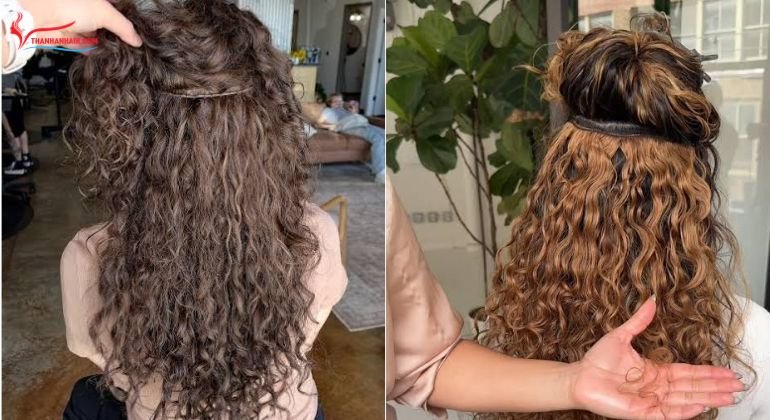
A sew-in anchors curly wefts to cornrow braids with thread, so you get no glue and no heat at the root. Tighter curls hide the wefts well, which lets your stylist keep the leave-out small and the blend seamless. The American Academy of Dermatology recommends sewn-in weaves over glue-bonded ones because thread puts no adhesive on your roots.
For curly installs, ask for double-stitched weft hair. Curly wefts get combed through more often than straight ones, and a reinforced top seam holds the hair in place while you detangle. The trade-off sits in the braids underneath: if they feel tight, ask your stylist to redo them before the wefts go on.
2. Curly Clip-In Extensions: Best for Volume Without Commitment
Curly clip-in extensions snap onto small sections and come out every night, so they carry the lowest tension risk of the three. They suit 2B to 4A curls, special events, and anyone testing a texture before committing to a sew-in.
Two tips from our salon clients. On fine curls, open a section, clip close to the root and let the curls above fall over the clip. On 4A hair, use fewer, wider pieces so the clips do not stack into bulk. If clips bother a sensitive scalp, a halo extension rests on an invisible wire and puts no grip on your hair at all.
3. Curly Tape-In Extensions: Best for 2C to 3B Curls
Tape-ins sandwich a section of your hair between two thin adhesive panels, so they lie flat and install fast. They work best on looser curls, where the root lies smooth enough for the tape to grip. On type 4 hair, tight coils lift the panel and the oils that coily hair needs break the adhesive down.
Most stylists move tape-ins up every six to eight weeks as your hair grows. Keep oil-based products off the tape line, and rinse conditioner from the bonds with care.
For 4B to 4C hair that needs a full change of length, a curly full lace wig protects your edges better than any of the three methods above.
Curl Pattern Matching: Which Texture Fits Your Hair
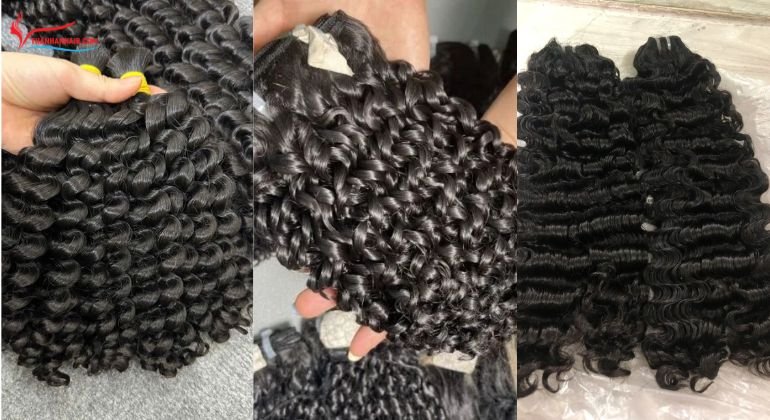
Match the extension’s dry curl to your dry curl, then check it wet. This chart maps common curl types to the textures we produce.
| Your curl type | Closest Thanh An texture | Why it blends |
| 2A to 2B (loose waves) | Steam Body Wave | A soft S-pattern that also relaxes into a smooth blowout |
| 2C to 3A (waves into loops) | Steam Loose Wave | Defined loops that sit well with mixed wave and curl |
| 3A to 3B (springy curls) | Burmese (natural wave) | Donor wave with no added processing; pattern varies bundle to bundle |
| 3B to 3C (tight curls) | Steam Deep Wave | Tight, springy curl with the volume 3C hair carries |
| 4A to 4C (coils) | Yaki/Kinky Straight for blowouts and press styles; Steam Deep Wave for curly blends | Kinky Straight copies the texture of blown-out type 4 hair |
The Wet Test for Raw Curly Hair
We set our curly textures with steam on raw hair instead of a chemical perm. Steam-set curls come back after every wash; repeated flat ironing loosens them over time, as it would any curl. Before you buy in bulk, wet one strand from a sample and let it air dry. Good curly hair springs back to its pattern. Chemically processed hair often frizzes or loses definition.
Cuticle direction matters more on curly hair than straight. When cuticles point both ways, curls grip each other and mat at the nape. Single-donor raw hair keeps cuticles aligned root to tip, which keeps deep wave and loose wave textures from tangling.
How to Blend Extensions with Curly Hair
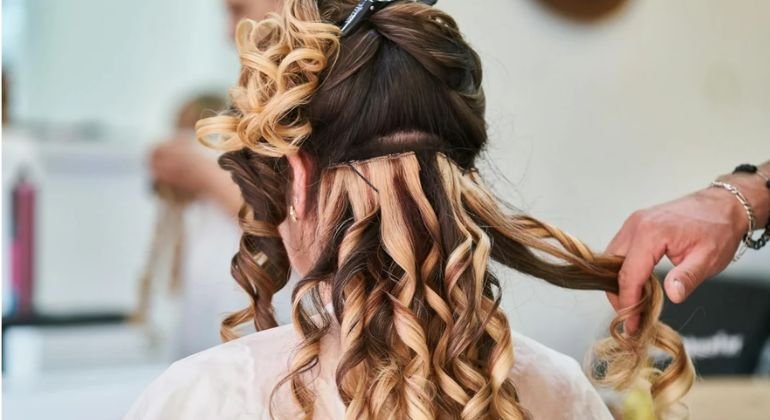
Follow these five steps for an install that blends from day one.
- Type your curl on clean, dry hair. Wash, skip all styling product, and let your hair air dry. Wrap one curl around a pencil, then a marker. The tool that fits the curl tells you its diameter, and that number guides the texture you buy.
- Pick the texture one step looser if you are unsure. You can tighten a looser extension curl with a flexi rod or twist set. Loosening a tight curl takes heat, and repeated heat wears the steam-set pattern down over time.
- Order by hang length, not stretched length. Measure from your install row to where you want dry curls to land. Curly bundles are sold by stretched length, so add length to cover shrinkage before you order.
- Wash the extensions before the install. Co-wash the wefts or clip-ins with the conditioner you use at home and let them air dry. Your curls and the extension curls then react to the same product before they meet.
- Style both together with one product pass. Rake leave-in or gel through your hair and the extensions in the same pass, then scrunch. Both clump into matching curl groups, which hides the line where your hair meets the extension.
Frequently Asked Questions About Curly Hair Extensions
What are the best hair extensions for curly hair?
Sew-in wefts give the most secure, natural blend for 3A to 4C curls. Clip-ins suit anyone who wants volume without braids or adhesive. Tape-ins work best on looser 2C to 3B curls. Whichever method you pick, match the extension texture to your dry curl pattern first.
Can you put tape-in extensions on 4C hair?
You can, but most stylists avoid it. Tight coils lift the tape panel away from the root, and the oils and heavy conditioners that 4C hair needs weaken the adhesive. A sew-in, a halo or a curly lace wig gives a longer-lasting result for type 4 hair.
Do curly hair extensions lose their curl after washing?
Steam-set and natural raw curly hair returns to its pattern after washing and air drying. Chemically permed hair often frizzes or loosens within a few washes. Repeated flat ironing loosens any curl over time, so limit heat and refresh the pattern with water and leave-in instead.
How long do curly sew-in extensions last?
Most stylists reinstall a curly sew-in every six to eight weeks as your braids grow out. The American Academy of Dermatology advises wearing weaves for two to three months at most before giving your own hair a break. Quality raw hair wefts can be reused across several installs.
Can hair extensions cause hair loss on curly hair?
Yes, if they pull too hard or stay in too long. Constant tension causes traction alopecia, which shows up as broken hairs and a receding hairline. Caught early, it often reverses when you stop the tight style. Pain or a headache after an install means the braids or bonds are too tight.
The Bottom Line
Choose a sew-in for the most natural blend on 3A to 4C curls, clip-ins for volume you can take off at night, and tape-ins for looser 2C to 3B curls. Match the texture to your dry curl, buy for hang length, run the wet test, and keep tension low so your own curls stay healthy under the extensions.
Stylists and salon owners: send us your clients’ curl types and we will ship a matched texture sample set, so you can run the wet test before you stock a single bundle.
Request a curly texture sample set
- WhatsApp/Hotline: (+84) 973 522 855
- Official Website: https://thanhanhair.com/
- Instagram: @thanhanhair
- Email: thanhanexport@gmail.com