
Raw Vietnamese Hair
Hair Factory vs Trading Company vs Reseller: 7 Checks That Prove Who You Are Buying From
Sep
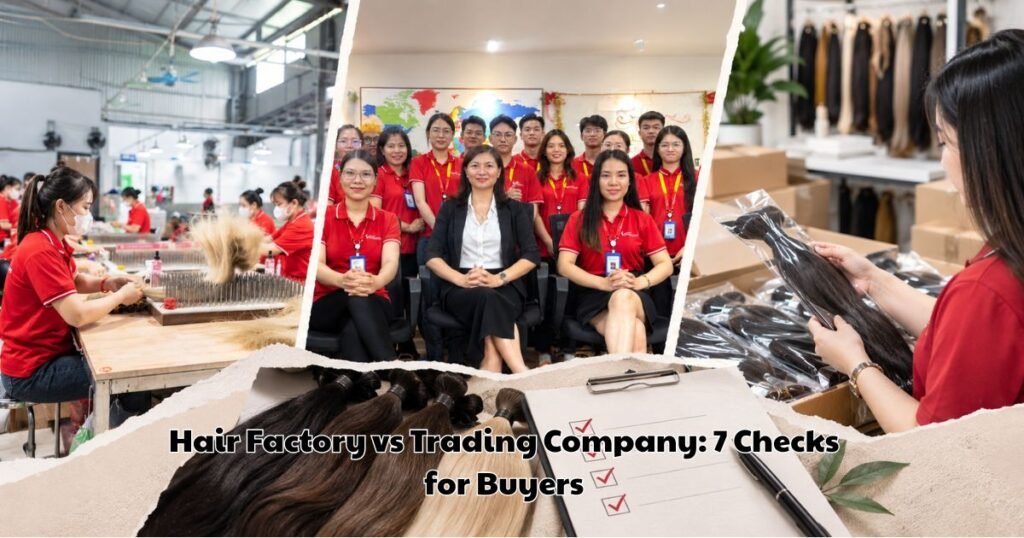
Hair factory vs trading company comes down to one question: does the company you pay own the production line, or does it buy finished hair from someone who does? Seven checks settle it. Business registration records, origin documents, a live production call and a custom spec request will expose an intermediary before you wire a deposit.
Hair factory vs trading company vs reseller: what actually differs
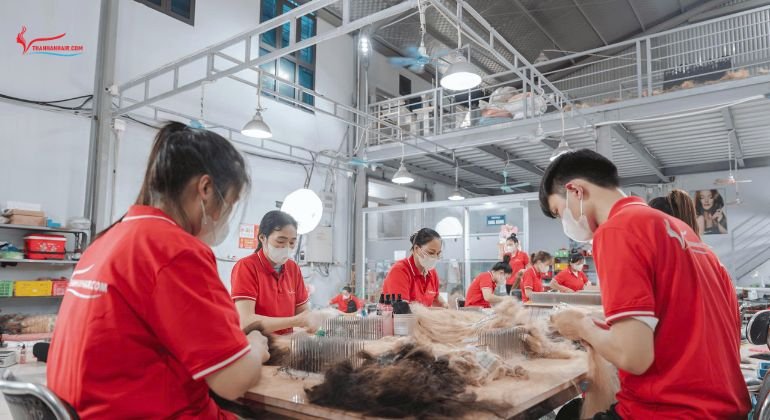
A factory owns the sorting tables, the wefting machines and the finishing room, and it sells what it makes. A trading company buys finished hair from one or more factories and sells it under its own name, often filing the export declaration in its own name too. A reseller holds little or no stock and forwards your order to whoever does.
All three sell hair. One of them can change how the hair is made. That is the practical difference, and it decides what happens on the day a batch sheds.
Factory, trading company and reseller compared on the seven things a buyer can actually test
| What you are testing | Factory | Trading company | Reseller or dropship agent |
| Owns the production line | Yes | No, it buys finished goods | No |
| Controls sorting and QC | Yes, in house | At incoming inspection only | No inspection step |
| Can run a spec that is not in the catalog | Yes, it schedules a run | Only if its factory agrees | No |
| Named as exporter on the customs declaration and C/O | Yes, in its own name | Sometimes, sometimes its factory is named | Rarely appears on any customs document |
| Lead time when you change a spec | Set by its own production schedule | Its factory’s schedule plus its own queue | Unpredictable |
| Who fixes a defective batch | Reworks or replaces from its own line | Whatever its factory will accept | Refunds, or stops replying |
| What breaks first as your volume grows | Capacity, which you can see and plan around | The supplier relationship behind it, which you cannot see | Everything, at the first large order |
Why the factory question got sharper in 2026
Vietnam tightened origin enforcement through 2025, which changed what a supplier has to be able to prove about itself.
On 21 April 2025 the Ministry of Industry and Trade issued Decision 1103/QD-BCT, withdrawing the Vietnam Chamber of Commerce and Industry’s authority to issue certificates of origin. From 5 May 2025 the Ministry’s own agencies handle every non-preferential certificate, including Form B, the form that travels with US-bound shipments because Vietnam and the United States have no free trade agreement. Eight days after that decision, on 29 April 2025, the Customs Department issued Decision 467/QD-CHQ, a new procedure for checking and determining the origin of exported and imported goods, aimed at stopping foreign products from reaching the US labeled as made in Vietnam (Vietnam Briefing, May 2025).
For a salon owner in the US, that lands in one specific place. If the company taking your deposit does not produce in Vietnam, its Vietnamese origin claim rests on a file submitted by a company you have never spoken to. Your landed cost, the origin story you repeat to your own clients, and your position if an entry gets questioned all sit on that second company’s paperwork.
Price works along the same line. A trading company’s margin sits on top of a factory price, which is the usual argument for going direct. The counter-argument holds up too: a trading company that consolidates four factories into one air waybill can beat a single factory on freight, and it can hold US stock so a salon reorders on Tuesday and installs on Friday. Compare landed cost per gram delivered rather than the unit price on the quote.
Seven checks that prove who you are buying from
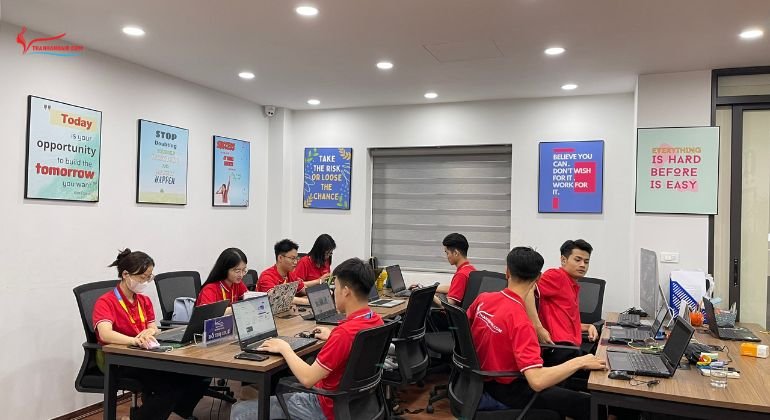
Run them in order. The first three cost nothing and take an afternoon. The rest cost you a sample order and one awkward conversation.
Check 1. Pull the company’s registration record
Ask for the enterprise code, which in Vietnam is also the tax code, and look it up on the National Business Registration Portal at dangkykinhdoanh.gov.vn. The free public record shows the registered name, enterprise code, legal representative, address, registered business lines and current status. Check that a manufacturing activity appears in the business lines, not wholesale trade alone, and that the status reads active.
Check 2. Ask whose name goes on the export documents
Request a document set from a past shipment with the buyer details redacted: commercial invoice, packing list and certificate of origin. Look at the exporter field. A factory or an exporting trading company will show its own name there. A reseller cannot produce the set at all, because it never files an export declaration.
Check 3. Check the origin certificate against the current issuing authority
Shipments to the United States travel under Form B, the non-preferential certificate of origin, because Vietnam and the US have no free trade agreement. Since 5 May 2025 the Ministry of Industry and Trade issues it and the Vietnam Chamber of Commerce and Industry does not. A supplier who still says VCCI handles its certificates has not shipped recently in its own name.
Check 4. Run a live production call on your schedule, not theirs
Ask for an unannounced video call during Vietnamese working hours. Request three things in one continuous shot: the sorting tables, a wefting machine running, and the production board for that day. A cut between scenes, a silent showroom or an offer to film tomorrow answers the question.
Check 5. Order one specification the catalog does not carry
Request something small and non-standard: a weft width you name, a length between two catalog sizes, or a color blend to your reference. A factory replies with a production date and a price per unit. An intermediary goes quiet, then steers you back toward a catalog item.
Check 6. Search public US import records, then read the silence correctly
ImportYeti and similar services index United States Customs bill of lading records, which are public. Two limits matter for hair: these databases cover sea freight, and most extension orders move by air courier. A match is strong evidence that the company exports. No match proves nothing in this category.
Check 7. Put the defect clause in writing before you pay
Add one clause to the proforma invoice covering who inspects, what counts as a defect, and who pays for rework, replacement and return freight. A producer negotiates the wording because it controls the line. An intermediary changes the subject, because it cannot commit to terms its own supplier has not accepted.
Five questions that separate a producer from a reseller
Documents tell you what a company is registered to do. A call tells you whether anyone on the other end has stood on a production floor. Ask these five, then listen to the shape of the answer rather than the confidence behind it.
- “Which production steps do you do in house, and which do you buy in?”
Almost every hair factory buys something in, whether that is lace bases, tape tabs or keratin. A producer names the bought-in step without hesitating. A reseller claims to do all of it. - “What is your scrap rate on a wefting run, and what causes it?”
Production people answer with a cause: short hair in the bundle, a tension setting, an operator new to the machine. Sales-only people give you a tidy number and no mechanism. - “Which lengths are hardest for you to source this month?”
Anyone touching raw material knows the current squeeze and will say so. A reseller tells you everything is available in every length. - “Can you ship in my packaging, and what changes on your line to do it?”
Listen for a process answer about where labeling happens and how it affects the run. A yes with no process behind it means the packaging gets done somewhere else. - “Who signs the export declaration for my shipment?”
You want a name and a role. A deflection here, after four solid answers, is the most useful reply in the whole call.
Spec control shows up fastest in construction work. Ask for a hand-tied weft at a width you name, or a single-donor bulk lot held together through production, and the reply tells you whether a line exists behind the conversation.
When a trading company is the right partner
A trading company is not the enemy of your margin. Several of them do work a single factory cannot: consolidating four suppliers into one shipment, holding US stock for fast reorders, carrying the customs paperwork for a first-time importer who has never filed an entry.
The problem is the undisclosed middleman, not the middleman. A company that tells you what it is, names its role on the documents and signs a defect clause is a legitimate partner. A company that walks you through a factory floor it does not own has already shown you how it will handle a bad batch.
Six red flags in the first three replies
Most of these surface before you ever reach a sample.
- The price drops on your first push without a single change to the specification.
- Reverse image search puts the same product photos on three other suppliers’ sites.
- They will not give you an enterprise code, or they send a certificate image with the number cropped out.
- The address on the website resolves to a house or a shared office in street view.
- Every product and every quantity carries the same quoted lead time.
- A technical question comes back as a paragraph from the brochure.
Run these checks on us first
Ask for our verification pack before you discuss price: enterprise code, a redacted export document set from a recent US shipment, and a live line call booked at your local time. We have run a family production line in Vietnam long enough that none of it is awkward to send.
Contact Thanh An Hair to discuss hair textures, lengths, and wholesale options for your business.
- WhatsApp/Hotline: (+84) 973 522 855
- Official Website: https://thanhanhair.com/
- Instagram: @thanhanhair
- Email: thanhanexport@gmail.com