
Raw Vietnamese Hair
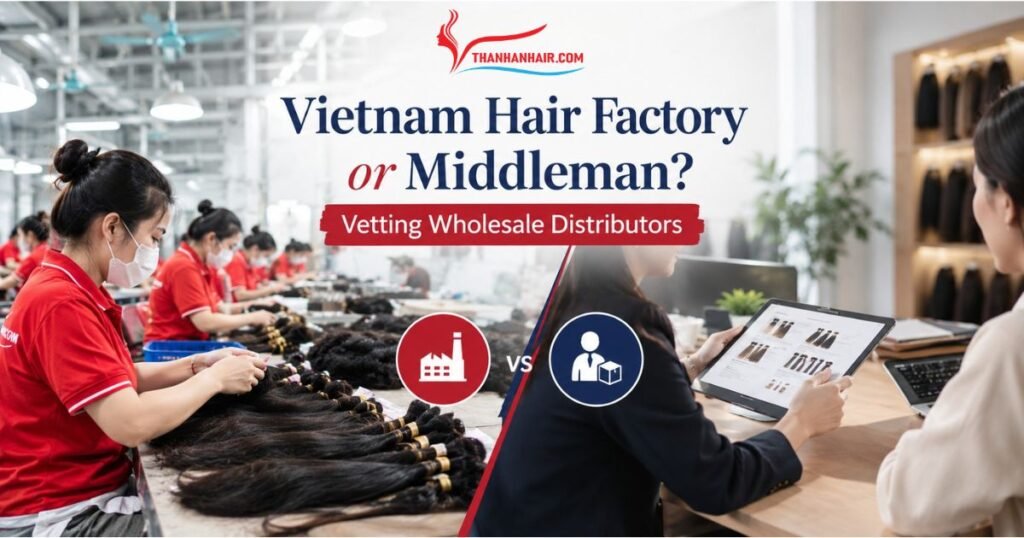
Vietnam Hair Factory or Middleman? Vetting Wholesale Distributors
Sep
What “top-rated” should mean when you compare wholesale hair distributors
Most lists of Vietnam hair factory vendors rank suppliers by how long they have traded or how large their social following is. Neither predicts the thing that decides your margin, which is whether your fourth order matches your first. A supplier that nails a sample and drifts by lot three costs you more than one that starts average and holds.
Buyers who place repeat wholesale orders grade air factory on six measurable criteria. Each one has a weak answer and a strong answer, and the gap between them is where sourcing risk lives.
Vietnam’s real position in the global hair trade (and why it protects your pricing)
Here is the number almost no supplier page will show you. World exports in the wig and hairpiece category, HS 6704, came to about 6.42 billion US dollars in 2023, with China taking roughly 84 percent of it. Vietnam, by contrast, recorded around 58.7 million US dollars of HS 6704 exports in 2022, which works out to under one percent of world trade in the category. Exports of dressed human hair under HS 6703 added about 8.63 million US dollars, up 29 percent year on year, with the United States taking 57 percent of it.
Read that as a sourcing signal rather than a weakness. Vietnam is a specialty origin, not a volume origin. Collection is manual, donors are individual, and the supply ceiling is set by how much hair can physically be gathered in a season. That is precisely why raw Vietnamese hair wholesale pricing sits above Chinese processed hair, and why a factory quoting unlimited tonnage at Chinese prices is a warning sign, not a bargain.
It also explains the MOQ behaviour you will meet. A real collection network protects its yield by setting minimums per texture and length band. A reseller does not need to, because it is shipping someone else’s finished goods.
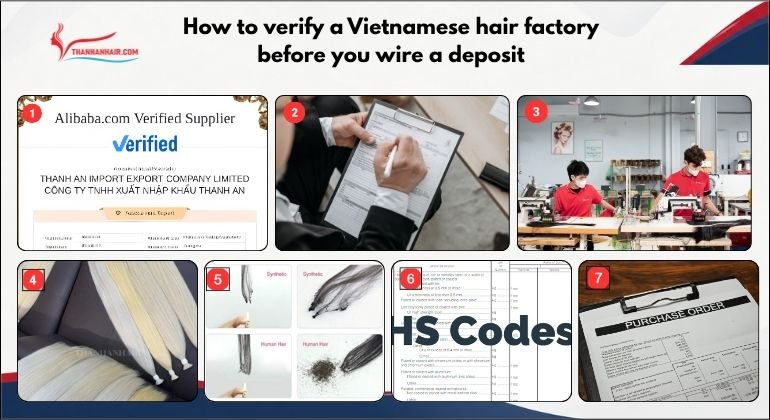
How to verify a Vietnamese hair factory before you wire a deposit
Run this sequence in order. It takes about three weeks end to end and it costs less than one bad container. Each step is designed to fail cheaply, which is the entire point.
- Match the legal entity to the exporter. Ask for the enterprise registration number and the exact company name that will appear on the commercial invoice. A distributor that invoices under a different entity than the one it shows you on video is a trading company, not a factory.
- Request a lot-level origin statement. Ask for the collection province and the donor count behind the specific lot you are buying, not a generic company claim. A real collection network can name both in writing.
- Book an unedited live walkthrough. Request a live video tour of the collection store, the wash line and the weft line, with the current date spoken on camera. Pre-recorded footage proves nothing about who owns the floor.
- Order two samples two weeks apart. Buy one sample from stock and one made to your spec a fortnight later. Consistency between those two lots predicts your reorder experience better than any single sample.
- Run the five bench tests on both samples. Apply the direction, wet comb, bleach lift, fill and seam tests described below. Record the results so you can hold the supplier to the same standard on every future lot.
- Check the HS code and confirm duty with your broker. Hair enters the United States under Chapter 67 headings 6703 and 6704. Verify the code your supplier declares at hts.usitc.gov and have your customs broker price the landed cost before you commit.
- Start small with a written reject-and-replace clause. Place a limited first production order with agreed tolerances for shade, shed rate and weft length, and a written remedy if the lot misses them. Volume pricing comes after the supplier passes.
The five-test bench protocol for raw Vietnamese hair wholesale
Every one of these tests runs on a 10 to 20 gram cut, needs no lab, and gives you a number you can write into a purchase agreement. Do them yourself rather than asking the supplier to certify them.
- Direction test. Run two fingers down a 10 gram cut from root to tip, then reverse. Smooth one way and resistant the other means the cuticle is aligned. Equal friction in both directions means the hair was acid-stripped.
- Wet comb shed test. Soak the sample, comb it ten times from mid-length down and count loose strands. Record the number. Use that figure as your written tolerance on every future lot.
- Bleach lift test. Lift a small section to your lightest working level. Hair with an intact cortex lifts evenly and keeps elasticity. Hair that turns gummy or lifts patchy was over-processed before you received it.
- Fill test for double-drawn claims. Lay the bundle flat and check thickness at the tip against the root. A true double-drawn lot stays full to the last inch, because short strands were pulled out by hand.
- Weft seam stress test. Pull the weft against the seam with firm steady pressure, then wash and repeat. Seam failure on a sample predicts returns at salon level, where the weft is cut and sewn.
Record every result against the lot number. After three orders you will have a private quality baseline that no supplier marketing can argue with, and it transfers across formats, whether you are buying clip-in extensions, halo hair or full lace wigs.
Red flags when screening Vietnamese hair vendors
None of these is conclusive on its own. Two together are usually enough to walk away.
- Wholesale pricing offered at any quantity, which signals finished stock rather than production.
- A company name on the invoice that differs from the entity shown in the factory video.
- Refusal to put shed rate, shade tolerance or weft length in writing.
- Origin claims that stop at the country and never reach the province or the lot.
- Prices well under the market for long double-drawn lengths, where collection yield sets a hard floor.
- No answer on HS code, certificate of origin or who is listed as exporter of record.
Request a sample pack and test us against this checklist
We will send a cut sample with its collection province, donor count and lot number attached, so you can run all five bench tests before you place a single wholesale order. Bring your own tolerances. We would rather be measured than described.
Request your sample pack from Thanh An Hair
- WhatsApp/Hotline: (+84) 973 522 855
- Official Website: https://thanhanhair.com/
- Instagram: @thanhanhair
- Email: thanhanexport@gmail.com